Daily Devotional 8-3-20

Old Testament: Job 38:4-18 (Pentecost 10: Series A)

It is important to see how the LORD does NOT answer the questions Job and his friends have been wrestling with.

he Old Testament Lesson for this Sunday is written in the Book of Job. The text is  Job 38:4-18  and is the part in Job frequently referred to as the first speech of Yahweh. In truth, this is the moment Job and his friends have been waiting for. They have been hoping the LORD will break His silence and set things straight, answer their questions, and reveal the “why” of what is going on in Job’s miserable life. However, it is important to see how the LORD does NOT answer the questions Job and his friends have been wrestling with. He ignores Job’s complaints and claims of innocence and refuses to support the accusations of Job’s friends. He just does not go there! This disappoints even the readers of Job today.

Job, as a book, is where most Christians turn in the hope of finding an answer to suffering. They also seek to understand the LORD’s role or power in all the slings and arrows we struggle with in this life. The term frequently used is “Theodicy,” which is an apology for God in the face of evil. What is God doing? What can God do? When will He do something? What is He trying to do? Why does He allow/put up with/bring suffering/give suffering? These are difficult questions.

The first place man tends to go is toward retribution theology (i.e., good things happen to good people – bad things happen to bad people). This is the argument of Job’s three friends, as well as Elihu. “Job, you must have done some terrible thing to be in the midst of this kind of suffering!” And, eventually, after a long struggle with his friends and with the suffering itself, Job even falls into this trap, but retribution theology is nothing more than works righteousness. Do good and God will love you, bless you big, and bring you to Heaven. Do bad and it is H-E-L-L for you… both on earth and in the bowels of Sheol. Human nature turns us this direction, but God turns us back, just as He is about to do to Job in our pericope.

Truthfully, Job does not answer any of our questions and neither does the LORD in His address to Job. The fact that the LORD answers Job is a great gift of love and mercy, but He does NOT provide the answer Job seeks. Rather, He teaches him about the relationship between God and man; who God is and who man is in relationship to Him. The first verses of the LORD’s speech, 38:1-3, basically say, “You wish to question me Job? Stand up, gird your loins (prepare for battle), I have some questions for you!” It is doubtful this is the direction Job was hoping the conversation would go!

The fact that the LORD answers Job is a great gift of love and mercy, but He does NOT provide the answer Job seeks.

The LORD begins His questioning using the language of construction concerning His creation of the world. God had a plan and implemented it, but no man, certainly not Job, was there to bear witness. The inference is clear: How can you question the LORD when you have no knowledge? Job, undoubtedly, is hearing the message loud and clear.

38:4 אֵיפֹה (ei-Foh) “where?”

בְּיָסְדִי (be-ya-se-di) root: יסד (yaw-sad) Qal: “to found; to establish”

בִינָה (vi-Nah) “understanding”

38:5 מְמַדֶּיהָ. (Me-mad-dei-ha) from: ממד (may-mad) “measurement; measure”

קָּו (Kav) “measuring line; string to stretch for measuring”

38:6 אֲדָנֶיהָ] (a-da-Nei-ha) from: אדן, (eh-den) “base; pedestal; foundation”

הָטְבָּעוּ (ha-te-Ba-u) root: טבע (taw-bah) Hophal: “to be sunk; to be planted; to be settled”

יָרָה (ya-Rah) Qal: “to set; to lay out; to cast”

פִּנָּתָהּ (pin-na-Tah) “corner; cornerstone”

38:7 בְּרָן (be-ron) root: רנן (raw-nan) Qal: “to rejoice; to give a ringing cry out; to break out in rejoicing”

יַחַד (Ya-chad) “together; altogether”

וַיָּרִיעוּ: (vai-ya-Ri-u) root: רוע (roo-ah) Hiphil: “to rejoice; to shout in triumph; to cheer”

38:8 וַיָּסֶךְ (vai-Ya-sech) root: סכך (saw-kak) Hiphil: “to shut off; to shut in”

בְּגִיחוֹ (be-gi-Cho) root: גיח (ghee-akh) Qal: “to burst forth; to burst out”

מֵרֶחֶם (me-Re-chem) “womb”

38:9 לְבֻשׁוֹ. (le-vu-Sho) from: לבושׁ. () “garment; clothing”

וַעֲרָפֶל (va-a-ra-Fel) “cloud; thick darkness; heavy cloud cover”

חֲתֻלָּתוֹ] (cha-tul-la-To) “swaddling band”

38:10 בְּרִיחַ. (be-Ri-ach) “bar”

38:11 יָשִׁית (ya-Shit) root: שׁית (sheeth) Qal: “to set; to place; to fix”

בִּגְאוֹן (big-on) “height; majesty”

גַּלֶּיךָ; (gal-Lei-cha) from: lG: (gal) “wave; roller”

38:12 צִוִּיתָ (tziv-Vi-ta) root: צוה (tsaw-vaw) Qal: “to command”

הַשַּׁחַר; (hash-Sha-char) “dawn; first light; morning twilight”

38:13 לֶאֱחֹז, (Le-e-choz) root: אחז (aw-khaz) Qal: “to seize; to grasp”

וְיִנָּעֲרוּ > (ve-yin-na-a-Ru) root: נער (naw-ar) Niphal: “to be shaken off; to be shaken out”

38:14 תִּתְהַפֵּךְ (Tit-hap-pech) root: הפך (haw-fak) Hithpael: “to transform oneself; to change oneself”

כְּחֹמֶר. (ke-Cho-mer) from: חֹמר (kho’mer) “clay”

חוֹתָם (cho-Tam) “seal; signet ring”

וְיִתְיַצְּבוּ> (ve-yit-yatz-tze-Vu) root: יצב (yaw-tsab) Hithpael: “to stand forth; to stand out; to take one’s stand”

38:15 וְיִמָּנַע (ve-yim-ma-Na) root: מנע (maw-nah) Niphal: “to be withheld; to be restrained”

וּזְרוֹעַ (u-ze-Ro-a) “power; force; arm”

38:16 נִבְכֵי (niv-chei) “source; spring”


וּבְחֵקֶר (u-ve-Che-ker) “object of deep searching; the deep”

38:17 צַלְמָוֶת (tsal-Ma-vet) “deep darkness; impenetrable gloom; death-shadow”

38:18 רַחֲבֵי: (ra-cha-vei) “expanse; broad area”

While the pericope ends here, the questioning of the LORD continues to 40:2. In other words, the LORD is just warming up! And, Job has no answers. Why does the LORD even bother to show up to question him? The LORD is teaching Job concerning who he is and who the LORD is and what their relationship to one another is. This is the important thing for Job to grasp, not the nature of suffering.

—————————————————————-

Additional Resources:

Concordia Theology -Various helps from Concordia Seminary in St. Louis, MO to assist you in preaching  Job 38:4-18 .

ABOUT THE CONTRIBUTOR

Jeffrey Pulse (STM, Concordia Theological Seminary, Fort Wayne, IN) is Associate Professor of Exegetical Theology, director of Certification and Placement, and Director of Continuing Education at Concordia Theological Seminary in Fort Wayne, IN.
Newsmakers: Tim Hanley – REF Evangelist – Columbia, SC

Thank you for praying for us!

Bless the LORD, O my soul, and all that is within me, bless His holy name.

~ Psalm 103:1


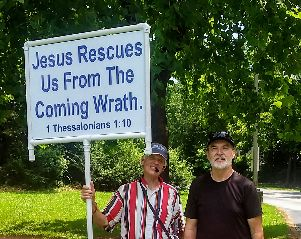
  • Over the last two weeks I have had the opportunity to preach the Gospel 6 times in the open-air in Chapin for 2-3 hours each time with Ken White and Scott Riles. You may ask the question, “How effective is that?” I do this for several reasons:  


  1. Our Lord commanded us to preach this Gospel from the housetops to every person (Mt 10:27; Mk 16:15).   
    We know that fallow ground must be plowed, and we are doing that with our signs and preaching (Hosea 10:12).  
  2. We also know that our preaching is prophetic. On THAT DAY when our Lord gathers the sheep and the goats together (Mt 25:31-46; Rev 20:11-15), He will be vindicated. He will remind those who rejected the Gospel that they heard it through an old blind guy with a bad back.   
       
    Almost all the Old Testament prophets, John the Baptist, our Lord Himself, and the apostles were open-air preachers. It is not the only way we share the Gospel, but the Lord has commanded us to boldly proclaim this Gospel as a testimony to the saved and to those who are perishing (2 Cor 2:13-17).   
     
  • We praise God for a great Men’s Forum this summer. We are completing our study of Traveling Light by Max Lucado. I also continue to meet with several great men who are growing in walking in the Spirit this summer.   
     
  • We are thankful that our family is physically doing well, and we have had some good quality time with the grandkids. Deb continues to be such an incredible best friend, wise counselor, and load-lifter to me. I praise God for her.


  • Please pray for the families of Jim Motley and Sallie Fravel. These mighty warriors of the Lord went home to be with Him last week. Also, please pray for Andy Murray with Covid in Lexington Extended Care and for Brenda Rich who is in tremendous pain.  
     
  • The harvest is plentiful, but the laborers are few (Lk 10:2). Please ask the Lord for younger men who will join us to pray, pass out tracts, or to preach with us. We are trusting the Lord for a great harvest of souls!  
     
  • The Apostle Paul expected conversions (Rom 15:16; 2 Tim 2:10; Jn 15:16). Why are we seeing so few? Why so little fruit? Sovereignty of God? Judgment of God? Hardened culture? Perhaps. But perhaps it is that I am really not willing to suffer for the Gospel (2 Tim 2:1-13). Please pray I would do the hard work of an evangelist in preaching AND personal witnessing to see MUCH fruit. Please pray many lost souls would be saved for HIS glory!

Revival Prayer Conference Calls 
Daily at 7:15am and 1:00pm

  1. Call 605-475-4000; 
    code: 624991#
  2. Mute your line (mute button or *6) and join prayer silently.
  3. Un-mute to pray aloud (you are not required to pray aloud); mute again when finished praying aloud
  4. Stay as long or as little as you like.


Thanks as always for praying for us.   We love you all.

  
We praise God as   He supplies our need.  
  
Through June   budget met: 96%

Includes the generosity of our many regular givers.

Reformed Evangelistic Fellowship

Tax deductible contributions to:  


REF  
P.O. Box 847  
Bristol, TN 37621  
(write ‘Hanley’ in memo)

OR Donate online: Tim Hanley .

Daily Devotional 7-31-20

Our Precious Sins We Don’t Want God to Forgive

There is a repentance that is anti-repentance, for it clings tightly to the sin over which it sorrows, because in that sorrow is its consolation. In this warped spiritual scheme, our anguish is atonement; shame is our absolution; tears are our baptism. We feel better knowing how bad we feel about our wrongs. But there is a much better way.

t didn’t matter if it was the dead of winter or the height of spring, a frown was frozen on this man’s face. He was a customer on my delivery route, so I saw him regularly. At first, I figured he’d just gotten out of the wrong side of bed or was going through a bad time. But as weeks dragged into months, nothing changed. I tried joking with him. Found out his hobbies. Inquired about his family. Little by little, through snippets of conversation, I found out he led a relatively ordinary life.

He was one of those people who wasn’t happy unless he was unhappy. When things were going well, he was on the lookout for something to bellyache about.

He saw a dark lining in every silver cloud.

There’s a shadow of this man in me, and perhaps in you, but in a different—and more dangerous—sense. He nursed negativity. He clung to bad things. Us? We tend to cling to the bad things, too, the bad things we’ve done.

So when we pray, “Forgive us our trespasses,” what we really mean is, “Forgive us our trespasses…except our special ones.” There are some sins we don’t want to hand over to our Father. Not yet anyway. They are our precious. We relish wallowing in the guilt they generate.

We feel better knowing how bad we feel.

There’s something very sinister happening. We’ve come to believe that: 
our anguish is our atonement; 
shame is our absolution; 
tears are our baptism; 
a body racked with regret is our eucharist.

This kind of repentance is anti-repentance, for it actually clings tightly to the sin over which it sorrows, because that sorrow is its consolation. If God forgives these sins, if he takes them away and tells us that we can’t have them back, on what will we rely? Then we’d have only his promise. Then we’d have to rely on someone else.

When it comes to atoning for our wrongdoing, we’d rather take care of that ourselves, thank you very much.

Now that takes us to the heart of the issue: that the Gospel of Jesus Christ excludes every hint of a do-it-yourself forgiveness. We want to do our part, especially when it comes to “big sins.” The little transgressions, well, God can take care of them. But when it comes to the big ones, they take a little extra effort on our part.

So we try to sorrow ourselves into salvation, to repent ourselves into redemption.

We hang on to our sins not despite the fact that they hurt, but precisely because they hurt. We need to hurt, to fret over them, to feel ashamed over them, to make amends over them, because by doing so, we will grease the wheels of God’s forgiveness.

If he sees how repentant we are, and what we’ve done to make things right, he’ll be much more likely to give us forgiveness when we’re adequately worthy to ask for it.

But here’s the shockingly beautiful truth: our special sins, to which we cling, they are all mere phantoms. The weighty bag of precious transgressions we carry around is full of nothing but air. Someone has taken them away, even before we asked him to, even before we wanted him to, even before we committed them.

“I, I am he who blots out your transgressions for my own sake, and I will not remember your sins” ( Isa. 43:25 ).

While we were out attempting a do-it-yourself atonement, the true atonement had already taken place, long ago. There is nothing more to be done.

You might ask:
But what about that time I did _____? 

Yes, it’s taken care of. 

What about all those years I did _____? 

That, too. 


But what about that deeply shameful thing I did? 
Yes, absolutely, that too has been taken away.

All our precious sins are gone. God came along and snatched them away. And he won’t give them back. He gathered up all—and I mean, all—the transgressions of all the people who have ever lived, and who will ever live, and he put them on Jesus.

This Son of God, who knew no sin, became all sin, so that in him we might become the righteousness of God. All humanity shrunk down into this one man. It was as if a funnel was placed over Jesus, God took the sinful world in his hand, and squeezed it over that funnel. Out oozed every single drop of iniquity, every imaginable horror that people have committed, every good deed they have left undone, and it filled from head to toe this Savior who loves us so. He drank it all in when he polished off the cup of judgement.

When he was done, when atonement was complete, he said simply, “It is finished.” And he meant it.

The absolution is absolute.
Forgiveness is final. 


God doesn’t keep score. 
It really is finished.

Your special sins are not yours. Jesus took them away.
And he will never, ever give them back.

That is his profound and precious promise.

ABOUT THE CONTRIBUTOR

Chad Bird holds master’s degrees from Concordia Theological Seminary and Hebrew Union College. He draws upon his expertise as a former professor of OT and Hebrew to cohost the podcast, “40 Minutes in the OT.” Chad has authored several books, including his latest, “Upside-Down Spirituality: The 9 Essential Failures of a Faithful Life.” He has written for Christianity Today, The Gospel Coalition, and elsewhere. He and his wife, Stacy, have four children and two grandchildren.


From:  https://www.1517.org/articles/our-precious-sins-we-dont-want-god-to-forgive-1?utm_source=New+Master+List+%286%2F23%2F19%29&utm_campaign=4e90f0a939-EMAIL_CAMPAIGN_2020_04_28_09_53_COPY_01&utm_medium=email&utm_term=0_752a9844e8-4e90f0a939-462863369&mc_cid=4e90f0a939&mc_eid=f37e1a7301

Daily Devotional 7-29-20

Daily Devotional 7-29-20

Word on Wednesday – by John Mason

‘Transformation for a Troubled World’ – July 29, 2020


Back in August 2011, The Wall Street Journal carried an article, ‘ Reversing the Decay of London Undone ’ by Dr. Jonathan Sacks, then chief rabbi in Britain.Dr. Sacks stated, ‘In virtually every Western society in the 1960s there was a moral revolution, an abandonment of its entire traditional ethic of self-restraint. All you need, sang the Beatles, is love. The Judeo-Christian moral code was jettisoned. In its place came: whatever works for you…’He further observed, ‘The collapse of families and communities leaves in its wake unsocialized young people, deprived of parental care, who on average—and yes, there are exceptions—do worse than their peers at school, are more susceptible to drug and alcohol abuse, less likely to find stable employment and more likely to land up in jail…‘Much can and must be done by governments, but they cannot of themselves change lives,’ he went on. ‘Governments cannot make marriages or turn feckless individuals into responsible citizens. That needs another kind of change agent…’


Gospel Centered Re-fresh . Let me suggest that more than ever we need a re-fresh moment of God’s good news. True and lasting changes in society occur when individual lives are transformed from the inside out through God’s mercy.Consider Paul’s words in Colossians 2:13-15: And you, who were dead in trespasses and the uncircumcision of your flesh, God made alive together with him, having forgiven us all our trespasses, having cancelled the bond which stood against us with its legal demands; this he set aside, nailing it to the cross. He disarmed the principalities and powers and made a public example of them, triumphing over them in him.


Paul is writing of the condition of the Jewish and the non-Jewish peoples. The Jewish people could not keep God’s written law, and the world that doesn’t know God fails to keep even the law of their own conscience.


All men and women are morally bankrupt.This biblical teaching is central to a Reformational understanding of humanity. Dr Ashley Null, a leading authority on Thomas Cranmer, Archbishop of Canterbury in the reign of Henry VIII, summarizes Cranmer’s anthropology this way: ‘What the heart loves, the will chooses, and the mind justifies.’ Cranmer understood that ‘the trouble with human nature is that we are born with a heart that loves ourselves over and above everything else in this world, including God. We are born slaves to the lust for self-gratification,….’


Captives . Furthermore, we are captive to spiritual forces we cannot defeat. Satan, holding himself out as a chief prosecutor, presents the catalogue of our failures to God. Being the demanding prosecutor he is, Satan insists that the penalty must be paid – something that God, in his justice, cannot refuse. And because sin is a capital offence we are all en route to a death we cannot avoid.C.S. Lewis brilliantly captures these elements in the Lion, The Witch and the Wardrobe. Edmund has betrayed Peter, Susan and Lucy, and Aslan himself. The Witch demands Edmunds’ life. “He has broken the laws of the deep,” she insists. “He is mine,” she shrieks. “His life is forfeit.”


God’s Intervention . In the busyness of life it is easy to forget the significance of Jesus’ crucifixion. Let’s pause and consider Paul’s words. He tells us that through Jesus’ death God has smashed the bars of our spiritual prison of self-interest and has cancelled the debt we owe. The charge sheet against us has been wiped clean. And in the same way that the indictments against Jesus were nailed to his cross, he has taken the indictments against us and nailed them to his cross as well.Furthermore, Paul tells us that Jesus through his death has disarmed the demonic powers that we couldn’t overcome.


Had those powers known the mighty power Jesus wielded through his voluntary sacrifice, they would have dismissed any thought of putting the Lord of glory to death (1 Corinthians 2:8). St. Augustine spoke of Jesus’ crucifixion as the devil’s mousetrap.And so it is, supremely, that Jesus Christ once and for all abolished death for us. As John 11 records, Jesus says to all men and women, “I am the resurrection and the life, those who believe in me, though they die, shall live, and everyone who lives and believes in me will never die” (John 11:25f).


No longer should we fear death’s inexorable approach: God made you alive with Christ , Paul says in Colossians 2:13.The cross is where Jesus turned our captivity into the glorious liberty of the children of God. The hymn-writers, Keith Getty and Stuart Townend wrote: This the power of the cross: Christ became sin for us. Took the blame, bore the wrath; we stand forgiven at the cross.


Transformation . Jesus’ death provides a fresh start in life for everyone who turns to him in repentance and faith.FF Bruce in his commentary on Colossians (p.112) writes: ‘The message proclaimed by Paul to the Colossians remains the one message of hope to men and women in their frustration and despair. Christ crucified and risen is Lord of all.’


A prayer . Almighty God, our heavenly Father, like lost sheep we have gone our own way, not loving you as we ought, nor loving our neighbors as ourselves.  We have done what we ought not to have done, and we have not done what we ought to have done. We justly deserve your condemnation.  Father, for the sake of your Son, Jesus Christ, forgive us all that is past, and grant that from this time forward, we may serve and please you in newness of life, to the honor and glory of your name, through Jesus Christ our Lord. Amen.


The good news is, God has promised in his Word that when we confess our sins, he forgives us and cleanses us from all unrighteousness. Thanks be to God.


Receive Word on Wednesday


(c) John G. Mason –  www.anglicanconnection.com

Newsmakers: John O’Roark – REF Evangelist

Newsmakers: John O’Roark – REF Evangelist

John O’Roark has been a born again Christian since he was 17 years old. It was not long after his conversion that he felt an inward calling to full-time Gospel ministry, which was recognized by friends and family members around him.

He is currently enrolled at LAMP Theological Seminary with a goal to fulfill his inward call to Pastoral Ministry. John has been using his God-given spiritual gifts by doing teaching and discipleship ministries for the past 6 years, but currently feels an inward call to utilize the gifts and skills that he has been developing to focus on Evangelism and Anti-Abortion Ministries.

H e has a wife and one son and they live in the Tri-Cities area of East Tennessee. John has a burden for the Lost and the Unborn. He desires to see the Lost won to Christ and end of Abortion in his area by fulfilling the Great Commission. 

For more info: https://www.refglobal.org/oroark-john.html

To Give: Donate to John .

Daily Devotional 7-28-20

Daily Devotional 7-28-20

Acts 23:12-24


“Some of the Jews banded together and bound themselves under an oath, saying that they would neither eat nor drink till they had killed Paul.”

Do you find this incredible, that a bunch of 1st century Jews would vow to eat or drink nothing until they had murdered someone? It’s incredible to me, not only because of the great sacrifice involved (and the possibility that if they never killed Paul they would die of hunger or thirst), but also that they would bind themselves to such a terrible task.

I’m most interested not in their terrible purpose but in their incredible dedication. Such vows don’t just happen. They are too heavy and costly to just happen spontaneously. There must be some incredible motivation to inspire men to such awful purposes.

If Satan can inspire men to such murderous vows (and I’m thinking also of radical Islam of our own day – all 100 million of them), then surely the Holy Spirit can inspire those who are His Temple to acts of love and devotion equal to or greater than them.

So what good gifts of God has Satan perverted to make men motivated by such murderous malevolence?

First, we find that those who wanted to kill Paul “banded together” to kill Paul. This fervent frenzy of hatred was the ultimate social disease. Once Paul seemed to be a one-man wrecking crew, but such men are rare. Usually, men undertake such heightened actions only with the collective courage necessary to do so. And even Paul carried letters from other haters of Christians when he went about with his murderous threats.

But Christians often go about their daily worldly business with no greater purpose in mind than to make it through the work day so they can get to the real work of play. And we like to go it alone. No wonder we aren’t very motivated! No wonder why we’re so easily defeated or distracted!

God has made us the Body of His Son: that is the ultimate banding together that humans can experience. If only we understood the kind of banding together God desires from us and died to give us, our dedication to God and His kingdom would make the radical Moslems look like bunnies in comparison.

Second, those who wanted to murder Paul bound themselves not only to each other but also bound themselves with an oath. In other words, they took a vow. We used to know what vows meant. We still vow to tell the truth in a court of law. We used to vow to be bound to our spouses for life.

But if you’ve been baptized, you have taken a vow more profound and awful than the one the would-be murderers of Paul took. You vowed to manfully fight under the banner of Christ and His Kingdom. You vowed to renounce the devil and his works, the pomp and glory of this world, and the lusts of your own flesh. You vowed with your life that you would live for your Master and do His will and not your own.

How well do we hold ourselves, since we are bound to each other as well, to these vows?

Third, those who vowed to kill Paul ratified their vows with a particular outward sign of this oath: they promised not to eat or drink until they fulfilled their vows. Whatever motivation they had from hating Paul because they hated Jesus Christ, whatever motivation they received from the peer pressure of the group they had bound themselves to, there was now another high motivation: they would get to eat or drink only when the deed was done.

We, too, as Christians, have an outward and physical sign of our vows. We renew those baptismal vows every time we partake of the Lord’s Supper. But unlike the followers of Satan who had to vow not to eat or drink, we have vowed that we will eat and drink to fulfill our vows. In fact, it’s only as we feed off the Body and Blood of Jesus Christ that we’re able to fulfill our vows to God because Jesus is the only one who can keep those vows. And the food we vow to eat is no earthly food but the heavenly food which is God Himself in the person of His Son.

We do, however, have a fast in common with those murderers, but it is not from food or drink. In following our Master and fulfilling our vows to serve Him, we fast from ourselves and our selfish desires. Those we must give up, if we are to fulfill our mission. There is, therefore, a sacrifice we must give to our Lord, and that sacrifice is ourselves, our souls and bodies, to be a reasonable, holy, and lively sacrifice unto God.

Those murderers had focus in their lives: they rid themselves of all distractions. The band of murderous brothers, the vow, the fasting all helped them to focus on the terrible task at hand.

We, too, must focus. But where are our brothers and sisters to keep us focused? Are they in our lives, or do we keep them safely at bay? Where is the memory of our vows, and where is the holy fasting and sacrifice? The world is too much with us, and I fear many of us have been seduced into a life of ease in Zion.

Finally, a great purpose is required for such dedication. Although Paul was only one man, his would-be murderers understood that he was attached to Jesus Christ, who was their real target. They killed him once, and He rose again. And now they wanted Him dead again. Thus, their life was about death.

But our lives are about Life, and life more abundantly. Our lives, our mission, and our great purpose, are those of God Himself! We seek not to kill with hatred but to give life with love. This is not only the ultimate motivation but also the greatest commandment.

Let us go, then, today, to fulfill our great purpose in life, armed with a great company of God’s army with us, with sacred vows affirmed by the Body and Blood of Jesus Christ Himself, offering ourselves up to Him who sacrificed Himself for us, and with the grace and power of the Holy Spirit.

Let’s do it until we gather around His Table again to recount our stories of glory and be fed by Him again!

Prayer: Here, Lord, I offer and present unto thee, my self, my soul and body, to be a reasonable, holy, and living sacrifice unto thee; humbly beseeching thee that I, and all others who shall be partakers of Your Son, may worthily receive His most precious Body and Blood, be filled with thy grace and heavenly benediction, and made one body with Him, that He may dwell in us, and we in Him. Amen. 

Point for Meditation: 

1. What is the incredible purpose to which God has called you?

2. Which of the things that the would-be murderers of Paul had do you lack to fulfill your vow? 

Resolution: I resolve to renew my vows to God today. 

From:  https://www.patheos.com/blogs/giveusthisday/tuesday-trinity-7-acts-2312-24/

Design a site like this with WordPress.com
Get started