Get in the Game: Jamie Clark 10/17 University of South Carolina

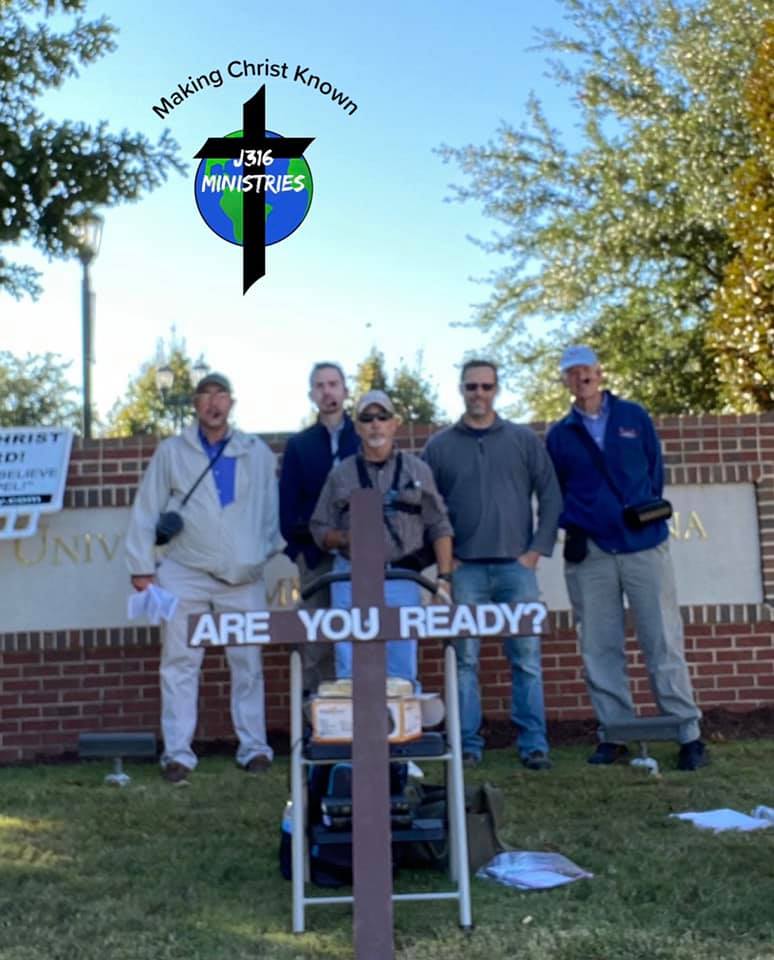
See Jamie’s report from outreach Saturday below.

Humbled and greatly encouraged to serve with these men today at the South Carolina- Auburn game at Williams Brice Stadium. These men truly love the Lord, and have true compassion for the lost- enough to go into the harvest field, and make Christ known. Please pray for the salvation of those who heard Christ proclaimed this morning. SDG.

Instagram: https://www.instagram.com/p/CFuwWWMFCrn/

Twitter: https://twitter.com/J316Min/status/1317624057081155587

Daily Devotional 10-16-20

Daily Devotional 10-16-20

Favored with a Famine

There are times in our spiritual experience when human counsel or sympathy or religious ordinances fail to comfort or help us. Why does our gracious God permit this? Perhaps it is because we have been living too much without Him, and so He takes away everything upon which we have been in the habit of depending, so that He may drive us to Himself. It is a great blessing to live at the fountainhead. While our water bottles are full, we are content, like Hagar and Ishmael, to go into the wilderness; but when those are empty, nothing will serve us but God Himself.

We are like the prodigal; we love the pig-swill and forget our Father’s house. Remember, we can fashion pigsties and husks even out of the forms of religion; they are blessed things, but if we put them in the place of God, then they are of no value. Anything becomes an idol when it keeps us away from God: Even the brazen serpent is to be despised if we worship it instead of God. The prodigal was never safer than when he was driven to his father’s home, because he could be sustained nowhere else. Our Lord favors us with a famine in the land so that it may make us seek after Himself even more.

The best position for a Christian is living wholly and directly on God’s grace—remaining where he stood at first—“having nothing, yet possessing everything.”1 Let us never for a moment think that our standing is in our sanctification, our mortification, our graces, or our feelings. But be sure of this, that because Christ offered a full atonement, therefore we are saved; for we are complete in Him. Having nothing of our own to trust in, but resting upon the merits of Jesus, His passion and holy life provide us with the only sure ground of confidence. Beloved, when we are brought to a thirsty condition, we are sure to turn eagerly to the fountain of life.

1) 2 Corinthians 6:10

From: https://www.truthforlife.org/resources/daily-devotionals/latest/?gclid=CjwKCAjwnK36BRBVEiwAsMT8WCR8UteIwaWlAyP4o9ZIuAWio8l7qmAM1nDcB3pFiYr-jOUNkgMsShoC68IQAvD_BwE

Daily Devotional 10-15-20

Daily Devotional 10-15-20

Freedom Under Attack

Dear Christian, yours is a freedom that is under attack. I am not talking about the religious freedoms you may experience in the political realm as a citizen of a free country (though, this seems like an increasingly necessary discussion). Nor am I talking about the freedom from political bondage or slavery. I am talking about the freedom you have before God on account of Jesus Christ. The freedom from fear of judgment, the freedom from guilt and shame, the freedom to call upon God in every trouble, pray, praise, and give thanks. Spend some time in the book of Galatians, and you will see in no uncertain terms that Christ came with the express purpose to set you free from a slavery that would condemn you eternally. Christ has liberated you from the powers of sin, and the condemnation God’s law imposes on sinners. This is a spiritual freedom you have been granted despite your social standing or political situation. You are free!

And that freedom is under attack.

In Galatians 5:1, St. Paul cries in victory, “For freedom Christ has set us free!” and you would think that was it! We have freedom! No more struggles or trials, right? Not so fast. Paul’s cry of victory is followed by the speech of a general readying his troops for battle: “…stand firm, therefore, and do not submit again to a yoke of slavery.” In other words, you have the victory! So be ready to stand against those who would take that from you. You are liberated to live in the Kingdom of God. So do not let anyone move you from that Promised Land. You are free! So fight to stay that way.

You must stand, for the enemy is not happy to see you free. The devil is not free. He is bound (Rev 20:.2-3). Yet he still prowls on his leash looking to devour those who have been rescued from his tyranny (1 Peter 5:8-11). Which means he has his eyes set on you. The exorcism that took place at your baptism freed you from Satan’s grasp. Christ bound the strong man and rescued that which was his own (Mark 3:22-27). Satan hates the new freedom Christ has given you, for he hates Christ. Now there is a demonic bounty on your head. So, be ready to fight!

These assaults are not all that obvious. They require constant vigilance at having God’s law and gospel preached into your ears to give you the eyes of discernment. Satan will misuse and twist that which is God’s against you. Think of Eve in the Garden. Satan warped that beautiful altar of the Tree of the Knowledge of Good and Evil, that tree that stood to remind Adam and Eve of how God created them to live, love, eat, and work in freedom. Instead, Satan deceived Eve into believing in the potential for something better: an autonomy in which she could now be no mere image of God, but like God himself. Becoming this self-sufficient deity was the temptation; eating the fruit from the tree imposed death.

Autonomy (literally, being a law unto yourself) is the way we moderns think of freedom. We do not need anyone telling us what to do, how to feel, who to be, or even what to be. We decide for ourselves. The old definitions, we say, are too binding and limiting. We must get beyond God’s law and his words and create our own way of thinking and speaking. Nietzsche said, “I fear we will never be rid of God so long as we believe in grammar.” We simply need to make up our own grammar, our own definitions. Once we’ve done that, our words can undo the bondage of the flesh and we can dwell happily according to our own rules.

You who would be a law unto yourself, Christ is the gospel unto you, proclaiming you forgiven.

But such demonic impulses cannot shake bondage. Whether you are under the condemnation of God’s law or seeking to establish your own laws, you are still a slave to sin and under the law. Being a law unto yourself still leaves you a slave to the law, just a far less impressive one.

Paul is putting the Galatians on their guard from such slavery. Satan had employed the Judaizers to come in and tell this legally-minded society of Gentiles that Jesus was the sort of God who offered them a better law than any offered by their current gods. In his commentary on Galatians, Andrew Das points out that the idols throughout the Galatian regions would typically be found holding scales. One god was even named “Diakios,” which is the Greek word for justice. These were a people whose gods had taught them to live in fear of divine retribution. The shed blood and preaching of Christ Jesus liberated these saints from the bondage of such demonic deities. But now, Satan had employed the Judaizers to move in and proclaim the true God as – not only the savior from these gods – but one who gives a higher calling, a better law. And, if you want to prove you are willing to follow him, that you are one of his and not theirs, then you need to take the first step of being circumcised. To quote The Who, “Meet the new boss. Same as the old boss.”

In response, Paul comes in guns blazing! He will not have the freedom of Christ’s dear saints so wickedly attacked. Breaking the second commandment is the primary way to break the first. So Paul must shout down the false teachers and, once again, rescue these Galatians from bondage. The work of the gospel always does this. After all, Satan is always looking for ways to re-enslave you: whether through the lie of autonomy, the fear of gods who only accuse, or the command to get to work for God because Christ’s substitutionary work is insufficient.

But, forget not, you belong to Christ Jesus. He has set you free. There is no law you must fulfill to please God. You are pleasing to God because Christ fulfilled the law in your place. He fulfilled it by keeping it perfectly, and he fulfilled it by paying the debt you owed it with his own blood. There is no higher platform of living, no greater freedom, than what you have in Christ. Being a law unto yourself will only enslave you unto death. But Christ has conquered the grave and called you his own. You who would be a law unto yourself, Christ is the gospel unto you, proclaiming you forgiven. Forgiven, and eternally and totally free. That is a freedom worth fighting for.

From: https://www.1517.org/articles/freedom-under-attack

Daily Devotional 10-14-20

Daily Devotional 10-14-20

Blessed are the Merciful in a Troubled World

In his book, God is Good for You, Dr. Greg Sheridan an Australian commentator writes: ‘… Christianity has been marginalized in the popular culture in the West …’ He notes that there are ‘very few Christian celebrities, or rather celebrities whose primary fame is due to their Christianity, their works or writings’.

Consider President Abraham Lincoln’s letter on January 19, 1863 to the textile workers in Lancashire, England, who, at great personal cost, had voted to continue to reject cotton produced by slaves in the US Confederacy. Deploring the sufferings arising from this decision, Lincoln wrote: “Under these circumstances I cannot but regard your decisive utterance on the question as an instance of sublime Christian heroism which has not been surpassed by any age or in any country”.

Lincoln’s words point to the traditional understanding of Christianity that, amongst other qualities, calls for mercy.

How would Lincoln’s reference to ‘Christian’ be understood today? Greg Sheridan comments, ‘Christians have a right to be worried about what is happening to their beliefs in the West.’ ‘… The primary challenge is not intellectual but cultural,’ he writes.

How do we respond to this changing world that denies the sacrificial practice of Christianity?

Come with me to Jesus’ fifth Beatitude, one of the eight ‘Blessings’ found in his Sermon on the Mount recorded in Matthew chapter 5. “Blessed are the merciful, for they shall be shown mercy”, we read in verse 7 (Mt. 5:7).

The words mercy and grace are often used interchangeably, but there is a distinction. Grace is a love that is underserved. Mercy is love’s response to someone’s misery and helplessness.

Mercy responds to a world in pain because of humanity’s ‘me first’ problem. For despite the extraordinary advances in science and technology, we find it impossible to solve the issues of hunger and poverty, corruption and injustice, tension and conflict. In his Parable of the Good Samaritan Jesus provides an object lesson in neighbor love which, if practised, would lead to a world of selflessness, genuine love, kindness and mercy. It is a neighbor love that is motivated and shaped by God’s love for us and our love for him.

It is significant that when God came amongst us in the person of Jesus of Nazareth his priority was not first to destroy Roman rule, or to cure all the sick, or to deal with all the social ills of the world.

That said, he did reach out to people in need. The ancient historian Josephus says that Jesus carried out ‘remarkable feats’. The Gospel records tell us he enabled the deaf to hear, the blind to see and the lame to walk. And he wept with those who grieved.

Yet despite his divine powers Jesus allowed himself to be betrayed and put to death. His priority was to follow the highest path of mercy and grace – mercy for the helpless, grace for the undeserving. Through his voluntary death he addressed our broken relationship with the living and one true God. He the sinless, chose to die in our place – the sinful.

When we come to understand and personally experience this mercy of God, we will want to be merciful to others. Mercy is more than feeling compassion. It acts in doing good for those in need.

So what does this mercy look like in practice?

We show mercy by providing food for the hungry person, clothes for the needy and a bed for the homeless. In the big cites of the world mercy needs to be tempered with wisdom. For if we give to everyone in need, we will quickly find we don’t have the means to live ourselves.

This is why Christian foundations are formed so that resources can be used more effectively for those truly in need. In the churches I was involved in setting up in New York City, we supported and were involved in various care missions in the city as well as providing scholarship funds for children in Africa orphaned through AIDS.

But mercy is more than meeting physical needs, pressing though they are. Mercy has compassion for the spiritually lost. Augustine, the 5th century Bishop of Hippo in North Africa, said: ‘If I weep for the body from which the soul is divided, how should I weep for the soul from which God is divided?’ If we say we have experienced God’s mercy shouldn’t we now show mercy to those whose souls are lost for eternity?

When Stephen, the first Christian martyr was being stoned, he said, “Lord, do not hold this sin against them.” Stephen pitied the souls of those who were stoning him to death.

Mercy prays for others and looks for opportunities to open up conversations about the God who has revealed himself in the Lord Jesus. Let me ask, do you pray for family members, friends, neighbors and work colleagues who are indifferent or hostile to the Christian faith? The most merciful thing we can do is pray for and create ways to draw others to the Lord Jesus.

The outcome of mercy. “Blessed are the merciful for they shall obtain mercy.”

We are not restored in our relationship with God by being merciful. It is only when we are conscious of our spiritual bankruptcy (Mt 5:3), grieve over our sin (Mt 5:4), and hunger and thirst for righteousness (Mt 5:6), that we will receive the blessing of God’s mercy.

Psalm 103 says, As the heavens are high above the earth, so great is God’s mercy towards those who fear him. Contrary to what many consider God to be, the Bible consistently reveals a God who is not only there but who is slow to anger and merciful.

How then will people around us come to know this? A little further on in his Sermon, Jesus says: “Let your light so shine before others that they see your good works and give glory to your Father in heaven” (Mt 5:16).

From: https://anglicanconnection.com/blessed-are-the-merciful-in-a-troubled-world/
Daily Devotional 10-13-20

Daily Devotional 10-13-20

Emulating the Model of Worship

God instituted the model of worship found in the Old Testament.

The worship of Israel was formal and liturgical. Solemn rites were central to the experience. The setting of temple worship was anything but casual. The meeting place had an ambiance of the solemn and the holy. The ritual was designed for drama. The literature and music were high and majestic. God inspired the content of songs (the Psalms). The finest craftsmen, who were filled by the Holy Spirit, fashioned the articles of art. God designed the vestments of the priests “for glory and for beauty” (Ex. 28:2).

Everything in Israelite worship, from the music to the building to the liturgy, focused attention on the majesty of God. God, in His holiness and in His redemptive work, was the content of the form. It was solemn, because to enter the presence of God is a solemn matter.

But even God-ordained patterns of worship can be corrupted. Liturgy can degenerate into liturgicalism, or even worse, sacerdotalism, by which the rites and sacraments themselves are seen as the instruments of salvation. The forms of worship can devolve into formalism and the externals into externalism.

Coram Deo

In your devotional time today, try some of the forms of praise and worship described in Psalm 150.

Passages for Further Study

John 4:22-23

Revelation 22:9

Psalm 99:5

From: https://www.ligonier.org/learn/devotionals/emulating-model-worship/

Get in the Game: Oct. 19th, Dallas Cowboys Outreach

Dallas Cowboys vs. Louisville Cardinals, Monday 

Join Joe Hinson in heralding the glorious gospel of Jesus Christ at the Dallas Cowboys home football games this 2020 season.

Check out the event details here: https://www.facebook.com/events/773743210078474/?acontext=%7B%22source%22%3A5%2C%22action_history%22%3A[%7B%22surface%22%3A%22page%22%2C%22mechanism%22%3A%22main_list%22%2C%22extra_data%22%3A%22%5C%22[]%5C%22%22%7D]%2C%22has_source%22%3Atrue%7D

Get in the Game: Oct. 18th, LA Chargers Outreach

Los Angeles Chargers vs. New York Jets, Sunday 4 pm

Join Mark Jasa and his team in heralding the glorious gospel of Jesus Christ at the LA Chargers home football games this 2020 season.

Click below for additional event details: https://www.facebook.com/events/1304192333291357/?acontext=%7B%22source%22%3A5%2C%22action_history%22%3A[%7B%22surface%22%3A%22page%22%2C%22mechanism%22%3A%22main_list%22%2C%22extra_data%22%3A%22%5C%22[]%5C%22%22%7D]%2C%22has_source%22%3Atrue%7D

Get in the Game: Oct. 18th, Jacksonville Jaguars Outreach

Jacksonville Jaguars vs. Detroit Lions, Sunday 1pm

Join Peter Doherty and his team in heralding the glorious gospel of Jesus Christ at the Jacksonville Jaguars home football games this 2020 season.

Find the event details here: https://www.facebook.com/events/1258091677877767/?acontext=%7B%22source%22%3A5%2C%22action_history%22%3A[%7B%22surface%22%3A%22page%22%2C%22mechanism%22%3A%22main_list%22%2C%22extra_data%22%3A%22%5C%22[]%5C%22%22%7D]%2C%22has_source%22%3Atrue%7D

Get in the Game: Oct. 18th, Minnesota Vikings Outreach

Minnesota Vikings vs. Atlanta Falcons, Sunday 1pm

Join Bill Schank and his team in heralding the glorious gospel of Jesus Christ at the Minnesota Vikings home football games this 2020 season.

Event details here: https://www.facebook.com/events/335749407535035/?acontext=%7B%22source%22%3A5%2C%22action_history%22%3A[%7B%22surface%22%3A%22page%22%2C%22mechanism%22%3A%22main_list%22%2C%22extra_data%22%3A%22%5C%22[]%5C%22%22%7D]%2C%22has_source%22%3Atrue%7D

Design a site like this with WordPress.com
Get started