Get in the Game: ACC Outreach 12/19 Report

ACC Championship – Charlotte, NC

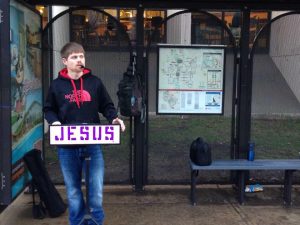
Sam Wilking and Mike Anderson were heralding the glorious gospel of Jesus Christ at the ACC Championship Game.

Watch their live preaching from the event here:

https://twitter.com/SportsFanOutrea/status/1340357101110108163?s=20 https://www.facebook.com/100042850402501/videos/414716713300005/

Daily Devotional 12-21-20

Daily Devotional 12-21-20

The Season and the Reason

Mary was pregnant. A distressed Joseph thought about severing the relationship. “But when he had considered this, behold, an angel of the Lord appeared to him in a dream, saying, ‘Joseph, son of David, do not be afraid to take Mary as your wife; for the Child who has been conceived in her is of the Holy Spirit’” (Matthew 1:20).

The angel gave further information and direction. “She will bear a Son; and you shall call His name Jesus, for He will save His people from their sins” (Matthew 1:21). The name Jesus is a New Testament form of Joshua meaning, “Jehovah saves.”

Jesus saves. Salvation has to do with sins. Sins are violations of God’s standard for our lives. God gives us His standard in the Ten Commandments. One of them requires truth and being true (Exodus 20:16). Lying and deceit are violations of God’s standard. Lies undercut life.

Jesus saves from sins. Jesus separates people from evil conduct, such as lying, in two ways. He bears the penalty for their conduct. He died as a sacrifice for their sins. He provides new life through the Holy Spirit. He arose from the grave to do so.

Jesus saves His people. He has a focused mission. His people are those who believe in Him and trust in Him. This is the reason for the season.

Click here and listen to, “Christ Came for His People.”

From: http://dennyprutow.com/daily-devotions/

Meet: Michael Coughlin, SBO ’21 Evangelist

Michael Coughlin – Columbus, OH

Michael Coughlin lives near Columbus, OH, and leads local outreaches to glorify our Lord and reach the lost with the gospel. Michael’s joys are spending time with his dear wife and children, programming computers, and studying and discussing God’s Word. He is a member of Covenant Bible Church in Pickerington.

Daily Devotional 12-18-20

Daily Devotional 12-18-20

Take Stock

Every wise businessman will occasionally hold a stock-taking, when he will examine his accounts, consider what he has on hand, and determine clearly whether his trade is prosperous or declining. Every man who is wise in the kingdom of heaven will cry, “Search me, O God . . . Try me”;1 and he will frequently set apart special seasons for self-examination, to discover whether things are right between God and his soul. The God whom we worship is a great heart-searcher; and in the past His servants referred to Him as “I am he who searches mind and heart, and I will give to each of you as your works deserve.”2

Let me encourage you in His name to diligently search and solemnly test your spiritual state, for fear you should come short of the promised rest. This is what every wise man does, and what God Himself does with us all. I exhort you to do the same yourself this evening. Let the oldest saint examine the basics of his piety, for gray heads may cover evil hearts: And the young professor should not despise the word of warning, for the greenness of youth may accompany the rottenness of hypocrisy. Every now and then a spiritual giant falls. The enemy still continues to sow tares among the wheat.

It is not my aim to introduce doubts and fears to your mind; I rather hope that the rough wind of self-examination may help to drive them away. It is not security but fleshly security that we would kill, not confidence but carnal confidence that we would overthrow, not peace but false peace that we would destroy.

By the precious blood of Christ, which was not shed to make you a hypocrite, but rather that sincere souls might declare His praise, I urge you to search and look, for fear that in the end it will be said of you, “Tekel, you have been weighed in the balances and found wanting.”3

1) Psalm 139:23

2) Revelation 2:23

3) Daniel 5:27

From: https://www.truthforlife.org/resources/daily-devotionals/latest/?gclid=CjwKCAjwnK36BRBVEiwAsMT8WCR8UteIwaWlAyP4o9ZIuAWio8l7qmAM1nDcB3pFiYr-jOUNkgMsShoC68IQAvD_BwE

Meet: Brackston Combs, SBO ’21 Evangelist

Brackston Combs – Bloomington, IL

My Name is Brackston, I currently reside in Havana, IL with my wife Amanda and our four (almost five!) children. We have been married for almost 12 years. We have been blessed to home school all our children. I am a medically retired U.S. Army Veteran with 2 combat deployments to Iraq.

I am a previously professing backsliding Atheist/Agnostic. The first time I came to Church was when my wife tricked me into going by telling me we were going to an ice cream social, but God was dealing with me far before that during drug and alcohol rehabilitation shortly before I left the Army.

I spent most of my life addicted to some sort of drug. I needed inebriation almost constantly because I did not want to face the absurdity of my world views. You know the story, I blamed God for all of the bad things in my life – but refused to worship him or give him thanks. But, God had mercy on my soul by putting people in my life who were not afraid to tell me the truth of my ways and rebuke me.

After a very traumatic PTSD episode which involved me attempting suicide by jumping out of a moving vehicle – I came to the end of my rope after my Pastor came to visit me and sternly told me – I am not allowed to test God. I still struggled with full repentance, I was counting the cost as you would say.

But, God finally opened my eyes in the end of 2015 and he began to start ripping all of the idols that I had, out of my life. He was breaking me for service. In the beginning of 2016, I would struggle with the two idols I hadn’t fully let go of – drugs and alcohol. 

After coming across Evangelism videos on YouTube, and watching The Way Of The Master I began to realize God’s calling for my life was not to evangelize to my pot-smoking buddies. I began to search on the internet, and found an amplifier and decided to purchase it. When the box arrived, I began to look at it – and realized I could not be a cigarette and pot smokin’, drunk of an evangelist. On that day, February 2nd,  2016 I surrendered to God all of my remaining idols – my lifelong addictions. 

After this day, I began to go to locations with my amplifier and attempt to evangelize but, would ultimately chicken out. I began to pass out tracts in various parts of Bloomington and Normal, Illinois and that is when I ran into another street preacher and began getting involved with him and several other evangelists in my area. I began to instead of trying to quench my thirst for drugs and alcohol, I developed the unquenchable thirst for learning more about God, His Righteousness and the true way my life is meant to be lived, and to most importantly to fulfill my calling to “Go and Preach the Gospel to All Creation.” 

I am currently working on my Bachelor’s in Christian Ministry Degree from The Master’s University. 

I am blessed to be a member of Covell Community Church in Bloomington, IL.

Soli Deo Gloria!

Daily Devotional 12-17-20

Daily Devotional 12-17-20

Waiting with Hannah

I don’t know about you, but I find it hard not to reach for a tissue box whenever I hear or read Hannah’s story. No sooner do we learn Hannah’s name than we hear those poignant words, “but Hannah had no children.” Hannah is known, at least at first, not for what she has, but for what she does not have. There is no child growing, kicking, squirming, and flipping in her womb. No swaddling clothes to change. No crying newborn to soothe. No infant nursing at her breast. Hannah had no children.

Year after year, Elkanah, her husband, would journey with his two wives, Peninnah and Hannah, to Shiloh, the place of sacrifice, where Yahweh dwelt among and for his people. But Hannah had no children.

Year after year, Elkanah loved his wife, Hannah, even though the Lord had closed her womb. Hannah would receive a double portion of the sacrificial meal, possibly from the Old Testament Feast of Booths, or another annual pilgrimage. A foreshadowing of the double portion that would come to Hannah by God’s mercy. But Hannah had no children.

Year after year, Peninnah never failed to remind Hannah that her nursery was full and Hannah’s was empty. She provoked and taunted Hannah so grievously that her appetite became as barren as her womb. Hannah’s heart was sad. She wept bitterly. She was deeply distressed. Hannah had no children.

Year after year, Hannah prayed, no doubt as she did every day, that the Lord would hear her prayer, open her womb, and give her a child. But still, Hannah had no children.

So Hannah did what we often find ourselves doing in our deep distress and despair. Hannah poured out her soul before the Lord. She vowed a vow. “O Lord of hosts, if you will indeed look on the affliction of your servant and remember me and not forget your servant, but will give to your servant a son, then I will give him to the Lord all the days of his life, and no razor shall touch his head” (1 Sam 1:11).

There’s an irony in Hannah’s words. Hannah is barren, yet her mouth is filled with humility, prayer, praise, and faith. Peninnah’s womb and quiver may have been full, yet her mouth was nothing more than a shallow, empty, prideful pit. She may have had many children, yet she was the truly barren one.

As Hannah continued praying, Eli, the priest, saw her mouth forming words. Supposing her for a drunkard, Eli approached Hannah. She was not drunk, however. She was despondent. “Do not regard your servant as a worthless woman, for all along I have been speaking out of my great anxiety and vexation.” Then Eli answered, “Go in peace, and the God of Israel grant your petition that you have made to him” (1 Sam 1:16-17).

I love how this part of the story unfolds. Eli had no idea what Hannah had been praying for and what had caused her such deep agony. And yet, he says the one thing that Hannah needed to hear: “Go in peace.” In response to Eli’s words, Hannah speaks a rather “Mary-like” word. “Let your servant find favor in your eyes” (1 Sam 1:18).

Hannah received the Lord’s peace that day in Shiloh. Even though she had no idea how her prayer would be answered, she had received a blessing from the Lord. Even if her womb remained closed, she knew that the Lord’s ear was always open. Hannah went her way. She ate again. And her face was no longer sad.

When we first met Hannah, we found her waiting, wondering, and praying. No doubt she asked the same questions we all do when we wait on the Lord. Why? How long? Why is my womb closed? How long will I remain childless? We are told in 1 Samuel 1 that the Lord had closed her womb, but we are not told why. Just as we are not told why Bartimaeus was born blind or why the tower of Siloam fell and killed eighteen people. All we are told is that the Lord remembered Hannah. And when the Lord remembers, the Lord acts on behalf of Hannah.

In his mercy, the Lord opened more than his ear for Hannah. “Elkanah knew Hannah his wife, and the Lord remembered her. And in due time Hannah conceived and bore a son, and she called his name Samuel, for she said, ‘I have asked for him from the Lord’” (1 Sam 1:19-20).

When all seems hopeless and lost, God is doing his great and gracious work, often hidden from our eyes.

1 Samuel 2 goes on to record Hannah’s Magnificat, a beautiful song of great reversal. A song filled with the Lord’s mercy. A song that, in the fullness of time, would resound on Mary’s lips as she rejoiced in the Lord.

The story of Hannah begins in heartache but ends in hope. It is a story full of Hannah’s great pain but also of the Lord’s greater promise. The Lord remembered Hannah. The Lord opened her womb. The Lord gave Hannah a child. A son, named Samuel. A son who would grow up to be prophet and priest foreshadows the Son of God, the true prophet and great high priest. A son who would anoint King David and foretell the coming of a greater King, who would be David’s Son, yet David’s Lord. A son whose very name reminded Hannah, as it reminds us, that the Lord hears us.

Hannah’s story is the story about the unexpected, unimaginable, unbelievable grace of God. Against all odds, when all seems hopeless and lost, God is doing his great and gracious work, often hidden from our eyes. God performs his greatest work in humble, lowly, and hidden ways: a son in the barren womb of Hannah, a child in the Virgin Womb of Mary, a baby boy in a manger, Jesus crucified on the cross.

Hannah’s story is the story of God’s great reversal. The Lord turned Hannah’s mourning into dancing, her sorrow into joy, her despair into rejoicing, her barrenness into life. At last, Hannah had a child. And what God does in Hannah’s womb he does on a grand, cosmic scale in the incarnation, crucifixion, and resurrection of Jesus. God creates something out of nothing. God brings life out of death. From the barrenness of our tomb, he brings forth a new creation.

Hannah’s story, then, is our story as well. God comes to the lowly. God joins us in our weeping. God comes in the midst of our waiting, wondering, and “whys.” God may not answer our prayer the same way he answered Hannah’s prayer, but the same Lord who remembered Hannah remembers you.

And when the Lord remembers, the Lord acts on our behalf. The same Lord who heard Hannah’s prayers at Shiloh was born for you with ears to hear our prayers and carry them before the Father’s throne. The same Lord who opened the barren womb of Hannah long ago opened the Virgin womb of Mary to bring forth new life in her Son, our Lord, Jesus.

The same Lord who gave Hannah a child has given us his only begotten Son, Immanuel, God with us.

The same Lord who remembered Hannah remembers you, hears your prayer, and promises to be with you in your waiting.

From: https://www.1517.org/articles/waiting-with-hannah

Daily Devotional 12-16-20

Daily Devotional 12-16-20

Advent…

Catastrophic events such as we have seen this year give us pause and challenge us to see life with new eyes. This year nations have looked to their leaders to chart a course to preserve life and secure livelihoods. Leaders who worked at this won our respect.

Throughout the ages people have expressed their desire for leaders they can respect. Plato wrote about this theme with the notion of a philosopher king in his Republic. In recent times Tolkein addressed the longing people have for a trustworthy leader in the Lord of the Rings.

Good and upright leaders are rare. That said, because no leader is perfect, most people (as every election shows) long for a leader who will use their position to provide for the security and welfare of the nation.

When we look back to the history of Israel we learn that the prophets spoke of a special leader whom God would send. In Isaiah 1-39 we read of God’s condemnation of his people’s self-worship and their disregard of him. Isaiah had warned of God’s judgement and in 586BC the Babylonians demolished Jerusalem and took its people captive. But Isaiah is not all negative, for he opens a window on something new God planned to do – through a special king.

In Isaiah 61 we read: The Spirit of the Lord God is upon me, because the Lord has anointed me;… Isaiah 61 continues by telling us what this Spirit-led figure will do: He has come to bring good news to the oppressed, to bind up the broken-hearted, to proclaim liberty to the captives, and release to the prisoners; to proclaim the year of the Lord’s favor, and the day of vengeance of our God; And the day of vengeance of our God, to comfort all who mourn… (61:1b-2).

It is not until we come to the New Testament that we see the real significance of these words. For in Luke 4:17-19 we read that Jesus, as guest speaker in the synagogue in Nazareth, opened the scroll of the book of Isaiah at chapter 61. He read: The spirit of the Lord God is upon me, because the Lord has anointed me,… to proclaim the year of the Lord’s favor. Period. Full stop.

Jesus didn’t complete Isaiah’s words, “…and the day of vengeance of our God.” Significantly he went on to comment: “Today these words are being fulfilled in your midst”.

By putting a period/full stop to Isaiah’s words, Jesus indicated that there would be two stages to the ‘Day of the Lord’ – the day of favor, and the day of justice. His first coming was the time of favor, of mercy – of God’s rescue operation. His return would be the time of God’s judgment and the establishment of his rule in all its glory for all to see.

It’s important that we notice how Jesus applies Isaiah’s words in his public ministry: he says he has come to the aid of the poor, the captives, the blind, and the oppressed.

When did Jesus do this? After all he didn’t provide food and clothing for all the needy around him; he didn’t release any prisoners, not even John the Baptist. Why?

When we explore words such as poor, blind, captive and mourn in the pages of Isaiah and the Old Testament as a whole, we see that these words are often used as metaphors. The poor is often a reference to those who are spiritually poor, the blind, to those who are spiritually blind, and the captives, to those who are captive to self, sin and death. Those who mourn are aware of their broken relationship with God as well as the brokenness of the nation in its relationship with God.

That said, there were times when Jesus literally fulfilled Isaiah’s words. He did feed people who were hungry; he did give sight to some who were blind; and he did release people who were captive to the powers of evil. In each instance the miracle is a picture of God’s compassion and his ultimate purpose to provide life in all its fullness and freedom for his people. The events pointed to the beauty and perfection of the rule of God’s king.

By reading from Isaiah 61 in the synagogue in Nazareth that day, Jesus assumed the mantle of the anointed servant-king of Isaiah’s vision. He was announcing that the final great era of God’s mercy had dawned.

Yes, he introduced a tension between the is and the yet to be of God’s rule, but it is a tension we need to work with, for it is God’s plan. It’s so important for us to see this: for we need to live with this tension in our lives. Many around us have thrown God out of the equation of life and see political power and their world-view as the solution to the world’s ills – of which there are many. The day will come when Jesus Christ will return in all his kingly glory.

Before he departed from his followers, Jesus commissioned them with the primary task of proclamation – announcing God’s good news of release to all nations. What’s more, he continues to raise up men and women to carry on this task, to give people everywhere the chance to turn to God. Isaiah tells us and Jesus repeats: ‘Now is the time of God’s favour – the era of God’s grace’. The opportunity to respond to God’s good news won’t last forever.

Now is the time to listen up and to respond. In Jesus we find the leader we long for: God’s king who will come in all might, majesty, dominion and power.

Do you believe this? Are you prepared? And are you keen to help others to be ready for the Advent, the return of the King?

From: https://anglicanconnection.com/advent-2/

Design a site like this with WordPress.com
Get started