Daily Devotional 4-12-21

Daily Devotional 4-12-21

A Reason for Being, Seek God

Why did God create you and me? What is the purpose of our existence? We long to know. The Bible outlines one of our basic reasons for being. “He [God] made from one man every nation of mankind to live on all the face of the earth, having determined their appointed times and the boundaries of their habitation, that they would seek God.”

All the people of the world stem from Adam, the very first human being. God made him. God brought each of us into the world as his children, grandchildren, great-grandchildren, etc.

God brought each of us into the world at specific times and he takes each of us off the stage of life at our appointed time. “In Your book were all written the days that were ordained for me” (Psalm 139:16).

God put us in the world in the particular country, state, and city in which we live. He put us here for a reason. We are to seek Him. That is, we are to look to Him, pray to Him, worship Him, and seek counsel and comfort from Him.

God may be found among His people. Seek Him there in worship. God is nearby, in His Word. Seek Him by reading the Bible. “Seek the Lord while He may be found; call upon Him while He is near” (Isaiah 55:6).

Click here and listen to a message encouraging you to “Seek the Lord.”

From: http://dennyprutow.com/daily-devotions/

Daily Devotional 4-9-21

Daily Devotional 4-9-21

The Source of His Grief

Among the rabble that hounded the Redeemer to His doom, there were some gracious souls whose bitter anguish found an outlet in wailing and lamentations—suitable music to accompany that woeful march. When I can, in imagination, see the Savior bearing His cross to Calvary, my soul joins the godly women and weeps with them; for, indeed, there is true cause for grief—cause lying deeper than those mourning women recognized. They bewailed innocence maltreated, goodness persecuted, love bleeding, meekness about to die; but my heart has a deeper and more bitter cause to mourn. My sins were the scourges that lacerated those blessed shoulders and crowned with thorns those bleeding brows: my sins cried, “Crucify Him! crucify Him!” and laid the cross upon His gracious shoulders.

His being led forth to die is sorrow enough for one eternity: but my having been His murderer is more, infinitely more, grief than one poor fountain of tears can express. The reason for those women’s love and tears is plain to read, but they could not have had greater reasons for love and grief than my heart has. The widow of Nain saw her son restored—but I myself have been raised to newness of life. Peter’s mother-in-law was cured of the fever—but I of the greater plague of sin. Out of Magdalene seven devils were cast—but a whole legion out of me. Mary and Martha were favored with visits—but He dwells with me. His mother bore His body—but He is formed in me, the hope of glory. Since I am not behind the holy women in debt, let me not be behind them in gratitude or sorrow.

Love and grief my heart dividing,

With my tears His feet I’ll lave— 

Constant still in heart abiding,

Weep for Him who died to save.

From: https://www.truthforlife.org/resources/daily-devotionals/latest/?gclid=CjwKCAjwnK36BRBVEiwAsMT8WCR8UteIwaWlAyP4o9ZIuAWio8l7qmAM1nDcB3pFiYr-jOUNkgMsShoC68IQAvD_BwE

Get in the Game: Reflections on the Final Four Outreach

Final Four 2021

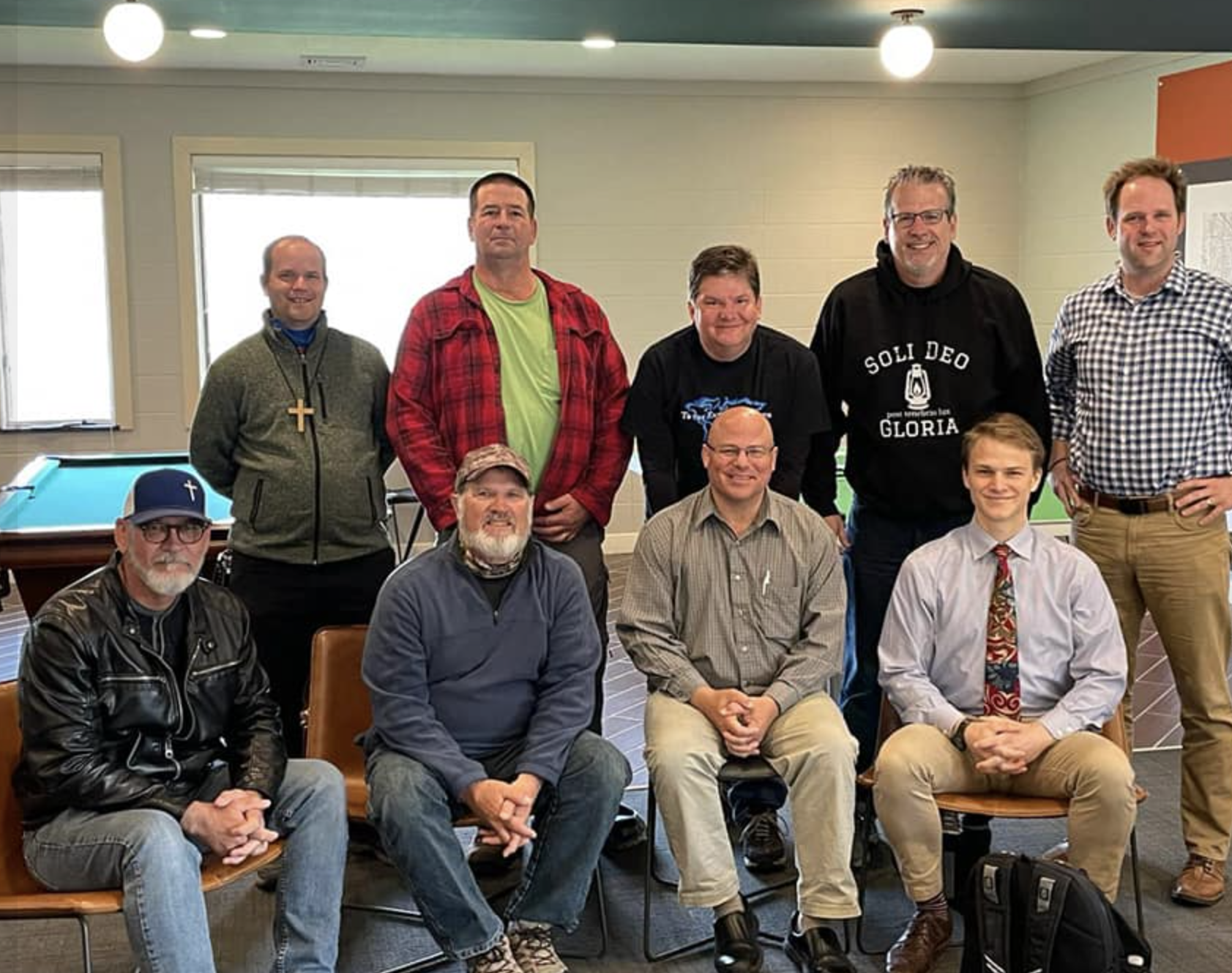
Left to right:

Bottom row: Ken Hisle; Joe Toy; Dan Davis; Jonathan Zavodney assistant to the President of the Seminary

Top row: Joshua Richard’s; Mark Yoho; Heath Pucel; Brian Ninde and Dr. Piotrowski President of Indianapolis Seminary and speaker

Evangelism Will Prevail…

After returning from a successful outreach at the Final Four in Indianapolis, it was time to sit back and reflect on our time there. The Lord blessed us with great weather, which meant being able to take the Gospel to the streets all day, every day and we had a great place to stay at the Benedict Inn Retreat and Conference Centre .

The area around the Lucas Oil Stadium makes for great preaching, but nothing more than Monument Circle which happens to be a free speech zone. The circle is so big there’s just plenty of room to set up and get into position for the day and with people passing by and cars going around the circle, this has to be one of the best spots in Indianapolis. 


There were lots of great encounters over the Easter weekend. A couple gathered across the street one day, and paid attention while Ken Hisle was preaching. I was filming Ken right by where they were standing, for our Facebook Live, when they asked me if I knew him. I told them that we were there together and they headed over to meet Ken in person. The couple explained how, upon hearing Ken speak, they felt really inspired. The man that was speaking with Ken then realised he knew Brian Ninde, another of our evangelists, but couldn’t place him. Eventually he realized it was from a basketball game they had both played in and they exchanged numbers. Hopefully the man will be coming out for further outreaches with us in the future.

There were crazy days too, one man started telling the team that satan was his Lord and he loved satan. I guess you’re always going to have encounters like that. Before travelling to Indianapolis I had looked up Seminaries online to find speakers for the outreach and I came across the Indianapolis Theological Seminary.

I was unsure at first as the Seminary looked new but it turned out to be tremendous. One of our speakers, Dr. Piotrowski, had joined the Seminary after gaining his PHD. The students that join the Indianapolis Theological Seminary work with their local church and as part of their curriculum, they have to spend time at the church. The mission of the Seminary is groundbreaking, check out their video below to learn more about them.

Dr. Piotrowski   gave some great talks and made a great point of reminding the team that being part of the Great Commission, means that evangelism will always prevail. It was refreshing and encouraging to hear something we already know, but framed from a different perspective. It certainly gave me a renewed vigour to feel like despite all obstacles put in our way, we will continue to preach and carry out the Lord’s work. Evangelism will prevail.

Daily Devotional 4-8-21

Daily Devotional 4-8-21

Christ’s Words of Comfort: Luke 12:32

Lest you’re under the illusion that having Jesus as a Good Shepherd who calms his flock is a sweet thing you can pull out of your Easter basket with your jelly beans and Peeps, I’m here to mess you up. Being called a sheep is most decidedly not a compliment.

If you walk into a sheep pen in springtime and cast your eyes around, you’ll see the newborn products of lambing season. The word “gambol” had to have been coined to describe how lambs move, especially when they hear their mother’s voice. It’ll elicit an immediate “Awww!” from you. But then you’ll also notice the incessant maa, maa, maa that continues ad nauseum.

The ewes will add their own alto baaing to the barnyard chorus. They’re nothing like the sheep on the bulletin cover on Good Shepherd Sunday. Spring sheep aren’t white. They’re overgrown balls of dirty gray wool with sprigs of Russia thistle tucked in and you-don’t-want-to-know-what hanging off their backsides. Can you say odoriferous?

The ram will be on his own, waiting to do his job again and bleating his own declaration of kinetic testicular potential. Don’t even think of getting in his way when there’s work to be done.

Once the flock is loosed from the pen, you will note the manifest lack of computing power available to the ovine brain. Here’s how it works: 1. Put nose to grass. 2. Nibble and chew. 3. Move forward. 4. Repeat steps 1-3. Notice there’s no step that calls for looking where you’re going. Sheep are all elemental brain stem activity. Walking id. Which, of course, marks them as easy prey for pasture predators. Sheep just can’t help themselves. If there’s a spirit animal for Martin Luther’s assertion of an unfree will captive to itself, it’s the sheep.

If Jesus is the shepherd and we’re his flock, he’s got his hands full chasing after one sheep who’s nibbled her way over a cliff, another being eyed by a coyote, and all the rest being susceptible to a long list of diseases, from pizzle rot to scrapie to uterine prolapse. Those guys in the nativity story outside of Bethlehem weren’t working sheep because it was the most desirable career available.

But isn’t it just like our Lord to take on a skittish batch like us? It’s our Father’s good pleasure to give us the kingdom, but it doesn’t come where we sheep imagine it will manifest itself. It’s not to be found in verdant pastures with predators kept at bay. Surely those will come, but they’re not the thing that quells our panic at the possibility of scarcity or danger.

It’s our Father’s good pleasure to give the kingdom in the person of the very one whose mouth speaks peace and calm. We need this shepherd, not to reform us and make us so self-confident that we can face down our jitters, but to take on every malady and enemy that menaces.

It’s a dirty job. Who would willingly take on the messes that hang off our backsides? Who but Jesus would bear the approbation of decent folks like me who sneer both at the moral turpitude and idiocy of his flock and at his own degeneracy in being willing to hang with this crowd? It would be an odd savior who would step away from and onto this cross.

Jesus can bid us to have no fear, because he knows the dangers better than we do. The ultimate predator had him marked from the beginning. His minions among the proper, the proud, and the pious prowled in ever tighter circles until he was caught and trussed up for slaughter. Yet his death took away the danger for his flock, so they wouldn’t wind up as mutton on the table of the powerful. His resurrection sealed the deal that brings the kingdom. It put a sheep tag in your ear that marks you as his.

When Luther wrote to his colleague Philip Melanchthon with advice for how to be a better preacher, he said his friend should first become a true sinner. He could just as easily have advised becoming more sheeply, that is, more dependent, more needy, more full of sin’s stench, more perilously close to death. To confess it is to shuck off the flock’s fear and have it replaced with faith.

This is the shepherd whose voice we know. You’ve heard it in baptism and in his Supper. If you’re skittish, you have good reason. But even better, you have this Shepherd who knows your voice, your cry, your incessant baaing. Even now he’s set his border collies to work to bring you into the safety of his sheepfold. Put your head down and nibble your way to his promised cote. You’ll find the good stuff there.

From: https://www.1517.org/articles/christs-words-of-comfort-luke-1232

Daily Devotional 4-7-21

Daily Devotional 4-7-21

Christ is Risen…!

Writing in The Weekend Australian (April 3-4, 2021), John Carroll, emeritus professor of sociology at La Trobe University, Australia, comments ‘Immortality has become the great question mark… For the secular modern age, belief in any form of life after death is in doubt … Most no longer believe in a supernatural being – whether providential, guiding, punishing, or forgiving. God has become a figment of the archaic imagination…’

What then does life have to offer? The sub-text of today’s elites are the words of the 5th century BC philosopher, Protagoras: In all things man (humanity) is the measure. Men and women determine what is of value and what is not. Voices today pronounce on race and gender, equality and rights. Interestingly, in the same way that 5th Greek philosophers drew aspects of their moral teaching from Moses, so there are aspects today that reflect Judaeo-Christian values – such as the abolition of slavery. That said, aspects of today’s agenda stand in clear contrast to those virtues.

Given that life and death matters are at stake, it’s imperative we ask whether the account of Jesus’ resurrection is an invention. I say this because the resurrection is foundational for Christianity. If it’s false, let’s eat, drink and be merry, for tomorrow we die. If it’s true, it’s life-changing.

The words of the Greek philosopher Heraclitus are apt: ‘Unless you expect the unexpected you will never find truth, for it is hard to discover and hard to attain’. And last century G.K. Chesterton remarked, ‘Truth is stranger than fiction, for fiction is the creation of the human mind and therefore congenial to it.’

The first witnesses. In the opening lines of John 20, the Apostle relates his experience on the morning of the third day following Jesus’ crucifixion. Mary of Magdala, one of the women who went to the tomb, ran back to tell Peter and John it was empty. “They have taken the Lord out of the tomb,” she said, “and we do not know where they have laid him” (John 20:2).

Despite the testimony of women being treated as unreliable and insignificant in first century Judaism, women were the first witnesses of the empty tomb. No Jewish writer would have written this if the account were fiction.

Furthermore, John the Apostle’s own testimony rings true. He tells us that he outran Peter, but he didn’t enter the tomb first: Peter did. Both saw the linen wrappings lying there and the linen cloth that had been around Jesus’ head… rolled up in another place. It was as though Jesus’ body had passed through the shroud which included some one hundred pounds weight of expensive myrrh and aloes (John 19:39) and the head covering had been discarded. It seemed that human hands had not removed the body. What did it mean?

John tells us that he saw and believed (20:8). But in the next sentence he tells us that neither he nor Peter understood it. Like Martha who had told Jesus she knew her brother Lazarus would rise from the dead on the last day (John 11:24), John reasoned that Jesus had gone to be with God the Father, as he had said (John 14:2-4). Neither he nor Peter understood what Jesus meant when he said they would see him again, physically risen from the dead. We need to grasp this, for it emphasises the unexpectedness and authenticity of what happened.

Despair. We need to appreciate how Jesus’ first friends felt when they saw him strung up on a cross. For three years they’d been with him. They’d seen him turn water into wine, heal the sick, restore sight to a man born blind. They’d even watched when, standing at the entrance of a tomb, he called out to a man who had been dead for four days: “Lazarus, come out” (John 11:43). Furthermore, they’d heard him teach and outclass the smartest minds that sought to break him. They believed that he was the Son of God incarnate.

Then to their horror, they’d watched him die! They’d heard his prayer of forgiveness and his promise to the penitent insurrectionist (Luke 23:34-43). They’d also heard his shout of victory, “It is finished” – ‘My work is done’ – as he died (John 19:30).

Their minds were numb with the shock that such an innocent man who had used his powers to serve others, should die a common criminal. No wonder they hid behind locked doors, fearing for their own lives.

John records that on that Sunday evening, Jesus suddenly stood in the midst of his disciples. His words, Jesus stood, contrast with the time they had last seen him – hanging on a cross, wounded and bleeding, wracked with pain, dying. And when they had seen the spear thrust in his side, they knew he was dead.

Yet here Jesus was, not weak and limp, but standing, tall and erect, in command, repeating words he had spoken when he was last with them: “Peace be with you”. And to prove he was real and not a ghost, he showed them his hands and his side (20:19f).

Bewildered and confused though they were, they nevertheless knew that Jesus was alive. “Peace be with you!” he said again. At their last meal he had promised, “My peace I leave with you… Don’t let your hearts be troubled. Believe in me” (John 14:27). His resurrection was proof of that.

They were overjoyed, but their minds couldn’t fully grasp what was happening. It was like a dream. But, as Chesterton observed, Truth is stranger than fiction.

As I have remarked before, Jesus’ resurrection is not the result of a natural law that can be tested. Rather, as the New Testament tells us, it happened because God chose to over-rule the ’natural laws’, intervening with his awesome, supernatural power (Romans 6:4b). And no-one has been able to prove conclusively that it didn’t happen.

More than ever our confused world needs to hear God’s good news. When we turn to the risen Christ, he says to us, ‘Peace be with you. Have no fear’.

Prayer: Almighty God, you have conquered death through your dearly beloved Son Jesus Christ and have opened to us the gate of everlasting life: grant us by your grace to set our mind on things above, so that by your continual help our whole life may be transformed; through Jesus Christ our Lord, who is alive and reigns with you and the Holy Spirit in everlasting glory. Amen. (BCP, Easter Day – adapted)

From: https://anglicanconnection.com/christ-is-risen/
Daily Devotional 4-6-21

Daily Devotional 4-6-21

Exposing the Permissive Will of God

The distinction between the sovereign will of God and the permissive will of God is fraught with peril and tends to generate untold confusion.

In ordinary language, the term permission suggests some sort of positive sanction. To say that God “allows” or “permits” evil does not mean that He sanctions it in the sense that He approves of it. It is easy to discern that God never permits sin in the sense that He sanctions it in His creatures.

What is usually meant by divine permission is that God simply lets it happen. That is, He does not directly intervene to prevent its happening. Here is where grave dangers lurk. Some theologies view this drama as if God were impotent to do anything about human sin.

This view makes man sovereign, not God. God is reduced to the role of spectator or cheerleader, by which God’s exercise in providence is that of a helpless Father who, having done all He can do, must now sit back and simply hope for the best. He permits what He cannot help but permit because He has no sovereign power over it. This ghastly view is not merely a defective view of theism; it is unvarnished atheism.

Coram Deo

How has a false view of God’s permissive will affected your Christian walk in the past? Do you have a different view of His permissive will now? How will it affect your walk in the future?

Passages for Further Study

John 7:17

Psalm 37:23

Psalm 27:11

From: https://www.ligonier.org/learn/devotionals/exposing-permissive-will-god/

Daily Devotional 4-5-21

Daily Devotional 4-5-21

Resurrection: Fact or Fiction

It is widely held that we cannot prove that Jesus is the Son of God. The supposition is that scientific theories and historical facts can be verified. On the other hand, faith operates in a realm incapable of such scientific or historical proof. But the Bible presents Christianity in an entirely different light. The Bible maintains that Jesus Christ “was declared to be the Son of God with power by the resurrection from the dead” (Romans 1:4). In other words, the resurrection is a verifiable historical event.

And how do we prove the resurrection? Here is one approach. After the arrest and crucifixion of Christ, the disciples were a fearful band hiding behind closed doors. Even courageous Peter, out of fear, denied he knew anything about Christ. But these apostles were transformed. They went out and boldly proclaimed the good news of Jesus Christ. Only one thing could have made a such a dramatic difference in their lives. It was the resurrection. The disciples saw the risen Christ. Acts 1:3 says, “To these He [Jesus] also presented Himself alive, after His suffering, by many convincing proofs, appearing to them over a period of forty days.”

To follow up on this devotion, please click here and listen to a message called, “Many Infallible Proofs of the Resurrection.”

Yes, the biblical record documents this dramatic transformation based upon the resurrection. But what about the Bible? Another time we’ll look at the historic accuracy and reliability of the Bible.

From: http://dennyprutow.com/daily-devotions/

Get in the Game: Final Four Outreach 2021

Get in the Game: Final Four Outreach 2021

A team of eight evangelists made their way to Indianapolis for the men’s basketball competition, The Final Four, hosted at Lucas Oil Stadium. The SFOI team spread out to minister at many key locations including Monument Circle. Take a look at our pictures and videos from the outreach. 

Left to right:

Bottom row: Ken Hisle; Joe Toy; Dan Davis; Jonathan Zavodney assistant to the President of the Seminary

Top row: Joshua Richard’s; Mark Yoho; Heath Pucel; Brian Ninde and Dr. Piotrowski  President of Indianapolis Seminary and speaker. REPORT

Daily Devotional 4-2-21

Daily Devotional 4-2-21

Slow to Speak

 Jesus had never been slow of speech when He could bless the sons of men, but He would not say a single word for Himself. “No man ever spoke like this man,” and no man was ever silent like Him. Was this singular silence the index of His perfect self-sacrifice? Did it show that He would not utter a word to prevent His crucifixion, which He had dedicated as an offering for us? Had He so entirely surrendered Himself that He would not interfere on His own behalf, even in the smallest details, but be crowned and killed an unstruggling, uncomplaining victim?

Was this silence a type of the defenselessness of sin? Nothing can be said to excuse human guilt; and, therefore, He who bore its whole weight stood speechless before His judge.

Patient silence is the best reply to a world of cruel opposition. Calm endurance answers some questions infinitely more conclusively than the loftiest eloquence. The best apologists for Christianity in the early days were its martyrs. The anvil breaks a host of hammers by quietly bearing their blows. Did not the silent Lamb of God furnish us with a grand example of wisdom? Where every word was occasion for new blasphemy, it was the line of duty to provide no fuel for the flame of sin. The ambiguous and the false, the unworthy and mean will soon enough confound themselves, and therefore the true can afford to be quiet and find silence to be its wisdom.

Evidently our Lord, by His silence, furnished a remarkable fulfillment of prophecy. A long defense of Himself would have been contrary to Isaiah’s prediction: “Like a lamb that is led to the slaughter, and like a sheep that before its shearers is silent, so he opened not his mouth.”1 By His silence He declared Himself to be the true Lamb of God. As such we worship Him this morning. Be with us, Jesus, and in the silence of our heart let us hear the voice of Your love.

1) Isaiah 53:7

From: https://www.truthforlife.org/resources/daily-devotionals/latest/?gclid=CjwKCAjwnK36BRBVEiwAsMT8WCR8UteIwaWlAyP4o9ZIuAWio8l7qmAM1nDcB3pFiYr-jOUNkgMsShoC68IQAvD_BwE

Daily Devotional 4-1-21

Daily Devotional 4-1-21

Repentance According to the Scriptures: 2 Peter 3-8-9

“But do not overlook this one fact, beloved, that with the Lord one day is as a thousand years, and a thousand years as one day. The Lord is not slow to fulfill his promise as some count slowness, but is patient toward you, not wishing that any should perish, but that all should reach repentance” (2 Pet 3:8-9).

Christians have been anticipating the return of Christ since the moment of his ascension. Even the Apostles’ seemed to believe Jesus may come back any day. The last chapter of the Bible is all about this. Three times in the final eleven verses of Revelation, John records Jesus saying, “I’m coming soon!”

Did we miss it?

Did John mishear Jesus?

Is Jesus a liar?

Maybe we just don’t understand what God means when he says “soon.”

Repentance means to turn or change your mind. It is not a turn from sin to righteousness. It is a turn from sin to the righteous Son of God who has defeated all sin.

One of the highlights of my childhood winters was my father reading books to me and my brother. On those days when the sun went down early, and the air quickly turned cold, my dad would start a fire, sit down in his worn-out armchair with my brother and me sitting at his feet, and read chapter after chapter of C.S. Lewis’ The Chronicles of Narnia out loud. I didn’t grow up with Martin Luther’s Small Catechism. I grew up with Lucy, Peter, Susan, and Edmund. Sin is still Turkish Delight as far as I’m concerned. I know the world is saved because the stone table is broken in two. I learned about repentance from Edmund and Eustace. And I know what Jesus means by “soon” because Aslan told Lucy.

“Do not look sad. We shall meet soon again.” “Please, Aslan,” said Lucy, “what do you call soon?”

“I call all times soon,” said Aslan, and instantly he was vanished away.” (C.S. Lewis, The Voyage of the Dawn Treader)

I cannot read Saint Peter’s words describing one day and a thousand years being the same to God as anything other than “I call all times soon.” And hopefully, that is helpful whether you’re familiar with Narnia and Aslan or not. It tells us that the eternal God is both outside of time and yet present in all times. All times are soon when you are eternal.

Nevertheless, Jesus said he is coming back soon, so why is this soon taking so long? Why is this promised soon so slow in arriving? Peter helps us with this by explaining that there is a difference between “slowness” in fulfilling promises and the patience of God. The love God has for a world of sinners is the reason for his delay. Every day 385,000 children are born that God desires to adopt into his family. He has a gift to give them. That gift is repentance.

Repentance is not simply something God demands we do; it is something he wants to give us. He gives this gift to the world as the gospel is preached, and we hear the good news that, in Christ, he has done everything necessary for us to escape death and hell and live forever as his children. Repentance means to turn or change your mind. It is not a turn from sin to righteousness. It is a turn from sin to the righteous Son of God who has defeated all sin.

God is not slow; he is patient. His heart desires that none perish, and the gospel reaches the ears of all people. This “soon” is long because of the longsuffering love of God that desires all to repent into his open arms.

From: https://www.1517.org/articles/repentance-according-to-the-scriptures-2-peter-3-8-9

Design a site like this with WordPress.com
Get started