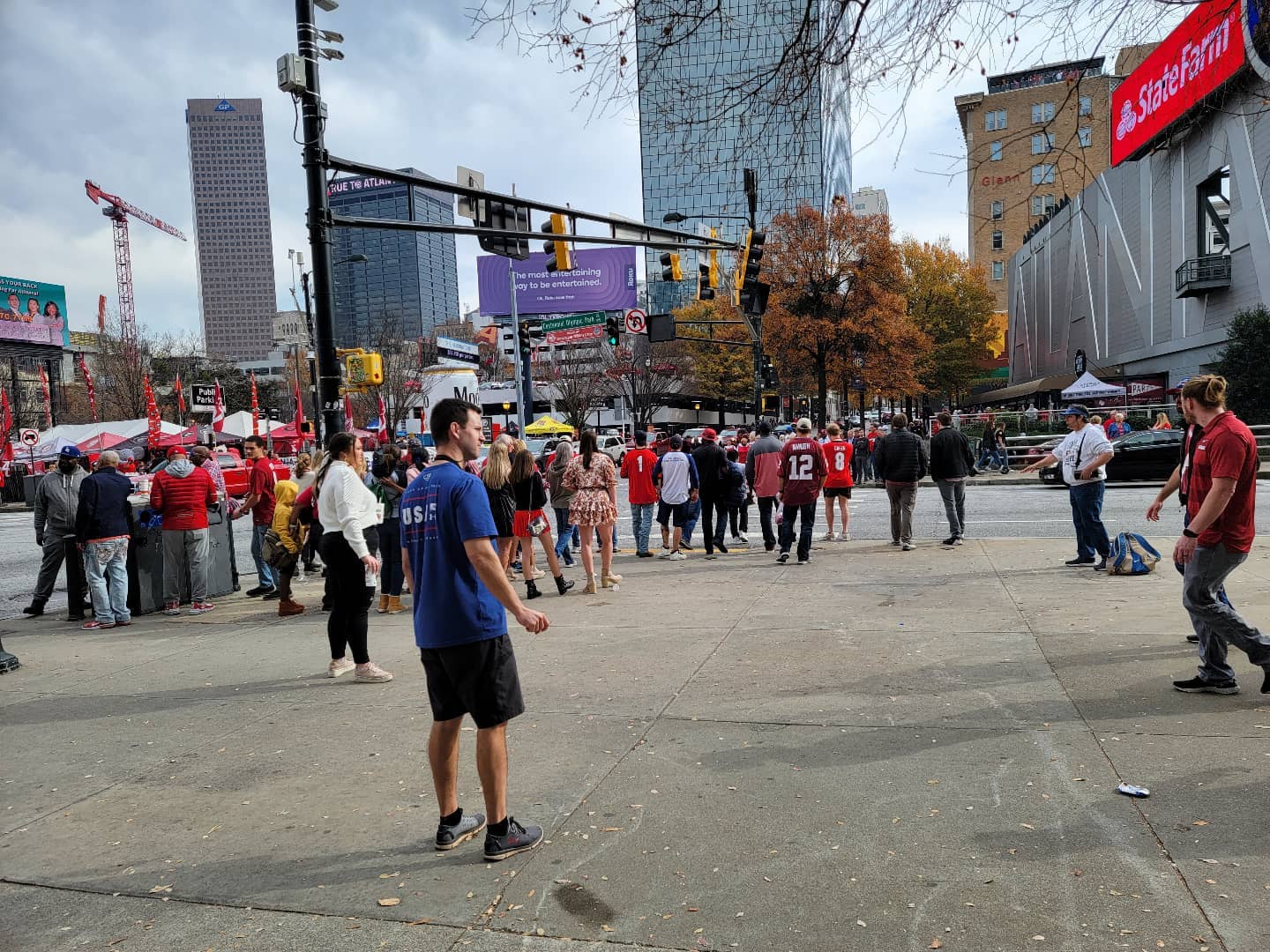
12/4 – Bill Adams – Big 10 Championship #SFOI1000

Game Summary

image of sports outreach

Big 10 Championship pictures and videos

Mark Yoho   Brian Ninde   Dennis Mohr   Ken Hisle  

This is an ideal location for Indianapolis ministry. Plus Amen Corner at Lucas Oil Stadium. Thousands passing by to receive tracts and hear the Word.

Below are pictures from two locations: the Indianapolis Convention Center and “Amen Corner” at Lucas Oil Stadium. 

At “Amen Corner” you’ll see Joe in the crimson shirt; Brian in the grey sweatshirt; Mark in the yellow hat and Payton in the fur hat. Everyone is preaching, distributing tracts and talking to people.

At the Indianapolis Convention Center is Mark, Ken Hisle, Dennis Mohr and Brandon Emerson preaching, etc.

https://sfoi.org/conference-championship-games

12/4 -Joe Hinson – Big 12 Championship #SFOI1000

Game Summary

image of sports outreach

Will Dieterich and Joe from today’s Big 12 Championship game at AT&T Stadium in Arlington Texas. We had many thousands of fans go past us hearing the gospel call as many people as there were we would have liked to have gotten a lot more tracts out but we still passed out a lot.

My boy  Joe Hinson  preaching Christ at the game last Saturday.

Big 12 Championship outreach… #sfoi1000 https://sfoi.org/conference-championship-games

Daily Devotional 12-10-21

Daily Devotional 12-10-21

Gazing Forever on Christ

So we will always be with the Lord.

 1 Thessalonians 4:17

Even the sweetest glimpses of Christ are short—how transitory they are! One moment our eyes see Him, and we rejoice with joy unspeakable and full of glory; but then the moment passes and we do not see Him, for our beloved withdraws Himself from us. Like a roe or a young hare He leaps over the mountains of division; He is gone to the land of spices and no longer feeds among the lilies.

If today He deigns to bless us
With a sense of pardoned sin,
He tomorrow may distress us,
Make us feel the plague within.

How sweet the prospect of the time when we will no longer see Him from a distance but rather face to face—when He will not be like a traveler staying only for a night but will enfold us in the bosom of His eternal glory. We will not see Him for a little while, but

Millions of years our wondering eyes,
Shall o’er our Savior’s beauties rove;
And myriad ages we’ll adore,
The wonders of His love.

In heaven we will not be interrupted by care or sins; no weeping will dim our eyes; no earthly business will distract our happy thoughts. We will have nothing to prevent us from gazing forever on the Sun of Righteousness with tireless eyes. If it is so sweet to see Him now and then, how wonderful to gaze on that blessed face forever, and without a cloud rolling between, and never have to turn one’s eyes away to look on a tired and sinful world. When will this blessed day dawn? Rise, unsetting sun! If to die is to enter into uninterrupted communion with Jesus, then death is swallowed up in a sea of victory and is definitely gain.

From: https://www.truthforlife.org/resources/daily-devotionals/latest/gclid=CjwKCAjwnK36BRBVEiwAsMT8WCR8UteIwaWlAyP4o9ZIuAWio8l7qmAM1nDcB3pFiYr-jOUNkgMsShoC68IQAvD_BwE

Daily Devotional 12-9-21

Daily Devotional 12-9-21

Bright Valley of Love: A Story for Preachers as Advent Turns Toward Christmas

As Advent takes a sharp turn toward Christmas, Edna Hong’s gentle yet powerful, Bright Valley of Love comes to mind. Set in post-War World I Germany, it is the story of Gunther, a boy whose body was twisted and whose mind was strangled already in the womb. Forsaken by his mother and left to live his earliest years hidden away in a back room of his grandmother’s house, Gunther is finally brought to Bethel, a Lutheran place of mercy where he is no longer seen as a shameful piece of human junk but a beloved child of the King of heaven. At Bethel, his ears are filled with the stories of Jesus, and the hymns of the church surround his feeble existence. Bethel was the house of God, and as such, it was also home to those that the world considered worthless: those seized with epilepsy, the crippled, the blind, and the mentally disabled. Here they were cared for by deaconesses with hearts and hands of mercy. Pastor Fritz (in real life Pastor Friedrich von Bodelschwingh the younger who stood in staunch opposition to National Socialism and with Hermann Sasse, Dietrich Bonhoeffer, Georg Merz, and Wilhlem Vischer was instrumental in producing the Bethel Confession of 1933 [1]) is the director of Bethel who shepherds his congregation of misfits to the crib of One born to be their Savior.

Before coming to Bethel, Gunther did not know of Christmas. In that life, one day was no different from the next as each was dark and dirty. But now at Bethel, life for the whole community moved with the ever-changing rhythms of the church year. The season of Advent was permeated with Gerhardt’s “O shall I receive Thee, How greet Thee Lord, aright?” Weissel’s “Lift up your heads, ye mighty gates! Behold the King of glory waits,” and Luther’s “Ah, dearest Jesus, Holy Child, Make thee a bed, soft undefiled, within my heart, that it may be a quiet chamber kept for thee.” Devotions around the Advent wreath and the Christmas crèche brought a new and undimmed world to the horizon of Bethel and its residents. The voice of praise was not silent here as the anticipation of the coming Savior brought light and love to the village. The promises of Advent were in the air.

All this was new to Gunther. So new and strange as to be contradicted by all that he experienced in his short life up to this point. In the glow of Advent candles and joyous songs exhorting mighty gates to fling open wide, little Gunther throws up his complaint: “There’s a crack in everything!” Indeed “For Gunther, the joyous expectation of Christmas feeling was practically rubbed out by the other, the fear feeling. His complaint turned into a cry for help: ‘What’s so great about Christmas?’” (59).

That is the question which the preacher must answer! Pastor Fritz enlists the other children to help him tell Gunther what is so great about Christmas. The answers are jumbled and not always coherent as the children reply with fragments of a hymn, like “to ransom captive Israel” or truisms like “Christmas is the 25th day of December” or “Christ is born in Bethlehem.” Finally, one little girl, Leni, triumphantly repeats Gunther’s initial complaint: “Because everything has a crack!”

Drawing close to Gunther’s side, Pastor Fritz now answers the question: “It is true, Gunther, that there is a crack in everything. God sees the crack better than we do, and the crack is ever so much worse than we think it is. That is why God sent his Son from the heavenly home to our earthly home. Not to patch up the crack, but to make everything new. That is why Christmas is so great, Gunther” (61).

From all eternity, the Father willed to send his Son, the eternal Word, into the flesh to tabernacle among those like Gunther that the world deemed unworthy of life. He was born not to reform this world but to redeem it by his blood.

At Bethlehem, God did not inaugurate a repair job, plastering over the fissures of this broken world, working with the art of an embalmer to paint over the face of death with a cosmetic appearance of life. The Christmas gospel first preached by the angels is the announcement of the birth of a Savior who will bring heaven’s peace to earth.From all eternity, the Father willed to send his Son, the eternal Word, into the flesh to tabernacle among those like Gunther that the world deemed unworthy of life. He was born not to reform this world but to redeem it by his blood.No longer veiled in poverty and shame, but forever clothed in our flesh, he now declares, “Behold, I am making all things new” ( Rev. 21:5 ). He came not merely to deal with the symptoms of sin, but once and for all to break the grip of sin and defeat death. He comes to us at Christmas, Helmut Thielicke says, “. . . in the depths. I do not need first to have religious feelings, out of which I then produce some internal and external results, before he comes to me. He comes in the stable, to the disconsolate, the sick, and the despairing; he trudges in the long line of refugees; and if everyone and everything should desert me in my final hour, I can say, ‘If I should have to depart, depart not from me.’ Then he comes even to the dark valley of death. Crib and cross are of the same wood.” [2] That is finally why Christmas is so great!

Christmas declares that there is mercy for the broken and those pushed aside as worthless. There is mercy for you now made evident in the fact that God became man, pleased with us to dwell.

Oswald Bayer writes that we live in a world where “mercy is not self-evident.” [3] That was certainly the case in the years leading up to World War II in Germany. It is no less true for us in 21st century North America. But in that “bright valley of love” called Bethel, the mercy that flows from crib and cross touched lives disfigured by the crack, which runs through all creation since our first parents’ grabbed at the glory of their Creator in a vain attempt to make it their own. Christmas declares that there is mercy for the broken and those pushed aside as worthless. There is mercy for you now made evident in the fact that God became man, pleased with us to dwell.

From the manger newborn light
Shines in glory through the night Darkness there no more resides; In this light faith now abides. (332:7 LSB)

From: https://www.1517.org/articles/bright-valley-of-love-a-story-for-preachers-as-advent-turns-toward-christmas-1

Daily Devotional 12-8-21

Daily Devotional 12-8-21

Prepare the Way of the Lord…!

“Prepare ye the way of the Lord …” are the opening words of the Broadway musical Godspell, that was released in 1971. The lyrics pick up the theme of John the Baptist’s preaching some two millennia ago as he prepared people for the coming of God’s promised Messiah or King. All four Gospels record John’s ministry.

John the Baptist was a great preacher. He drew thousands from the cities and towns to the wilderness region near the Jordan River. He may have been a member of the Qumran community which was located around the northern shores of the Dead Sea.

In his preaching John used the symbolism of the exodus from Egypt. God’s people, Israel had endured the wilderness for forty years because they had not listened to Moses. Now God, in his mercy, had sent John whose role was to prepare the way for God’s Messiah. John’s mission was to call Israel back to God through preaching a baptism of repentance for the forgiveness of sins (3:3).

For John, repentance and baptism are tightly linked. We men and women fail to honor God in our lives. This is our real sin. And we need to change. ‘Repentance and baptism’, said John, ‘were signs of a change of heart towards God and a renewed relationship with God’s people.’ In calling both the Jewish people and Gentiles to repent and be baptised, John angered many Jewish leaders. Baptism was a ceremony typically used as a sign of the incorporation of non-Jewish people, that is, outsiders, into the Jewish faith. When John preached that Abraham’s descendants should also be baptized, he was implying that God saw them as outsiders and not automatically as his people.

The glory of the Lord. To enable us to understand the significance of John’s ministry, Luke quotes Isaiah 40:1-9, the chapter from which the opening lines of Handel’s Messiah are drawn: Comfort, comfort, my people, says your God …. Isaiah 40 continues in verse 3: In the wilderness a voice cries out, “Prepare the way of the Lord, make straight … a highway for our God. Every valley shall be lifted up, and every mountain and hill be made low;… Then the glory of the Lord shall be revealed, and all people shall see it together, for the mouth of the Lord has spoken” (40:3-5).

The preaching of John the Baptist was a wake-up call for all of God’s people. ‘God is about to do a new thing; there will be a new exodus,’ John was saying. ‘God is going to fulfill his promises that prophets like Isaiah spoke about: he is about to send his Messiah who will offer comfort and hope to a broken world. My task,’ said John, ‘is to prepare you. You need to repent – to turn back to God – and, as a sign of your changed hearts, be baptized for the forgiveness of your sins’ (Luke 3:3).

Significantly, Luke emphasises LORD rather than God. John’s preaching is focused on God’s Messiah, namely, Jesus. This is significant. Luke is telling us that God is about to do a new thing. God is about to provide the means of the rescue of a lost world and with it, offer the comfort and hope the world longs for. All flesh shall see the salvation of God, we read in Luke 3:6. With reference to freeway or highway construction, cutting through mountains and filling in valleys, John’s ministry was to make the way ready for the Lord.

The priority of John’s ministry is preaching (3:7-18), the ministry of the sacrament is dependent on the ministry of God’s Word. This is important for us who live in an age when churches focus more on the outward signs of faith rather than an inner personal response. God uses the instrument of words, not signs, to bring people to himself and change their lives.

John likened his hearers to a brood of vipers (3:7). These people were descendants of Abraham and yet he told them that they were alienated from God. “Who warned you,” he asked, “to flee from the wrath to come?” (3:7).

‘The time is critical,’ he insisted: “Even now the axe is laid at the root of the tree” (3:9). The true children of God are not those who have the right credentials (physical descendants of Abraham, 3:8), but those who bear fruits that befit repentance (3:8). ‘Do not be complacent or self-satisfied about your lives,’ John declared, ‘for you do not bear the marks of godly living. Like the very desert you are standing in,’ he implied, ‘you are barren; be warned of God’s coming judgment’ (3:9).

Godspell dramatized the first coming of the Messiah. The words prepare ye now serve as a reminder of his return. The season of Advent, which is the first season in the annual Church calendar, and which began on Sunday, November 28, focuses on the second coming of the LORD Jesus.

The return of the King one day will surprise us all. We need to be prepared. We also have the task of preparing others for that great and glorious day. Will you join me in praying that all of us will look for and take up opportunities to introduce family and friends to Jesus, the Christ, especially over the Advent and Christmas seasons?

You can still register for the recent Anglican Connection seminar that introduced The Word One-to-One as an effective way we can introduce family and friends to Jesus. The Word One-to-One is an annotated version of the Gospel of St John. Here is the link:  https://anglicanconnection.com/seminars/.

A Prayer. Blessed Lord, you have caused all holy scriptures to be written for our learning, grant us so to hear them, read, mark, learn and inwardly digest them that, encouraged and supported by your holy Word, we may embrace and always hold fast the joyful hope of everlasting life, which you have given us in our Savior Jesus Christ. Amen.

From: https://anglicanconnection.com/prepare-the-way-of-the-lord/

Daily Devotional 12-7-21

Daily Devotional 12-7-21

The Foundation for the Joy of Christmas

Along with the great theologian and philosopher Anselm of Canterbury we ask the question, Cur deus homo? Why the God-man? When we look at the biblical answer to that question, we see that the purpose behind the incarnation of Christ is to fulfill His work as God’s appointed Mediator. It is said in  1 Timothy 2:5 : “For there is one God and one Mediator between God and men, the Man Christ Jesus, who gave Himself . . . ” Now, the Bible speaks of many mediators with a small or lower case “m.” A mediator is an agent who stands between two parties who are estranged and in need of reconciliation. But when Paul writes to Timothy of a solitary Mediator, a single Mediator, with a capital “M,” he’s referring to that Mediator who is the supreme Intercessor between God and fallen humanity. This Mediator, Jesus Christ, is indeed the God-man.

In the early centuries of the church, with the office of mediator and the ministry of reconciliation in view, the church had to deal with heretical movements that would disturb the balance of this mediating character of Christ. Our one Mediator, who stands as an agent to reconcile God and man, is the One who participates both in deity and in humanity. In the gospel of John, we read that it was the eternal Logos, the Word, who became flesh and dwelt among us. It was the second person of the Trinity who took upon Himself a human nature to work out our redemption. In the fifth century at the Council of Chalcedon in 451, the church had to fight against a sinister teaching called the Monophysite heresy. The term monophysite is derived from the prefix mono, which means “one,” and from the root phusis, which means “nature” or “essence.” The heretic Eutyches taught that Christ, in the incarnation, had a single nature, which he called a “theanthropic nature.” This theanthropic nature (which combines the word theos, meaning “God,” and anthropos, meaning “man”) gives us a Savior who is a hybrid, but under close scrutiny would be seen to be one who was neither God nor man. The Monophysite heresy obscured the distinction between God and man, giving us either a deified human or a humanized deity. It was against the backdrop of this heresy that the Chalcedonian Creed insisted Christ possesses two distinct natures, divine and human. He is vere homo (truly human) and vere Deus (truly divine, or truly God). These two natures are united in the mystery of the incarnation, but it is important according to Christian orthodoxy that we understand the divine nature of Christ is fully God and the human nature is fully human. So this one person who had two natures, divine and human, was perfectly suited to be our Mediator between God and men. An earlier church council, the Council of Nicea in 325, had declared that Christ came “for us men, and for our salvation.” That is, His mission was to reconcile the estrangement that existed between God and humanity.

It is important to note that for Christ to be our perfect Mediator, the incarnation was not a union between God and an angel, or between God and a brutish creature such as an elephant or a chimpanzee. The reconciliation that was needed was between God and human beings. In His role as Mediator and the Godman, Jesus assumed the office of the second Adam, or what the Bible calls the last Adam. He entered into a corporate solidarity with our humanity, being a representative like unto Adam in his representation. Paul, for example, in his letter to the Romans gives the contrast between the original Adam and Jesus as the second Adam. In Roman 5, verse 15, he says, “For if by the one man’s offense many died, much more the grace of God and the gift by the grace of the one Man, Jesus Christ, abounded to many.” Here we observe the contrast between the calamity that came upon the human race because of the disobedience of the original Adam and the glory that comes to believers because of Christ’s obedience. Paul goes on to say in verse 19: “For as by one man’s disobedience many were made sinners, so also by one Man’s obedience many will be made righteous.” Adam functioned in the role of a mediator, and he failed miserably in his task. That failure was rectified by the perfect success of Christ, the God-man. We read later in Paul’s letter to the Corinthians these words: “And so it is written, ‘The first man Adam became a living being.’ The last Adam became a life-giving spirit. However, the spiritual is not first, but the natural, and afterward the spiritual. The first man was of the earth, made of dust; the second Man is the Lord from heaven. As was the man of dust, so also are those who are made of dust; and as is the heavenly Man, so also are those who are heavenly. And as we have borne the image of the man of dust, we shall also bear the image of the heavenly Man” (1 Cor. 15:45).

We see then the purpose of the first advent of Christ. The Logos took upon Himself a human nature, the Word became flesh to affect our redemption by fulfilling the role of the perfect Mediator between God and man. The new Adam is our champion, our representative, who satisfies the demands of God’s law for us and wins for us the blessing that God promised to His creatures if we would obey His law. Like Adam, we failed to obey the Law, but the new Adam, our Mediator, has fulfilled the Law perfectly for us and won for us the crown of redemption. That is the foundation for the joy of Christmas.

From: https://www.ligonier.org/learn/articles/foundation-joy-christmas

Daily Devotional 12-6-21

Daily Devotional 12-6-21

Our Union with Christ

As is the man of heaven, so also are those who are of heaven.

 1 Corinthians 15:48

The head and members are of one nature, and not like that monstrous image that Nebuchadnezzar saw in his dream. The head was of fine gold, but the belly and thighs were of brass, the legs of iron, and the feet partly of iron and partly of clay. Christ’s mystical body is no absurd combination of opposites. The members were mortal, and therefore Jesus died; the glorified head is immortal, and therefore the body is immortal too, as the record states: “Because I live, you also will live.”1


As is our loving Head, so is His body, and every member in particular. A chosen Head, therefore chosen members; an accepted Head, therefore accepted members; a living Head, therefore living members. If the head is pure gold, all the parts of the body are pure gold also. There is a double union of nature as a basis for the closest communion.

Pause here, devout reader, and see if you can contemplate the infinite condescension of the Son of God in exalting your wretchedness into blessed union with His glory without being overwhelmed by the wonder of it. You are so feeble and poor that in remembering your mortality, you may say to decay, “You are my father,” and to the worm, “You are my sister”; and yet in Christ you are so honored that you can say to the Almighty, “Abba, Father” and to the Incarnate God, “You are my Brother and my Husband.”

Surely if relationships to ancient and noble families make men think highly of themselves, we have more cause to glory than all of them. Let the poorest and most despised believer take hold upon this privilege; do not let an unthinking laziness prevent him from tracing his pedigree, and do not let him focus so much on the here and now that he fails to think profitably of this glorious, heavenly honor of union with Christ.

1) John 14:19

From: https://www.truthforlife.org/resources/daily-devotionals/latest/gclid=CjwKCAjwnK36BRBVEiwAsMT8WCR8UteIwaWlAyP4o9ZIuAWio8l7qmAM1nDcB3pFiYr-jOUNkgMsShoC68IQAvD_BwE

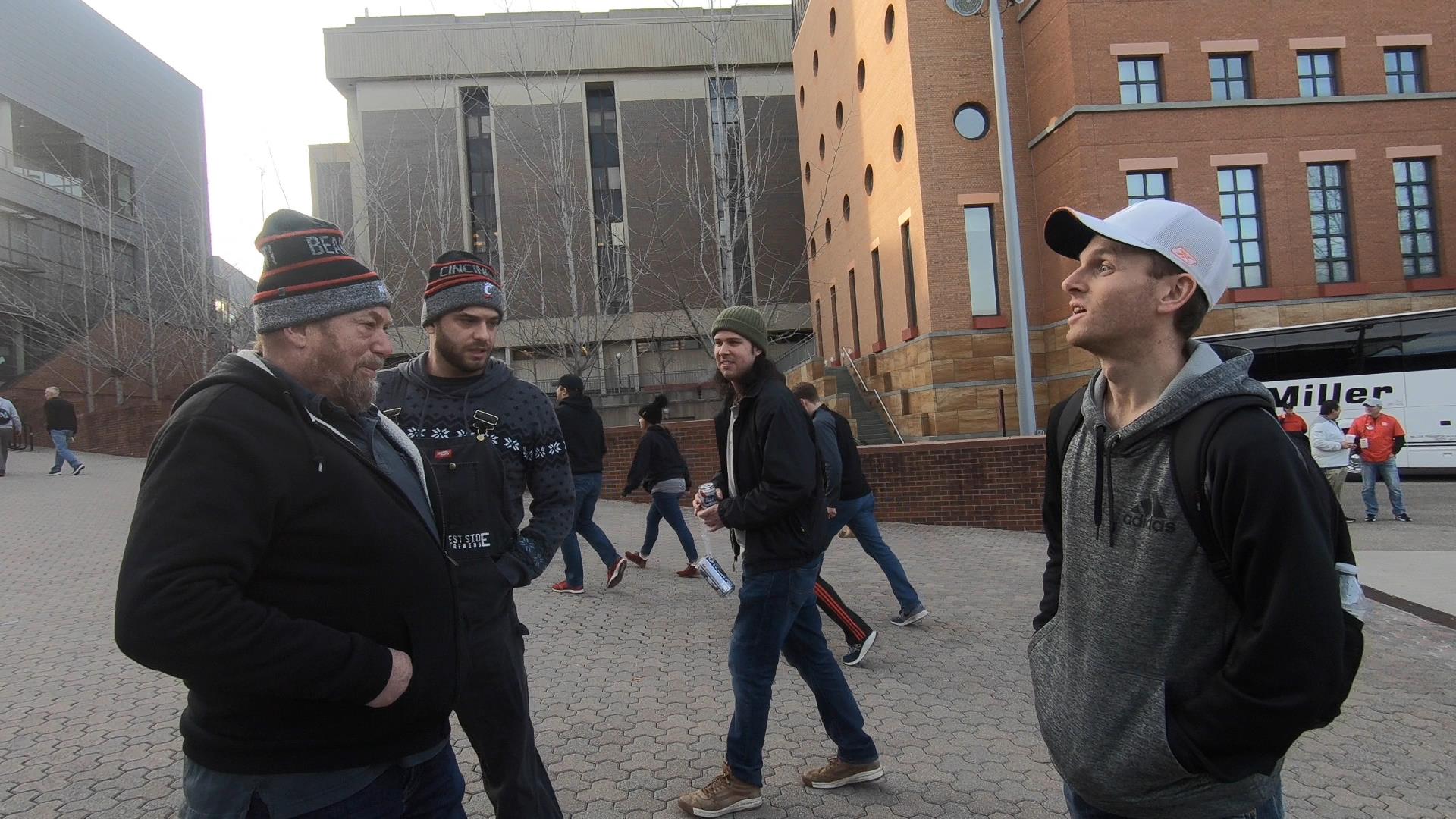
12/4 -David Doerman – University of Cincinnati #SFOI1000

Game Summary

image of sports outreach

 UC Bearcat Fans Hear Gospel on Championship Day

On December 4th, 2021 UC Bearcat Fans Heard the Gospel on Championship Day. The UC Bearcat football team completed their undefeated season and won the American Athletic Conference championship. They defeated the Houston Cougars 35-20. And they expect to qualify for the BCS College Football Playoffs.

To the praise of God’s glory, many of the 37,978 fans had an opportunity to receive the gospel as they entered Nippert Stadium. Some received gospel tracts from Kirk. Matt was able to present the gospel to a Universalist. And many heard the gospel proclaimed in the open-air.

See the one minute video below:

Evangelists Matt and Kirk Getting Out Gospel Tracts

Evangelize Cincinnati

We proclaim the gospel at sporting events and the local abortion clinic. We do one-to-one witnessing at the local bus station. Check our  Evangelism Outreach Schedule  and join us as we Evangelize Cincinnati.

If you are looking for a like-minded gospel organization in your area, check out Sports Fan Outreach International Ministries. https://sfoi.org/University-of-Cincinnati

Design a site like this with WordPress.com
Get started