MAGNA CARTA

MAGNA CARTA

“…I will make you a great nation; I will bless you and make your name great; and you shall be a blessing…and in you all the families of the earth shall be blessed.'” Genesis 12:1-3

Most Valuable

15 June marks the 806th anniversary of the proclamation of Magna Carta. Magna Carta has been one of the most valuable exports of Great Britain to the rest of the world. Magna Carta has truly blessed all the families of the earth. Magna Carta was the first Statute, the first written restriction on the powers of government. 

Foundational

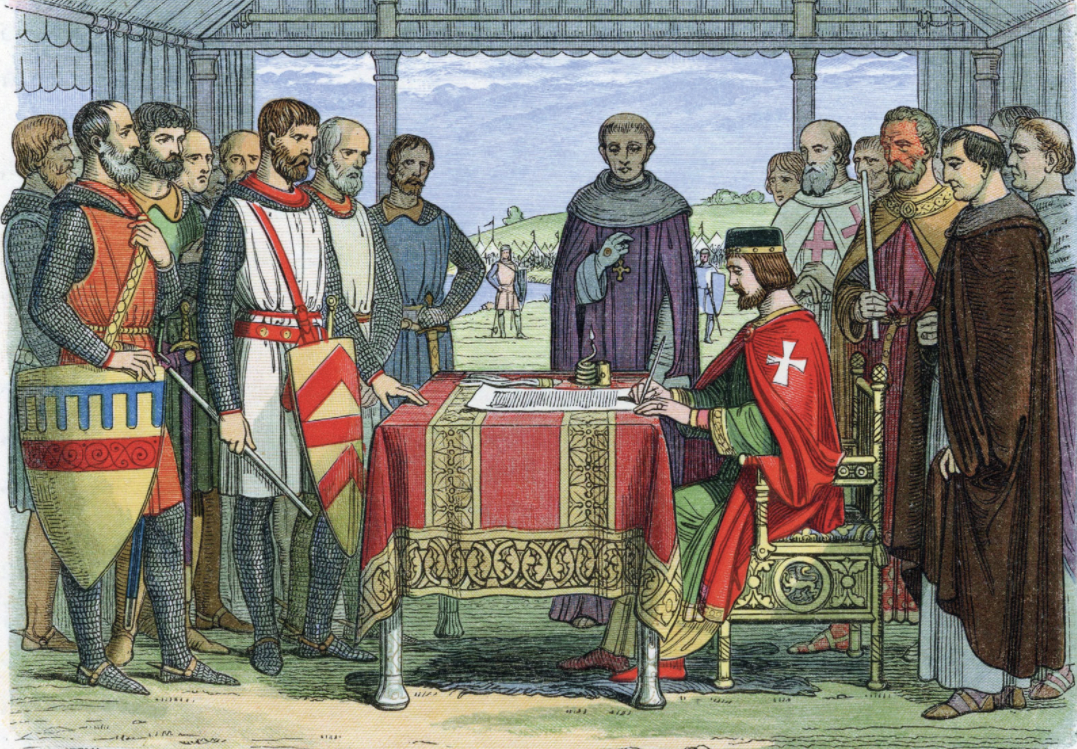
Magna Carta, signed by King John at Runnymede, 15 June 1215, recognised foundational Scriptural principles: Justice must not be sold, delayed, or denied; no taxes may be levied without the consent of representatives of those being taxed; no one may be imprisoned without a fair trial by a jury of their peers; property must not be taken from any owner without just compensation. Religious freedom is foundational and must remain inviolable, with all “its rights undiminished and its liberties unimpaired.”

First Bill of Rights

Magna Carta is recognised as the grandfather of all Bills of Rights. Magna Carta was the inspiration for the Glorious Revolution of 1688, the model for the English Bill of Rights of 1689; and for the Bill of Rights of the United States of America. 

Greatest Constitutional Document

Lord Denning described Magna Carta as “the greatest Constitutional document of all times – the foundation of the freedom of the individual against the arbitrary authority of the despot.”

Reformation

During the greatest century of Reformation, in the 16th century, there was a tremendous upsurge of interest in Magna Carta and strenuous efforts to apply these Biblical principles of justice and freedom into all areas of British life. 

Liberty

Magna Carta is an important symbol of liberty today. It is greatly respected worldwide by both historians and lawyers, as a potent foundational document for the protection of personal liberties. It has been described as one of the most important legal documents in history. “Do not remove the ancient landmark…” Proverbs 23:10

God-Honouring

The Archbishop of Canterbury, Stephen Langton, wrote Magna Carta, which declares: “John, by the grace of God, King of England… know ye, that we, in the presence of God and for the salvation of our soul and the souls of all our ancestors and heirs and unto the honour of God and the advancement of the Holy Church and amendment of our realm… by this our present charter confirmed, for us and our heirs, forever; that the Church of England shall be free and have her whole rights and her liberties inviolable…” 

Bible-Based

The Bible was clearly recognised as the foundational authority for Magna Carta. “You shall do no injustice in judgement. You shall not be partial to the poor, nor honour the person of the mighty. In righteousness you shall judge your neighbour.” Leviticus 19:15

Justice

Magna Carta established the right of Trial by Jury to protect the accused from capricious condemnation by authorities. The high value that Christianity, from its inception, has placed on the individual is in stark contrast to the ancient Egyptian, Babylonian, Persian, Chinese, Greek and Roman cultures, in which the individual was always subordinate to the state. True liberty, individual rights and respect for human personality found no place in the ancient world. 

Christian Emphasis

It was the Christian emphasis on the individual that established the freedoms and rights enshrined in Magna Carta of 1215 and the later English Petition of Rights of 1628, the English Bill of Rights of 1689 and in the American Bill of Rights of 1791.

Under God and Law

Sir Edward Coke, Chief Justice of the Court of Common Pleas, challenged King James I, that Magna Carta gave the Courts of Common Law the right to provide justice “from the highest to the lowest” because the king was “under God and the Law.” “‘You could have no power at all against Me unless it had been given you from above…'” John 19:11. All civil authority is delegated by God and answerable to God.

The Christian Roots of Liberty

Dr. Alvin Schmidt, in How Christianity Changed the World, documents that the freedoms and liberties expressed in Bills of Rights and Declarations of Independence, are extensions of Magna Carta, which is thoroughly Christian. Civic freedoms and liberties could not have occurred had it not been for the Christian values that prompted and shaped the formation of these documents, all of which are extensions of Magna Carta. Magna Carta is revered throughout the world as the cornerstone of modern freedom.

Reaction to Tyranny

Sir Winston Churchill noted in his History of the English Speaking Peoples, that the rights and liberties of English speakers owes more to the vices of King John, than to the virtues of any man. King John was one of the worst kings that England ever had. His cruelty and capriciousness drove the barons of England to mobilise and compel King John to set the royal seal to Magna Carta, or Great Charter. 

Habeas Corpus

The sealing of Magna Carta, 15 June 1215, was a splendid victory for the English people. It marked an end to the arbitrary power of any ruler to throw a man in prison without granting him opportunity to prove his innocence. Magna Carta decrees that any man arrested must be tried in court and if it cannot be proved that he has done wrong, he must be set free. “To no one will we sell, to no one deny, or delay, right or justice.” “He who justifies the wicked and he who condemns the just, both of them alike are an abomination to the Lord.”Proverbs 17:15

Just Weights and Measures

No taxation is legal that is not authorised by those being taxed. Weights and measures must be standardised. “You shall do no injustice in judgment, in measurement of length, weight, or volume. You shall have honest scales, honest weights, an honest ephah and an honest hin: I am the Lord your God.” Leviticus 19:35-36

Parliament

A Great Council of nobles and bishops is to advise and guide the king in governing the country. This Great Council soon developed into the English Parliament, which is the model and mother of all parliaments (Exodus 18:21).

Rule of Law

The right of a fair Trial by Jury of one’s peers, the right of having a voice in the running of the government and in determining taxes, the right to a just and uniform standard of weights and measures for money and goods, are just some of the many blessings which have flowed from Magna Carta. “Hate evil, love good; establish justice in the gate… let justice run down like water and righteousness like a mighty stream.” Amos 5:15,24

The Authority of the Archbishop

Archbishop Stephen Langton strongly sympathised with the Northern barons who openly rebelled against King John. The Archbishop declared that if John refused to negotiate, then he would excommunicate every man in the Royal Army. The Barons advanced on London, where they were warmly welcomed. By the time they had pursued the king to Staines, Magna Carta included 63 demands. On Monday, 15 June 1215, the Barons met the king in a meadow named Runnymede, on the South bank of the Thames River, halfway between Staines and Windsor. John agreed to the demands, but another four days were spent in hammering out the details of the wording and in making copies of the document. On Friday, 19 June, John fixed the royal seal to Magna Carta. 

Enduring Legacy of Liberty

Despite attempts by King John to violate his commitment and the hostility of Pope Innocent III to Magna Carta, the regency of John’s younger son, Henry III, reissued Magna Carta in 1216 and his son, Edward I, reissued Magna Carta in 1297, confirming it as part of England’s Statute Law. 

The Dooms of King Alfred

During the time of the Reformation in the 16th century, there was an upsurge of interest in Magna Carta as lawyers and historians traced the principles of freedom in the Great Charter, to Biblically-based laws enacted during the times of the Anglo Saxons, such as The Dooms of King Alfred the Great at the end of the 9th century, which begin with The Ten Commandments, The Case Laws of Exodus and Christ’s Sermon on the Mount. “…It is not good to show partiality in judgment. He who says to the wicked, ‘You are righteous’, him the people will curse; nations will abhor him.” Proverbs 24:23-24

Restoring Liberty

Both James I and his son, Charles I, attempted to supress the discussion of Magna Carta and this led to the English Civil War of the 1640s and the execution of Charles for high treason. The violation of the Rights of Englishmen as outlined in Magna Carta led to the Glorious Revolution of 1688, which ousted the Catholic James II, welcoming Protestant William and Mary to the throne and the signing of the English Bill of Rights in 1689. “Righteousness exalts a nation, but sin is a reproach to any people.” Proverbs 14:34

Charter Rights in America

The colonists in the 13 colonies of North America protested the violation of their chartered rights as outlined in Magna Carta when Parliament failed to provide redress for their grievances. In 1687, William Penn published The Excellent Privilege of Liberty and Property: Being the Birthright of the Free-born Subjects of England, which contained the first copy of Magna Carta printed on American soil. Penn’s comments reflected those of Coke’s, that Magna Carta was fundamental Law. The American colonists quoted extensively from Magna Carta concerning their rights to Trial by Jury and Habeas Corpus. The American founding fathers declared that their Constitution was to preserve their rights and liberties as enshrined in Magna Carta. The American founding fathers claimed Magna Carta as foundational for their American Constitution of 1789, which became the supreme law of the land in the USA. In 1976, Britain lent one of the four surviving originals of the 1215 Magna Carta to the United States for their Bicentennial celebrations and also donated an ornate case to display it. A replica is still on display in the United States capital crypt in Washington DC.

From Sea to Sea

William Stubb in his Constitutional History of England, published in the 1870s, documented that Magna Carta had been a major step in the shaping of the English people as a nation governed by laws under God. The British dominions, Australia, New Zealand, Canada, Southern Rhodesia and the Union of South Africa, all regard Magna Carta as foundational to their laws and sought to model their Constitutions on its provisions.

Birth Certificates of Freedom

Four exemplifications of the original 1215 Magna Carta remain in existence and are held by the British Library and the cathedrals of Lincoln and Salisbury. At least 13 original copies of the 1215 Magna Carta were issued by the Royal Chancery at the time. These were sent to county sheriffs and bishops who made more copies and ensured that the provisions were understood by the population. The original Charters were written on vellum sheets, using quill pens, in abbreviated Latin. Each was sealed with the royal great seal using beeswax and resin, most of which have not survived. The 63 numbered clauses of Magna Carta were introduced by Sir William Blackstone in 1759 as the original Charters formed a single, long unbroken text. The four original 1215 Charters will be on joint display at the British Library this year, to mark the 800th anniversary of Magna Carta.

Precious Heritage

Lincoln Cathedral’s original copy of the 1215 Magna Carta was being displayed at the World Fair in New York when the Second World War broke out and spent the war years in Fort Knox. Prime Minister Winston Churchill attempted to gift the Charter to the American government, hoping that this would encourage the USA, then neutral, to enter the war, but Lincoln Cathedral refused to hand over the rights to such a precious heritage.

Invaluable Documents

Only one exemplification of the 1216 Charter survived and is held in Durham Cathedral. Four copies of the 1217 Charter exist, three of these are held in the Bodleiam Library in Oxford and one at Hereford Cathedral. The Australian government has a 1297 Charter on display in the Members Hall of Parliament House, Canberra. The National Archives in Washington DC has a copy of the 1297 Charter. (In 2007, a 1297 Magna Carta was sold at an auction for US$21.3 Million, the most ever paid for a single page of text.)

Christian Heritage

The Church in England played a central role in drafting Magna Carta, initiating the negotiations between the Barons and the king and at least eleven other bishops were present at the signing of Magna Carta, along with its author, Archbishop Stephen Langton. “Now the Lord is the Spirit; and where the Spirit of the Lord is, there is liberty.” 2 Corinthians 3:17

Continental Clash and Contrast

It was not surprising that Pope Innocent III reacted with hostility to Magna Carta and attempted to annul it. The Inquisition was being established on the continent with its Corpus Juris, while the Church in England was establishing Habeas Corpus and Trial by Jury. “…Should you help the wicked and love those who hate the Lord? Therefore the wrath of the Lord is upon you.” 2 Chronicles 19:2

The Threat from Brussels

For those who think Magna Carta is only a matter of distant interest for historians, Britain’s membership of the European Union is threatening to undermine our Chartered Rights as Englishmen. Brussels is attempting to create a unified European criminal code which would abolish Trial by Jury, Habeas Corpus and other safeguards entrenched in Magna Carta. More influenced by the papal Inquisition and Napoleonic code’s Corpus Juris, if allowed to progress unchecked, an EU prosecutor could issue European warrants, which could violate the foundation stones of our freedoms established in Magna Carta. “Unless the Lord builds the house, they labour in vain who build it; unless the Lord guards the city, the watchman stays awake in vain.” Psalm 127:1

God’s Law or Chaos

Those who reject God and His Law have no objective basis for justice. If one rejects Creation and the Law of the Creator then social and moral chaos is inevitable. What does secular humanism offer us? “You came from nothing! You are going nowhere! Life is meaningless!”From goo to the zoo to you, from mud to monkeys to man. No ultimate standards of right and wrong. Situation ethics and relativism have led to the lawlessness tearing families and communities apart. We need to return to God’s Law of perfect Liberty. “But he who looks into the perfect Law of Liberty and continues in it and is not a forgetful hearer, but a doer of the work, this one will be blessed in what he does.” James 1:25

“Stand fast therefore in the liberty by which Christ has made us free and do not be entangled again with a yoke of bondage… For you, brethren, have been called to liberty; only do not use liberty as an opportunity for the flesh, but through love serve one another.” Galatians 5:1,13

Dr. Peter Hammond Frontline Fellowship
Get in the Game: MLB Weekly Report

MLB Weekly Report June 11th-13th 

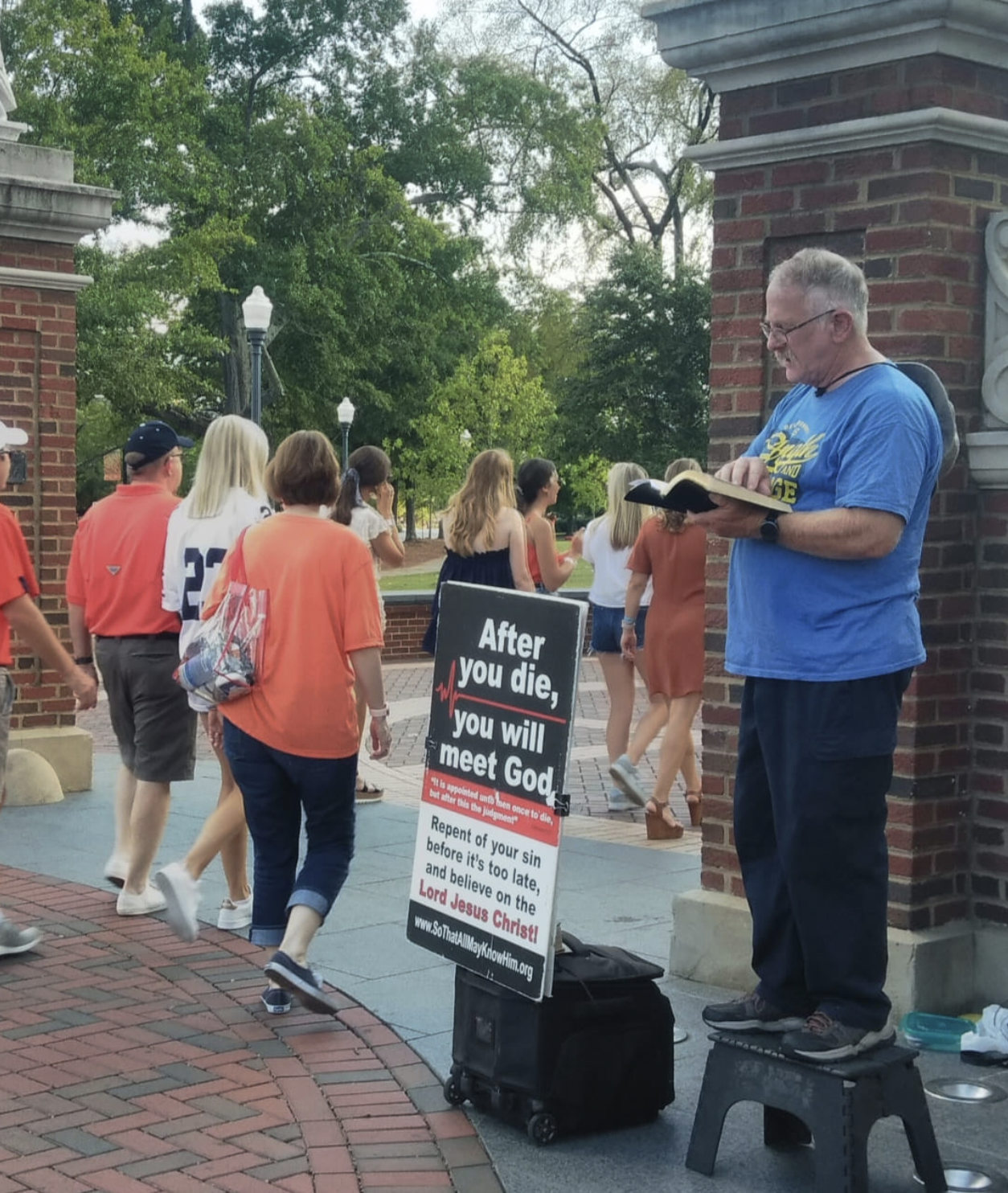
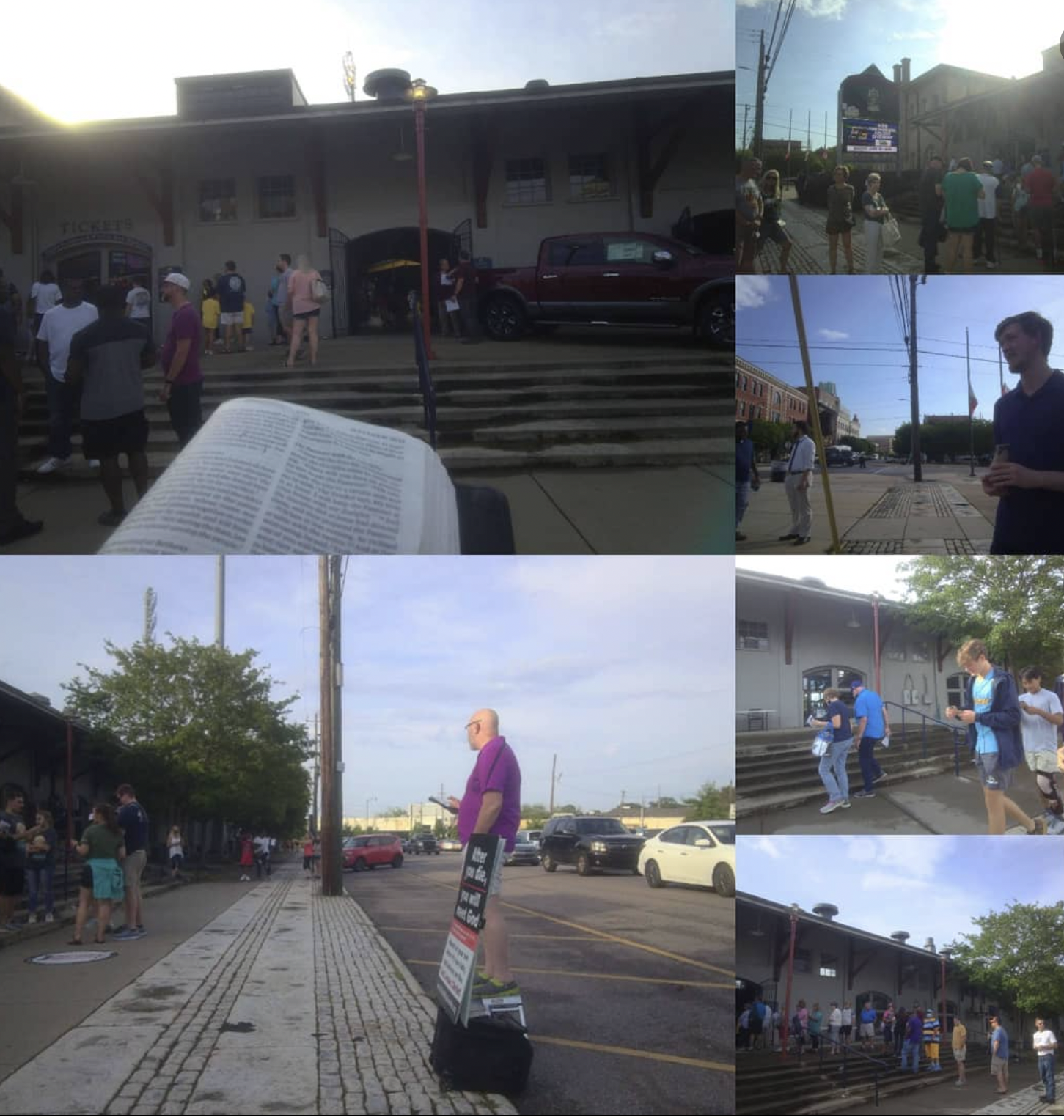
SFOI 1000 Evangelist David Day and brothers from the First Presbyterian Church of Montgomery, AL preached at the Family Biscuit League games on the 12th and 13th June and were unfortunately accosted by a heckler who said they should be preaching in a church, not a ball game. 

Despite this David reported great opportunities over the weekend. See the video of the heckling below.

Daily Devotional 6-11-21

Daily Devotional 6-11-21

The Origin

There is no light in the planet but that which proceeds from the sun; and there is no true love for Jesus in the heart but that which comes from the Lord Jesus Himself. From this overflowing fountain of the infinite love of God, all our love to God must spring.

This truth is foundational, that we love Him for no other reason than because He first loved us. Our love for Him is the result of His love for us. When studying the works of God, anyone may respond with cold admiration, but the warmth of love can only be kindled in the heart by God’s Spirit.

What a wonder that any of us, knowing what we’re like, should ever have been brought to love Jesus at all! How marvelous that when we had rebelled against Him, He should, by a display of such amazing love, seek to draw us back. We would never have had a grain of love toward God unless it had been sown in us by the sweet seed of His love for us.

Love, then, has for its parent the love of God shed abroad in the heart: But after it is divinely born, it must be divinely nourished. It is not like a plant, which will flourish naturally in human soil—it must be watered from above. Love for Jesus is a flower of a delicate nature, and if it received no nourishment but that which could be drawn from the rock of our hearts, it would soon wither. As love comes from heaven, so it must feed on heavenly bread. It cannot exist in the wilderness unless it be fed by manna from on high. Love must feed on love. The very soul and life of our love for God is His love for us.

I love Thee, Lord, but with no love of mine,

For I have none to give;

I love Thee, Lord; but all the love is Thine,

For by Thy love I live.

I am as nothing, and rejoice to be

Emptied, and lost, and swallowed up in Thee.

From: https://www.truthforlife.org/resources/daily-devotionals/latest/?gclid=CjwKCAjwnK36BRBVEiwAsMT8WCR8UteIwaWlAyP4o9ZIuAWio8l7qmAM1nDcB3pFiYr-jOUNkgMsShoC68IQAvD_BwE

Daily Devotional 6-10-21

Daily Devotional 6-10-21

The Gospel of a Fulfilled Law

One of the distinctive features of Matthew’s Gospel is that it gives us the fullest record of Jesus’s most famous sermon, i.e., the Sermon on the Mount (Matthew 5-7). Snippets of this discourse appear in the Gospels of Mark and Luke, too, but only in brief form. Matthew, however, gives us the fullest treatment of the sermon, covering three chapters and totaling over one hundred verses. Throughout the sermon, Jesus reveals what life in the kingdom of heaven looks like. We are likely familiar with much of it, from the timeless beauty of the beatitudes, to the emphasis on loving your neighbor, to the exquisite language of the Lord’s prayer, to the parable of the two men building houses, one upon the rock and the other upon the sand. Indeed, the greater part of Jesus’s sermon comprises the bulk of the church’s central tenets and beliefs. The Sermon on the Mount is, in a way, the vernacular of the church itself.

However, this does not mean that there is universal agreement on how to read and interpret this sermon. In fact, there are nearly half a dozen opinions on the best way to understand the Lord’s assertions. (1) Martin Luther asserts that the discord surrounding the Sermon on the Mount is the devil’s masterstroke versus the gospel of the kingdom. He writes: “The infernal Satan has not found a single text in the Scriptures which he has more shamefully perverted, and made more error and false doctrine out of, than just this one which was by Christ himself ordered and appointed to neutralize false doctrine. This we may call a masterpiece of the devil . . . For, as long as the devil lives and the world abides, he will not cease to attack this chapter.” (2)

The moral and ethical tenor of the Lord’s words lends itself toward an overly formulaic perspective, as though Christ’s sermon was meant to clue everyone in on how to “make it.” “If heaven is what you seek, here’s what’s required,” Jesus seems to say; “you have to be meek and righteous and merciful and peaceable and ‘pure in heart.’” There is a tendency, I think, to see these words as how men and women can attain perfection (as if that were a human possibility). “Just follow these 10 steps.” “Just implement these 12 things.” This, I’d say, has beclouded the legacy of this sermon in a mire of conditional language in which we are determined to achieve entry into the heavenly domain, as if that is all that Christ said and all that he intended. Luther would refer to this as a “nasty and maggoty” interpretation of the words of Christ, (3) a conclusion with which I am in wholehearted agreement.

To understand the Sermon on the Mount, one must keep in mind its essential premise. At its core, this sermon amounts to an extended commentary on the Ten Commandments. You know: worship God; don’t curse; don’t skip church; don’t disobey your parents; don’t kill; don’t steal; don’t lie, and don’t be jealous or promiscuous (Ex 20:1–17). Perhaps you can recite these commandments from memory, hearkening back to your days in Sunday School. Perhaps, too, you were told something to the effect that every good little boy and girl does their best to keep these commandments. But, as is evinced by Christ himself, the stakes are much higher than merely “good vs. bad.” Rather, what’s in the balance is a matter of eternal life or eternal death.

After Jesus’s opening description of those who are most “blessed” in his Father’s kingdom (Matt 5:3–11), he embarks upon his examination of the law. This he does by suppressing the apparent misconceptions regarding the design of his ministry and message. “Don’t think,” Jesus says, “that I came to abolish the Law or the Prophets. I did not come to abolish but to fulfill” (Matt 5:17). The public ministry of the Lord Jesus was still in its beginning stages and already misleading reports about what he was saying and doing were circulating throughout the regions of Judea, Samaria, Galilee, and beyond (Matt 4:25). Rumors were swirling about a “Man from Nazareth” who was going around healing the blind, raising the crippled, and liberating the oppressed.

Word on the street, though, was that this Galilean preacher was nothing but a troublemaker, one to be avoided at all costs. His talk of the kingdom did not mesh with his seemingly irreverent lifestyle. Jesus’s prevailing consideration of the immanence of the “kingdom of heaven” (Matt 4:17) did not seem to harmonize with his penchant for fraternizing with sinners, dining with lowlifes, and his audacious acceptance of a publican as a member of his entourage. From a certain point of view, Jesus’s body of work up to that point constituted an altogether different kingdom than what was being propagated by the religious bureaucracy of the day.

This, of course, was the predominant opinion of the Pharisees, that supremely devout group of Mosaic lawyers who had developed into the eminent authorities on all religious matters. We have a tendency, I think, to vilify and even demonize the Pharisees, as though they were some heretical group of biblical apostates. This simply is not the case. G. Campbell Morgan refers to them as “the Puritans of [the] Maccabean period in Jewish history.” (4) They rose to prominence during the four centuries of prophetic silence known as the “intertestamental period,” i.e., the historical divide between the Old and the New Testaments. Following in the footsteps of the prophetic scribe Ezra, the Pharisees took up the charge to uphold the precepts of Israel’s religious heritage during an age in which Israel herself was all but snuffed out. “The order of the Pharisees,” Morgan continues, “was an order of men who stood for purity in religion in an hour when Hebraism was threatened by contamination by Greek influence, which would have cut the nerve of the religion of Jehovah.” (5)

Despite what the Pharisees believed and advertised, Jesus was not intent upon deconstructing the fundamental tenets of the Old Testament law. Actually, he proceeds to do just the opposite.

As those who had found it their duty to maintain scrupulous reverence for Jehovah alone, Christ’s message certainly struck threatening tones in the ears of the Pharisees. In the Pharisaical mind, Jesus of Nazareth was nothing but an “anti-Moses” preacher, circumventing and countervailing the stipulations of religion with his stubborn emphasis on love, mercy, and forgiveness. But, as the Lord himself says, such a claim could not be further from the truth (Matt 5:17). “You’re utterly mistaken,” Jesus says. “I haven’t arrived to nullify the law or the prophets, but to bring it all to completion.” Despite what the Pharisees believed and advertised, Jesus was not intent upon deconstructing the fundamental tenets of the Old Testament law. Actually, he proceeds to do just the opposite.

Jesus definitively upholds all of the law’s demands. “For truly I tell you, until heaven and earth pass away, not the smallest letter or one stroke of a letter will pass away from the law until all things are accomplished” (Matt 5:18). His “truly,” or the King James’s “verily,” is indicative of the force with which these words ought to be taken. It was his truest, surest affirmation that the smallest letter of the law, even down to the tiniest stroke, must be maintained. “No part of the law,” comments John Broadus, “not the most insignificant letter, was to be set aside . . . ‘Not the dot of an i or the cross of a t.’” (6) All of the law’s demands were cogent for all who lived and wished to live eternally. Indeed, as Jesus continues, to diminish the law’s demands by a single degree was damning. “Therefore,” Jesus proclaims, “whoever breaks one of the least of these commands and teaches others to do the same will be called least in the kingdom of heaven. But whoever does and teaches these commands will be called great in the kingdom of heaven.” (Matt 5:19)

Mankind is not at liberty to “break” even the least of the law’s injunctions. The real force of the Lord’s declaration, though, hinges upon that word “break,” which might be better translated as “undo,” “loosen,” or “dissolve.” Whoever, then, loosens the demand of even the least of the law’s directives — and instructs others in the same course — is worthy of judgment, worthy of being reprimanded as “the least in the kingdom of heaven.” Jesus affirms that his teaching was not meant, in any way, to dissolve what God’s holy law required. Indeed, rather, his errand was akin to the Pharisees’ resolve in conforming lives to the will of the Heavenly Father.

By now, though, Christ has likely successfully rebuffed the notion that he was “anti-law.” Up to this point, his sermon has not sounded like what the gossip had said. No talk of free forgiveness or disenfranchising the established religious order of the day. Instead, his rhetoric is virtuous. Those in the crowd would have likely been nodding in agreement as he spoke. Jesus’s assertions, while uncomfortably rigid, were not unfamiliar. In fact, the Pharisees might have even been caught applauding and “Amen-ing” a few times. Such is when Jesus decides to take it one step further: “For I tell you, unless your righteousness surpasses that of the scribes and Pharisees, you will never get into the kingdom of heaven” (Matt 5:20).

I imagine Jesus pausing for dramatic effect after this verse. A low murmur, perhaps, spreads through the multitude. “Did he just say what I think he said?” the apostles asked puzzlingly. “Hold up, buster!” the Pharisees clapped back. This statement, no doubt, cast a pall on the entire crowd. Forlorn, confused, and defeated looks fell upon their faces. Jesus’s words were devastating. If the righteousness of the religious aristocracy wasn’t enough, then the messy religion of the commoner wasn’t making it either. What hope did the shepherds, fishermen, and handmaids have if the Pharisees weren’t making the cut? But Jesus was just getting started.

Mankind is not at liberty to “break” even the least of the law’s injunctions.

From there, Jesus proceeds to stress every point of the law, clarifying what it actually means to be righteous. The mere fact that you have not killed your brother is not the standard; it’s not being angry with them (Matt 5:21-22). Just because you haven’t actually laid in the bed with someone who was not your spouse doesn’t mean you are pure. The standard for purity is lust in your heart (Matt 5:27-28). Neither should you stop at loving your neighbor. The law requires that you love your enemies, too (Matt 5:43-44). In fact, to sum it all up, you have to be perfect. “Be perfect, therefore, as your heavenly Father is perfect” (Matt 5:48). That is the standard.

If the multitude wasn’t demoralized before, they certainly are now. Jesus has proceeded to decimate the accepted criterion by which men and women were deemed “righteous.” The law by which men lived, and that which the Pharisees propagated, was inflexibly stringent, demanding a holiness that is unflinching, unceasing, and unbroken. No deviation from its stipulations was allowed. This, to be sure, was a harsh word of the Lord. Its coarse intransigence went down like vinegar. But such, I think, was Jesus’s point. His aim was to show that life according to the “letter of the law” isn’t just difficult, it is impossible. The letter always kills (2 Cor 3:6).

Jesus’s sermon, therefore, not only reinforces but also intensifies the law’s benchmark for righteousness. There is no pass for “effort” given; there are no participation ribbons. The measure is perfection (Matt 5:48; cf. Lev 19:2). The righteousness of the kingdom of heaven is not graded on a curve. The Messiah is not the “straight-A-student” who makes up for your pitiful failure to allow the instructor to readjust everyone’s grade according to a new rubric. It is a gross degradation of the work of God’s Son to assume that its consequence is a lowered standard. That is decidedly not the gospel of the kingdom of God.

Christ’s heavy-handed words are the point of his sermon. His objective was to raise the bar for what constituted “righteous living” in order to bring everyone to the recognition of the sheer impossibility of such an endeavor. The Sermon on the Mount was a discourse which “salted” the law by which men deemed they could make themselves holy and just and right with the God of heaven. Christ dismisses such a notion as categorically untenable.

The climax of Jesus’s discourse (Matt 7:12–27), then, leaves everyone with only two options: (1) to carry on assuming that the righteousness of the kingdom of heaven is within your ability to fulfill; or (2) to relinquish any such aspiration in the knowledge that the righteousness of the kingdom of heaven has already been fulfilled. Indeed, those are the only two options that have ever existed. Either you believe in yourself and your own competence to successfully bring about this righteousness which secures your entry into the kingdom, or you believe that it is impossible and you are never getting in, barring some unforeseen miracle.

I am reminded, again, of Martin Luther. Many are likely familiar with his infamous publishing of the ninety-five theses in 1517, by which he intended to dialogue with the church leaders at Wittenberg on the merits of the selling of indulgences. But, perhaps, more theologically resonant are the twenty-eight theses he published one year later in 1518. These statements are now known as Luther’s “Heidelberg Disputation,” in which he expanded on his original concerns and delved further into what it meant to fulfill the righteousness of the law.

“It is certain that man must utterly despair of his own ability before he is prepared to receive the grace of Christ,” Luther concluded. “He is not righteous who does much, but he who, without work, believes much in Christ. For the righteousness of God is not acquired by means of acts frequently repeated, but it is imparted by faith, for ‘He who through faith is righteous shall live’ (Rom 1:17), and ‘Man believes with his heart and so is justified’ (Rom 10:10). Therefore I wish to have the words ‘without work’ understood in the following manner: Not that the righteous person does nothing, but that his works do not make him righteous, rather that his righteousness creates works . . . In other words, works contribute nothing to justification.

Either you believe in yourself and your own competence to successfully bring about this righteousness which secures your entry into the kingdom, or you believe that it is impossible and you are never getting in, barring some unforeseen miracle.

The law says, ‘do this,’ and it is never done. Grace says, ‘believe in this,’ and everything is already done . . . For through faith Christ is in us, indeed, one with us. Christ is just and has fulfilled all the commands of God, wherefore we also fulfill everything through him since he was made ours through faith.” (7)

Luther’s conclusion is both profound and problematic. I say “problematic” because it rubs against our self-righteous predisposition. We cannot do squat with a law that requires absolute perfection, and we know it. Our self-saving brains determine, therefore, to lessen and redefine the demands of the law in order to make its stipulations bearable and doable. But to that, Christ and Luther would say the same thing. “You want to be clued into how to live the ‘perfect life’? You want the ‘secret to righteousness’? Okay, give up. Surrender. Admit you can’t do it. Declare spiritual bankruptcy. Because that’s the only way.”

I’d say this is what makes the gospel so offensive. We are so resistant to the idea that our works are powerless to effect salvation. We are self-saviors by birth. Indeed, that’s how the Pharisees operated. The law’s demand for righteousness was achievable so long as one measured up and checked all the boxes. For them, grace was nothing more than a heavenly plaster that filled in the gaps of their own righteousness.

But such reasoning amounts to nothing but an utter denial of grace itself. Jesus is not a heavenly mason who has been sent to apply the divine plaster of grace on our already righteous lives. Jesus is heaven’s incendiary who comes to demolish the accepted conventions by which we pretend we are righteous. When confronted with this standard of perfection, you and I are utterly impotent. Every single one of us, from the pious Pharisee to the staggering drunk, stand condemned, facing a yawning eternity of ruin.

That is, again, barring some unforeseen miracle. Enter: the gospel.

The good news of the kingdom which Christ proclaimed was the miracle of a fulfilled law, a completed righteousness, which was held out to the world on the basis of faith. “I did not come to abolish,” our Lord says, “but to fulfill.” (Matt 5:17) This was Jesus’s mission. “What we cannot do,” Alexander Maclaren says, “Christ has done for us, and does in us.” (8) The purpose of his coming, of his appearing at all in this sin-ridden realm, was to accomplish that which we never could have accomplished (the righteousness of the law) by likewise bearing the brunt of what we rightly should have borne (the rigors of the cross). Jesus’s ministry of fulfillment culminates at Calvary, where he cries, “It is finished.” And so it was that as Christ’s blood mixed with the mud beneath Golgotha’s cross, all righteousness was fulfilled. (Matt 1:22; 3:15; 4:17; 5:17)

Free from the law, oh, happy condition!

Jesus hath bled and there is remission;

Cursed by the law and bruised by the fall,

Grace hath redeemed us once for all. 

From: https://www.1517.org/articles/the-gospel-of-a-fulfilled-law

Daily Devotional 6-9-21

Daily Devotional 6-9-21

Identity Matters

Personal identity is the subject of much robust discussion today. Is our identity defined by what we feel about our color or gender or something else? There are white people who say they ‘feel’ black. And I recently heard of someone who didn’t ‘feel’ their legs were theirs.

The capacity for choice is one of the most exciting and yet most frightening things about our humanity. For with the power to choose there is the moral responsibility to choose well. If we were robots, we could say our decisions were the outcome of the way we were programmed. If we were animals, we could say our decisions were shaped by our genetic code. But we are neither robots nor animals: we are human beings, and the matter of choice is in our hands.

When we think about it, our decisions are dependent upon assumptions we have made about life. And these assumptions include the spiritual values we might have.

Come with me to a parable that opens up a very big picture about life. It is found only in the Gospel of St Mark: Jesus also said, “The kingdom of God is as if someone would scatter seed on the ground, and would sleep and rise night and day, and the seed would sprout and grow, he does not know how. The earth produces of itself, first the stalk, then the head, then the full grain in the head. But when the grain is ripe, at once he goes in with his sickle, because the harvest has come” (Mark 4:26-29).

This fascinating parable focuses on the reality of God and the supernatural activity of his kingdom – the sowing of seed and the harvest. To understand the parable, we need to read it in the context of Jesus’ ministry. In Mark 1:15 he proclaims: “The time is fulfilled, and the kingdom of God has come near; repent and believe in the good news.”

With Jesus’ coming God’s kingdom or rule is now present in a new and vital way. God’s king or ruler has come in person. His mission, spoken of in the parable as seedtime and harvest, brings the supernatural realm into human affairs. But, just as a seed remains hidden, so is the seed of God’s kingdom hidden.

The parable helps us begin to understand God’s greater purposes and his way of working. The evidence of his existence is around us in the nature of the universe, but the proofs of this and his supernatural rule in Jesus Christ remain hidden. Yet, in the same way that Jesus’ predictions concerning his arrest and trial, crucifixion and resurrection were fulfilled, we can be sure that the prediction of his return and bringing in the harvest of his people will also be revealed.

Paul the Apostle in writing to God’s people in Colossae tells us that with the coming of Jesus Christ the new age of God’s kingdom dawned. This new age co-exists with the old which the New Testament refers to as the world. For the present a door is open, allowing people to pass from the old age to the new. In Colossians 1:13 Paul writes of God’s hidden supernatural work: God has rescued us from the dominion of darkness and has transferred us into the kingdom of the Son he loves…

In turning to Jesus as the Lord, our whole relationship with God changes. Paul speaks of everyone who turns to Christ as dying with him (Colossians 2:20). And in Colossians 3:1, he says: So if you have been raised with Christ…

While physically we are still in the old world, God’s people now move in the sphere of resurrection life. We should let the light of this sphere of eternity fall on all we think and feel, say and do. ‘Live,’ Paul is saying, ‘as though you belong, not on the earth, but in heaven.’

This means sitting at the feet of the enthroned Jesus Christ and letting our minds and hearts be instructed by his word – not least on matters such as our identity, gender and relationships.

It’s understandable that we hear the voices of those around us asking us ‘how we feel’. But Paul urges everyone of us who has this new life in the Lord Jesus to see ourselves and our identity, the challenges and troubles of life, through the lens of the glory of our life to come.

Paul develops this: For you have died, and your life is hidden with Christ in God… (Coloss 3:3). For the present others only see our physical bodies. The reality of our new and eternal life is hidden. However, what is now hidden will one day be disclosed. Everyone will see the harvest of which Jesus speaks in his parable. So Paul writes: When Christ who is our life appears, then you also will appear with him in glory (Coloss 3:4).

In today’s world the idea of Christ bursting through the skies in a blazing display of power and glory, seems pure science fiction. But the Bible leaves us in no doubt. From cover to cover it tells us that the world is going somewhere, and that the final outcome will be the return of God’s king.

In recent times there has been a revival of interest in 16th Century England, and especially the reigns of Henry VIII and Elizabeth I. Writing on Thomas Cranmer’s response to the news of Anne Boleyn’s execution (May 19, 1536) on false charges, Diarmaid MacCulloch records Cranmer’s words to a close friend: ‘She who has been the Queen of England on earth will today become a Queen of heaven’ (Diarmaid MacCulloch, Thomas Cranmer, 1996, p.159).

In Revelation 21 we read the words of St John: Then I saw a new heaven and a new earth; for the first heaven and the first earth had passed away, and the sea was no more. And I saw the holy city, the new Jerusalem, coming down out of heaven from God, prepared as a bride adorned for her husband. And I heard a loud voice from the throne saying, “See, the home of God is among mortals. He will dwell with them as their God; they will be his peoples, and God himself will be with them; he will wipe every tear from their eyes. Death will be no more; mourning and crying and pain will be no more, for the first things have passed away” (21:1-4).

© John G. Mason

A prayer. Lord God, the strength of all who put their trust in you: mercifully accept our prayers, and because through the weakness of our mortal nature we can do nothing good without you, grant us the help of your grace, so that in keeping your commandments we may please you both in word and deed; through Jesus Christ our Lord. Amen.

From: https://anglicanconnection.com/identity-matters/

Fishermen’s Call: Walleye Weekend Mission

Would you be willing to give some of your God-given time to make an impact for eternity on those in Fond du Lac? 

Although the past year has brought some of the larger ministry events to a halt, the great news is many of them are back!

Fishermen’s Call will be on mission at this year’s Fond du Lac’s Walleye Weekend. Walleye Weekend is a free, three-day festival featuring sporting events, national musical acts, fishing tournaments, attractions for all ages in conjunction with the Mercury Marine National Walleye Tournament. Walleye Weekend attracts over 100,000 visitors throughout the weekend festival. This effort will be evangelistic. We will be there to engage in the public proclamation of the Gospel of the Lord Jesus Christ. 

This is a prime opportunity for us to obey our Lord’s command to seek and save the lost. All you need to bring is a passion for Christ and a heart for the lost. Tracts and materials are provided by Fishermen’s Call. Admission is free. The hours of Walleye Weekend follows: Friday, June 11, 3:00 p.m. – 10:30 p.m.; Saturday, June 12, 8:00 a.m. – 10:30 p.m. Any time you can commit is greatly appreciated.

Please email heath@fishermenscall.com if you are interested in assisting OR call Duane at (920) 948-5594. Those who confirm their participation will receive more information on the schedule of Fishermen’s Call’s activities for the weekend.

If for any reason you cannot commit, please pray for us and for those whom the Father is drawing. Thank you. We look forward to laboring with you in preparing the way for the Lord.

Heath Pucel

Fishermen’s Call

Daily Devotional 6-8-21

Daily Devotional 6-8-21

Defining God’s Will

“It is the will of God.” How easily these words fall from the lips or flow from the pen. How difficult it is to penetrate exactly what they mean. Few concepts in theology generate more confusion than the will of God.

One problem we face is rooted in the multifaceted way in which the term will functions in biblical expressions. The Bible uses the expression “the will of God” in various ways. We encounter two different Greek words in the New Testament (boule and thelema), both of which are capable of several nuances. They encompass such ideas as the counsel of God, the plan of God, the decrees of God, the disposition or attitude of God, as well as other nuances.

Augustine once remarked, “In some sense, God wills everything that happens.” The immediate question raised by this comment is, In what sense? How does God “will” the presence of evil and suffering? Is He the immediate cause of evil? Does He do evil? God forbid. Yet evil is a part of His creation. If He is sovereign over the whole of His creation, we must face the conundrum: How is evil related to the divine will?

Questions like this one make distinctions necessary—sometimes fine distinctions, even technical distinctions—with respect to the will of God.

Coram Deo

What is your response to the questions raised in this reading: How does God “will” the presence of evil and suffering? Is He the immediate cause of evil? Does He do evil?

Passages for Further Study

Psalm 40:8

Psalm 143:10

Matthew 6:10

From: https://www.ligonier.org/learn/devotionals/defining-gods-will/

Daily Devotional 6-7-21

Restoring Our Relationship

Unregenerate man is consistently described as being in a state of alienation and enmity. This is the condition that makes reconciliation necessary. Reconciliation is necessary only when a state of estrangement exists between two or more parties. Estrangement is the natural fallen state of our relationship to God.

How are we enemies of God? Jonathan Edwards provides an insightful summary of the problem. He lists several points of tension between God and man:

1. By nature, we have a low esteem of God. We count Him unworthy of our love or fear.

2. We prefer to keep a distance from God. We have no natural inclination to seek His presence in prayer.

3. Our wills are opposed to the law of God. We are not loyal subjects of His sovereign rule.

4. We are enemies against God in our affections. Our souls have a seed of malice against God. We are quick to blaspheme and to rage against Him.

5. We are enemies in practice. We walk in a way that is contrary to Him.

Coram Deo

Examine your spiritual condition in light of Edwards’s five points of tension between God and man.

Passages for Further Study

Ephesians 2:12

Ephesians 2:14-16

Romans 5:10

From: https://www.ligonier.org/learn/devotionals/restoring-our-relationship/

MLB Weekly Report

MLB Outreach May-June 2021

During May and June we have had two evangelists out preaching the Gospel for the MLB Outreach, both on behalf of SFOI and their own ministries. 

MLB Outreach – Cincinnati Red’s Games

David Doerman and brothers have been preaching at Red’s games in Cincinnati In an effort to bring glory to God. The Cincinnati Red’s draw over 12,000 fans at every home game. Lord willing, we will proclaim the gospel at about 40 of the 81 home games.

Evangelize Cincinnati preaches at Red’s games to:

Proclaim the Gospel  – We share the law and the gospel of Jesus Christ with Red’s fans as they arrive at Great American Ballpark. We warn them about sin and point them to the Savior.

Offer the Good Person Test  – We offer the  Good Person Test  which points people to the gospel of Jesus Christ. Once people understand that they have broken the Ten Commandments, we share the gospel.

Distribute Gospel Tracts  – We share  million dollar bill  gospel tracts with fans entering the game and fans congregating in the open bar area.

Then we pray for fruit. Join us in praying that God would grant Red’s fans the gift of repentance. 2 Timothy 2:25-26.

Take a look at their video from May 2021.

MLB Outreach Biscuits Games Montgomery, AL

David Day and brothers have been preaching for the Minor League Baseball games in Montgomery, AL. In early June David Day reported: One of the objections to Open-Air Preaching is how “Yelling” turns people off to the Gospel, isn’t effective, nice, or just not how evangelism should be done.

Last night outside the Riverwalk Stadium and every time we are there, there is this guy who often comes up as we are preaching. He walks up, raises his voice over ours, and begins yelling at all the people. The people respond by stopping whatever they are doing and then follow him inside. See, he works for the stadium, and he is yelling at them so they would all hear that they can come inside, he’s telling them what they want to hear. You get that? “IT IS WHAT THEY WANT TO HEAR.”

So, it’s not necessarily the yelling, lifting up your voice above the crowd, it is the message that is offensive to some, but to some, to those being saved, the message of the cross is the sweetest song they would ever hear.
Go lift up your voice and unapologetically tell of our King.

For the preaching of the cross is to them that perish foolishness; but unto us which are saved it is the power of God.
1 Corinthians 1:18

Design a site like this with WordPress.com
Get started