Daily Devotional 6-30-21

Daily Devotional 6-30-21

Thorn in the Flesh

What on earth does God promise us? Health, wealth, success?

Confusion often arises amongst God’s people, as well as in the wider community, because many of us think we have a right to expect to be healed and blessed with material riches and success. And there are preachers who reinforce this idea.

Paul the Apostle experienced an affliction that in 2 Corinthians 12:7 he speaks of as a thorn in the flesh.

To understand why Paul writes about this, we need to consider how some of the Corinthians regarded him. His Letters reveal that some treated him as weak because he lacked oratorical skills and spiritual experiences. And he had a recurring sickness. ‘How can a man like that be an apostle?’ they asked. ‘Spirituality means presence, power, mystique.’

Paul faced a dilemma. How could he puncture their self-opinionated spiritual disdain? It’s evident that he was uncomfortable in making a response: he didn’t want to boast. But he saw he had no option. In chapter 11 we see that his boasting or self-promotion has an unexpected focus. His response identifies principles that begin to answer our question: ‘What on earth does God promise us?’

Paul’s boast. In 2 Corinthians 11:23 – 28 he writes about the various challenges and afflictions he experienced. He doesn’t refer to the number of churches he has started, or the number of books and articles he has written. Rather, he sets out the persecutions and dangers he faced. He also speaks of the sense of responsibility that daily pressed on him.

In verse 30 he concludes: If I must boast, I will boast of the things that show my weakness. The God and Father of the Lord Jesus, he who is blessed for ever, knows that I do not lie….

Paul turns upside down the glamorous image of Christian spirituality the Corinthians were being fed by teachers who insisted that spiritual leaders were superheroes. True Christian leaders experience hardship. They have a sense of their own unworthiness and inadequacy.

An autobiographical note. That said, in chapter 12 Paul touches on an experience he once had. He writes: I know a man in Christ who fourteen years ago was caught up to the third heaven — whether in the body or out of the body I do not know, God knows…. and he heard things that cannot be told, which man may not utter. On behalf of this man I will boast, but on my own behalf I will not boast, except of my weaknesses (12: 2, 4, 5).

This very special, personal and private experience happened only once. And that Paul does not elaborate is very important. He wanted his reputation to be based only on what others could observe of his character, his life, and his teaching.

A thorn in the flesh. Paul continues: And to keep me from being too elated by the abundance of revelations, a thorn was given me in the flesh, a messenger of Satan, to harass me, to keep me from being too elated. Three times I besought the Lord about this, that it should leave me;… (12:7-9a).

Much ink has been spilled in discussing the nature of Paul’s thorn in the flesh. Was it depression, an eye issue, or something else? Certainly it wasn’t insignificant. Three times I besought the Lord, he said.

But consider the Lord’s response: “My grace is sufficient for you, for my power is made perfect in weakness” (12:9). God used the thorn to prevent any conceit in Paul. His ministry wouldn’t suffer. Rather it would become more effective, not because people saw Paul as some impressive, super-spiritual leader, but because the grace of God could be seen at work in him.

From our human perspective true spirituality looks ordinary and weak. The Son of God looks weak and ordinary when he lies in a manger and hangs on the cross. Paul’s testimony contrasts with that of Christian leaders who surround themselves with an aura of spiritual power and mystery. Sadly, a number of them have fallen into disgrace.

Paul’s testimony brings us back to the question: ‘What on earth does God promise us?’ He shows us that the prayers of the greatest saints are sometimes not answered in the way they desire. Prayer is not a wish to be granted unconditionally. God, who is our Father is not going to give us something he knows is not good for us, no matter how much we press him. Even Jesus prayed, ‘Take this cup from me’ and received the answer, ‘No!’

True Christian spirituality acknowledges and accepts weakness. Indeed, it is only when we recognize and confess our weakness that we find the supernatural grace of God flowing to meet our need. In speaking like this I am not wanting to make light of the harsh realities of sickness and suffering, of loss and grief. Nor am I wanting to gloss over the tough questions posed by the Bible’s teaching that God is all-powerful, good and loving.

Yet, only in humiliation do we find God exalting us. Only in dying to self do we find God making us alive. Only in throwing our lives away do we find God giving life back to us. Only when I am weak, am I strong.

When we are pressed by some thorn in the flesh in our own lives, let’s never forget God’s words to Paul the Apostle: “My grace is sufficient for you, for my power is made perfect in weakness”.

A prayer. Lord our God, fountain of all wisdom, you know our necessities before we ask and our ignorance in asking: have compassion on our infirmities; and those things which for our unworthiness we dare not and for our blindness we cannot ask, graciously give us for the worthiness of your Son, Jesus Christ our Lord. Amen.
From: https://anglicanconnection.com/thorn-in-the-flesh/

Daily Devotional 6-29-21

Daily Devotional 6-29-21

Renewing the Mind

It is possible to have knowledge without having wisdom. It is not possible, however, to have wisdom without knowledge. Knowledge is a necessary precondition for wisdom. The practice of godliness demands that we know and understand what godliness requires.

The Christian life is a transformed life. The transformation of life comes about, as the apostle Paul declares, through the renewal of the mind. An understanding of the Word of God renews the mind. The Word of God expresses the mind of God to us.

Our minds are to be conformed to the mind of Christ. That conformity does not automatically or instantly occur with conversion. Our conversion by the power of the Holy Spirit is not the end of our learning process but the beginning. At conversion we enroll in the school of Christ. There is no graduation this side of heaven. It is a pilgrimage of lifelong education.

The pursuit of wisdom is the pursuit of the knowledge of God. In one sense, Socrates was right in his insistence that right conduct is right knowledge. This is not in the sense that correct knowledge guarantees right behavior, but in the sense that knowledge, when it grows to wisdom, leads into right behavior. Thus, philosophers can become philotheos, “lovers of God.”

Coram Deo

Renew your mind today by immersing it in God’s Word.

Passages for Further Study

2 Thessalonians 2:1–2

1 Corinthians 2:16

2 Corinthians 10:4–5

From: https://www.ligonier.org/learn/devotionals/renewing-mind/

Daily Devotional 6-28-21

Daily Devotional 6-29-21

Walking in Wisdom

In the New Testament, the word disciple literally means “a learner.” The Christian is called to be enrolled in the school of Christ. Careful study of the Bible is necessary for true discipleship.

Jesus said to His own students: “If you abide in My word, you are My disciples indeed. And you shall know the truth and the truth shall make you free” (John 8:31–32). Our Lord calls for a continued application of the mind to His Word. A disciple does not dabble in learning. He makes the pursuit of an understanding of God’s Word a chief business of his life.

The wisdom literature of the Old Testament distinguishes between knowledge and wisdom, just as the New Testament distinguishes between knowledge and love. Knowledge without love merely puffs up with pride. Yet the love that edifies is not a love without contentment. Likewise, the Old Testament makes it clear that one can have knowledge without wisdom.

Since we can have knowledge without love and/or knowledge without wisdom, we tend to downplay the importance of knowledge. The wisdom literature of the Old Testament never views the difference between knowledge and wisdom as a difference between the bad and the good. Rather, the distinction is one between the good and the better. It is good to attain knowledge; it is better to achieve wisdom.

Coram Deo

Is after the pursuit of an understanding of God’s Word the chief aim of your life?

Passages for Further Study

Proverbs 1:20–22

From: https://www.ligonier.org/learn/devotionals/walking-wisdom/

Daily Devotional 6-25-21

Daily Devotional 6-25-21

Climbing a Mountain

Our knowledge of Christ is somewhat like climbing one of the mountains in Wales. When you are at the base you see only a little: the mountain itself appears to be only half as high as it really is. Confined in a little valley, you discover scarcely anything but the rippling brooks as they descend into the stream at the foot of the mountain. Climb the first rising knoll, and the valley lengthens and widens beneath your feet. Go higher, and you see the country for four or five miles around, and you are delighted with the widening prospect. Higher still, and the scene enlarges; until at last, when you are on the summit and look east, west, north, and south, you see almost all of England lying before you. There is a forest in some distant county, perhaps two hundred miles away, and here the sea, and there a shining river and the smoking chimneys of a manufacturing town, or the masts of the ships in a busy port. All these things please and delight you, and you say, “I could not have imagined that so much could be seen at this elevation.”

Now, the Christian life is of the same order. When we first believe in Christ, we see only a little of Him. The higher we climb, the more we discover of His beauty. But who has ever gained the summit? Who has known all the heights and depths of the love of Christ that passes knowledge? When Paul had grown old and was sitting gray-haired and shivering in a dungeon in Rome, he was able to say with greater emphasis than we can, “I know whom I have believed,”1 for each experience had been like the climbing of a hill, each trial had been like ascending another summit, and his death seemed like gaining the top of the mountain, from which he could see the whole panorama of the faithfulness and love of Him to whom he had committed his soul. Get up, dear friend, into a high mountain.

1) 2 Timothy 1:12

From: https://www.truthforlife.org/resources/daily-devotionals/latest/?gclid=CjwKCAjwnK36BRBVEiwAsMT8WCR8UteIwaWlAyP4o9ZIuAWio8l7qmAM1nDcB3pFiYr-jOUNkgMsShoC68IQAvD_BwE

Daily Devotional 6-24-21

Daily Devotional 6-24-21

The Psalms as the Prayerbook of Jesus and the Church

This is an excerpt from “The Christ Key: Unlocking the Centrality of Christ in the Old Testament” by Chad Bird (1517 Publishing, 2021).

Like so many of David’s prayers, Psalm 41 concerns the trauma that arises from the attacks of enemies, especially verbal attacks. His haters whisper about him; they daydream of the worst befalling him.

As if such hatred were not bad enough, he continues, “Even my close friend in whom I trusted, who ate my bread, has lifted his heel against me” (41:9). The phrase “close friend” is literally “man of my shalom”—that is, a person with whom I was at peace. This “friend,” however, turned foe.

What was happening in David’s life that inspired this psalm, we don’t know. Perhaps it reflects the events surrounding Absalom’s coup and Ahithophel’s betrayal. What we do know, however, is that the Spirit inspired it as a description of what was happening in the final days of Christ’s earthly life.

On the night he celebrated the Passover with his disciples, having washed their feet, Jesus then said, “I am not speaking of all of you; I know whom I have chosen. But the Scripture will be fulfilled, ‘He who ate my bread has lifted his heel against me.’ I am telling you this now, before it takes place, that when it does take place you may believe that I am he” (John 13:18–19). The “Scripture” being fulfilled is, of course, Psalm 41. And the one who has eating Christ’s bread is Judas.

It’s easy to see how the rest of Psalm 41 is descriptive of the ministry of Jesus, especially considering the malicious lies and verbal attacks he had to endure from his adversaries.

There is, however, one verse that might be troubling to some readers. How could Christ be the speaker of this verse, “As for me, I said, ‘O Lord, be gracious to me; heal me, for I have sinned against you!’” (41:4)? How could the Messiah say he is sick because of sin and his iniquities hang over his head (38:3–4)? Very similar language occurs in Psalm 41. Why would the Messiah pray for grace? How could he say to his Father, “I have sinned against you” (41:4)?

Could it be that Jesus sinned? That he broke some command of his Father? No, because the Scriptures are clear that Jesus, our high priest, was temped as we are, yet was “without sin” (Heb. 4:15). Could it be that this verse (Ps. 41:4) doesn’t really belong on the lips of the speaker in the rest of the psalm? No, because that makes no textual sense. The “I” of Psalm 41 is the same speaker throughout the prayer.

If, therefore, Christ has no sin but prays “I have sinned against you,” how are we to solve the seeming contradiction?

The Scriptures have prepared us for the answer in a variety of ways.

For one, the worship of Israel involved numerous kinds of sacrifices in which animals, free of blemish, were offered by those who had been made unclean by sin or death. It doesn’t matter what theory one uses to explain the connection between the worshiper and the animal, we wind up in the same place: the unblemished animal is offered by the blemished human with the result that the sinner is made clean or forgiven. The “sinless” victim in some way takes the impurity upon itself. This is the only way to make sense of John the Baptist’s words, “Behold, the Lamb of God, who takes away the sin of the world” (John 1:29). John’s listeners would have understood this because they were accustomed to thinking of sacrificial lambs “taking away” sins in some way.

In Psalm 41, and in other psalms like it (e.g., Psalm 38), the Messiah is speaking as one who is free of blemish, without sin, yet also as the sacrificial victim who will take upon himself the sin of the world. “He had done no violence, and there was no deceit in his mouth,” Isaiah says, yet he was “like a lamb that is led to the slaughter,” for “he was pierced for our transgressions; he was crushed for our iniquities; upon him was the chastisement that brought us peace, and with his wounds we are healed” (Isa. 53:9, 7, 5).

In short, what happened at Israel’s altar teaches us how to pray Israel’s psalms.

The vocation of the high priest also instructs us on how to interpret psalms in which the Messiah confesses sins. On the vestments of the high priest were two different representations of the tribes of Israel. First, on the shoulder straps were two onyx stones, each of which had six names of the tribes of Israel (Exod. 28:9). When the high priest wore the ephod, he bore “their names before the Lord on his two shoulders for remembrance” (28:12). Second, on the breastpiece— a square pouch that held the Urim and Thummim—were four rows of precious stones, with three stones per row. These dozen stones represented the twelve tribes (28:21).

All these stones together—the two onyx and the dozen others—were an emblematic proclamation that the priest was the representative embodiment of the tribes. All Israel melted into Aaron when he stood before God. This one man was the nation. He was a sinner himself, to be sure, but because he was also the singular symbol of the nation before God, he also bore the sins of the nation before the Lord, even sins that he himself had not personally committed.

We see this ritually enacted on the Day of Atonement, when the high priest was to lay his hands on the head of the goat and to “confess over it all the iniquities of the people of Israel, and all their transgressions, all their sins” (Lev. 16:21). The priest confessed not only his own sins but the sins of others, “all the iniquities of the people of Israel.”

When Christ came as our great and final high priest, he too was the nation. Indeed, he was all humanity reduced to one man. Though he had no sins of his own to confess, he confessed all the iniquities, all the transgressions, all the sins of every individual, everywhere, for all time, on the great and climactic Day of Atonement known as Good Friday. What he does in the psalms, when he prays, “I have sinned against you” (41:4), is pray as our high priest.

Because Jesus is the sacrifice for our sins as well as our high priest—and because “in Christ God was reconciling the world to himself, not counting their trespasses against them” (2 Cor. 5:19)— therefore, Paul can write that “for our sake [God] made [Christ] to be sin who knew no sin, so that in him we might become the righteousness of God” (5:21).

As the sin-bearer, Jesus was also the sin-confessor in the psalms.

Discussing such psalms, Martin Luther writes, “In these psalms the Holy Spirit is speaking in the Person of Christ and testifying in clear words that he has sinned or has sins. These testimonies of the psalms are not the words of an innocent one; they are the words of the suffering of Christ, who undertook to bear the person of all sinners and therefore was made guilty of the sins of the entire world” (Lectures on Galatians, AE 26:279).

Dietrich Bonhoeffer explains it similarly:

However, the question could arise as to how one is to think about the fact that Christ also prays these Psalms with us. How can the sinless one ask for forgiveness? In no way other than he can, as the sinless one, bear the sins of the world and be made sin for us (2 Corinthians 5:21). Not for the sake of his sins, but for the sake of our sins, which he has taken upon himself and for which he suffers, does Jesus pray for the forgiveness of sins. He positions himself entirely for us. He wants to be a man before God as we are. So he prays also the most human of all prayers with us and thereby demonstrates precisely that he is the true Son of God (Psalms, 51).

Jesus is not only the one who prays Psalms 1– 5 but also the praying sinner of Psalm 6. Our discussion of Psalm 41 should have adequately explained what I meant. Indeed, this perspective swings wide open the door into the Psalms.

Years ago, I remember thinking, “Sure, I can picture Jesus praying Psalms 1 and 3 and lots of others that are usually regarded as non-messianic. But Psalms 6 or 51 or even 119? In these, the poet confesses iniquities or admits he’s strayed from God. So, no, that just won’t do.” I guess that I assumed Jesus would sit quietly in the synagogue when those psalms were being sung!

Now I see things differently. Now I know that whatever psalm was on the lips of others was also on the lips of Jesus.

Yes, in fact, the psalm was his psalm more than anyone else’s.

This is an excerpt from “The Christ Key: Unlocking the Centrality of Christ in the Old Testament” by Chad Bird (1517 Publishing, 2021), pgs. 170-173.

From: https://www.1517.org/articles/the-psalms-as-the-prayerbook-of-jesus-and-the-church

My Adventure in Open Air Preaching

My Adventure in Open Air Preaching

by Pastor Brad D. Evans

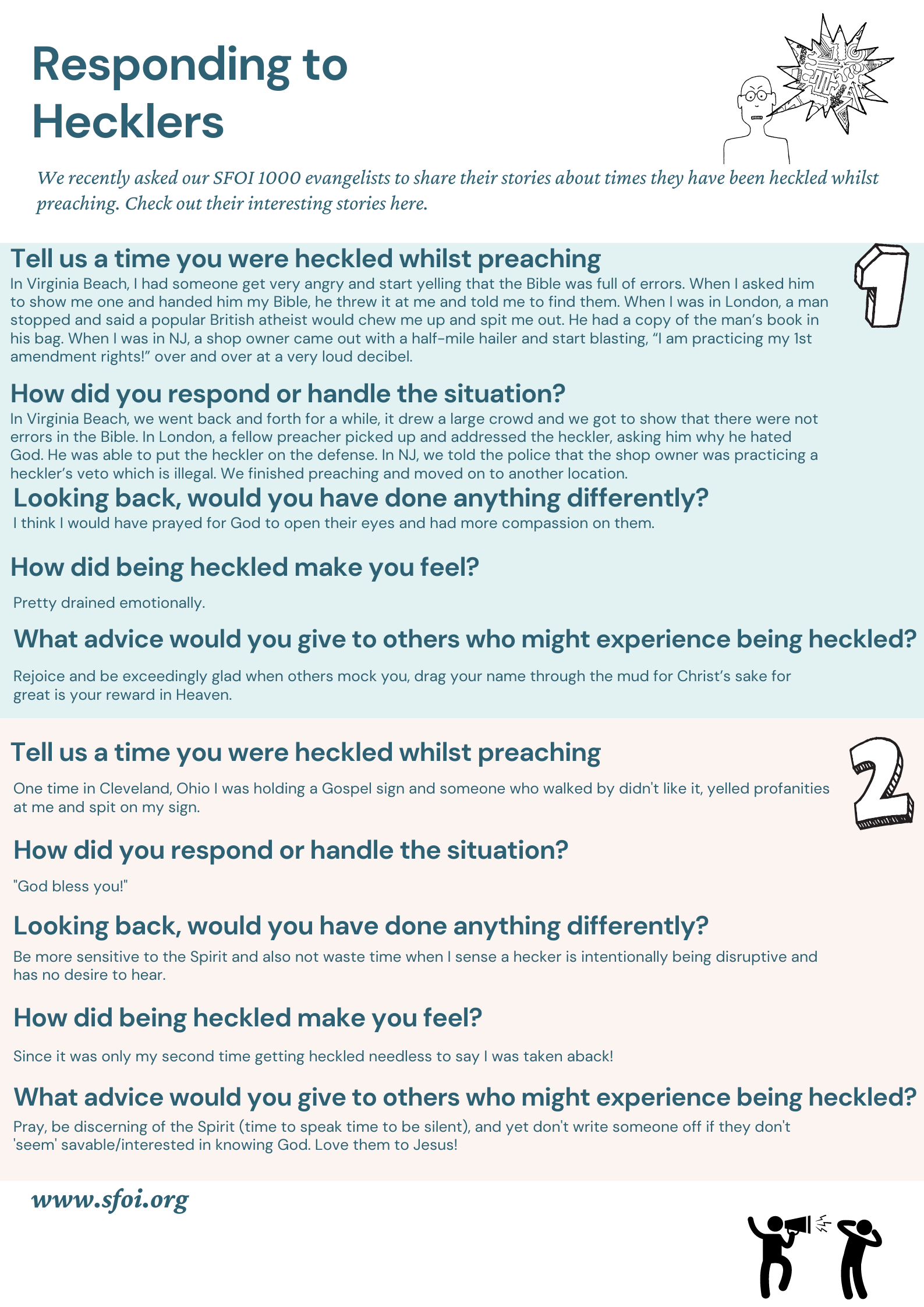
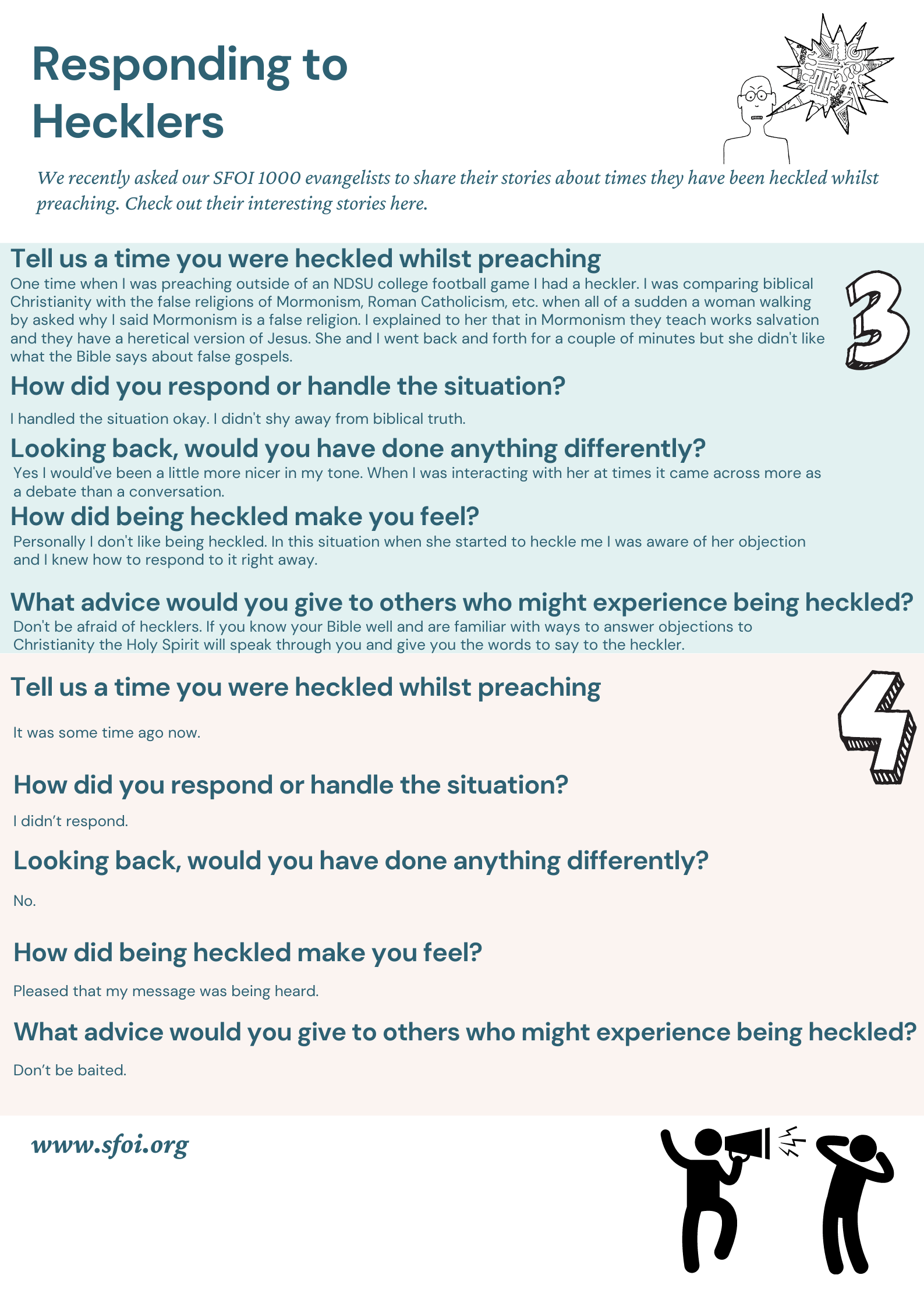
Memorial Day 2018. I stood in Union Square, New York City, attached to a personal voice amplification system. I was nervous. I opened my Bible and stepped forward, lifted my voice and began to proclaim the gospel of Jesus Christ. Strangers passed by. Some stopped to listen. A few hecklers showed up. A few even drew closer to seek out a personal conversation about the message.

Why would a conservative, Presbyterian pastor do such a crazy thing? Humanly, you can blame it on my friend Al Baker, veteran church planter and street preacher, and on his friend, Bill Adams. They had invited me to come to New York that weekend to instruct a group of young men in the basics of preaching. We stayed at a mission school and every morning Al and I would lecture on preaching. Our audience was a group of about a dozen young men who had travelled at their own expense from places such as Georgia, Ohio and Oklahoma. Their eagerness to preach and sacrifice in order to learn was both humbling and encouraging.

Then, after the lectures and a time of prayer, we would hop on the subway and head to Union Square where we would take turns giving open air messages and being available to anyone who wanted to discuss what we were preaching.

By that time of my life, I had spent close to forty years preaching God’s Word each Lord’s Day both morning and evening to my congregation in Connecticut. I had engaged in personal and door to door evangelism many times in my life. But rarely had I ever gone out into the streets and preached the gospel in sermonic form. This was new to me. It was a bit frightening. It was also something I would do again in a heartbeat.

The theological and biblical logic of open air preaching is simple. We believe that God has appointed the preaching of the Word as a means of grace, as a primary instrument for working His salvation in human hearts. It is perfectly fitting to set preaching at the center of a Christian worship service. But why would we limit preaching to that setting? It fitting to learn from the preachers in the book of Acts and take our preaching to the streets. We should take the gospel within earshot of lost, needy sinners.

Combined with my long experience of regular preaching, here is a handful of counsel about open air preaching that I would encourage you brothers to try sometime.

First, know what you want to say. Have a text and an outline as you would for any sermon. Drive your point home clearly. Use repetition. Remember, people are hurrying past. If you ramble, those passersby will not get your point.

Second, feature brevity and boldness. Don’t assume you will have people listening to you even for as long as 15 minutes. So, get to the point, and come back to your point several times. Use short sentences in the active voice. Avoid cumbersome passive constructions. Mix vivid descriptions of the truth with punchy imperatives that call the listeners to faith and repentance.

Third, focus on the Lord Jesus Christ. Bill Adams, a veteran street preacher and director of Sports Fan International Outreach, would typically begin his street sermons by saying, “We are out here today to lift up the Name of Jesus Christ.” Exactly. Remember that Jesus said that when He is lifted up he will draw all men to Himself. This lifting up included both His work on the cross and preaching about His work on the cross.

Fourth, don’t try to go it alone for street preaching. You need a preaching partner for several reasons. You need someone else present for prayer and moral support. You need a partner to engage with those who might have questions while you preach. You also need a partner to help ward off inevitable hecklers. The Apostles always did mission as a team. We should heed their example. Finally, Preach! Get out there, lift up your voice and proclaim the Word of God. Don’t try to share a “fireside chat” in a public forum. Rather: “Go up to a high mountain, O Zion herald of good news; lift up your voice with strength, O Jerusalem herald of good news; lift it up, fear not; say to the cities of Judah, ‘Behold your God.’” Isaiah 40.9

Daily Devotional 6-23-21

Daily Devotional 6-23-21

Hopeless or Hopeful?

Helpless. Over the last seventeen months millions have watched helplessly as loved ones have died from Covid-19. For many there has been no comfort or hope.

In recent times our culture has made a habit of setting aside the wisdom of the past, and especially the wisdom of the Bible. But, as we touched on last week, when we are facing catastrophe and are confronted with the realities of the human experience, the words of the Bible come through with immense power and wisdom, truth and compassion. For here there is comfort for the broken-hearted and hope for the bereaved.

In the Book of Job, chapter 19 we read Job’s words: ‘I know that my redeemer lives, and at the last he will stand upon the earth. And after my skin has been thus destroyed, yet in my flesh I shall see God, whom I shall see for myself, and my eyes shall behold, and not another’ (19:25ff).

And through the words and works of Jesus Christ we see the evidence of God’s life-giving power, providing a sure hope of life beyond the grave.

A dying girl. In chapter 5 of his record, St Mark tells of a 12-year-old girl who was dying. Her father, Jairus, a synagogue ruler had ignored the usual Jewish religious leadership opposition to Jesus and begged him for help. And, while Jesus agreed to go with Jairus, he hadn’t hurried. In fact, when he realized that a woman had been cured by touching his clothing, Jesus had stopped to speak with her. We can imagine Jairus’ further sense of helplessness.

It’s worth pausing to consider Jesus’ lack of urgency here. Often we’re anxious because we think God doesn’t understand the urgency of our need. It’s helpful to realize that Jesus knows our situation.

Don’t fear, only believe. During the delay a messenger brought Jairus the news that his daughter had died. Overhearing a comment to Jairus: “Why trouble the teacher any further?” Jesus’ reassuring response is remarkable: “Do not fear, only believe” (5:35f).

Jesus’ words underline a theme we have already observed: With his coming, fear can give way to faith, not just any faith, or faith in faith, but faith in him. It was a test of Jairus’ faith. The delay not only heightened the drama of the miracle, but shows us that we can trust God to be working out his good purposes for us at all times, even in tough times when he seems to be doing nothing.

So far in Mark’s narrative there is very little evidence of this kind of faith. Yet it is something he wants to press on us, his readers, as he moves on to the climax of this event.

God’s compassion. By noting that Jesus took with him into the house, Peter and John and James (the three who would later witness his transfiguration), Mark affirms their credibility as witnesses to Jesus. Furthermore, by describing the scene at Jairus’ house where people were weeping and wailing loudly, Mark heightens the drama of the scene (5:38).

With Jesus’ words, “Why are you making a commotion and weeping? The child is not dead but sleeping”, the crowds laughed (5:39). They knew the girl was dead, otherwise they would not have been there, and they certainly didn’t believe that Jesus could do anything for her now. But in saying that the girl was sleeping, a word that could signify either physical sleep or death, Jesus indicated the situation was not as hopeless as they thought. Are there not times when we are downcast because we don’t expect God to do the unexpected?

Taking the girl’s parents and the three disciples with him to her bedside, he took the girl’s hand and without any fuss or incantation, said, “Talitha cumi” which means, “Little girl, I say to you, arise” (5:41).

In touching the dead girl Jesus had technically become impure and ritually unclean. Yet he had not hesitated to do this for her sake.

New life. At his words, immediately the girl got up and began walking… (5:42). Understandably the parents were amazed (8:56) at this extraordinary act of Jesus. Directing that they should give her something to eat (5:43), Jesus not only showed his understanding of the girl’s need, he wanted everyone to know she was not an apparition. She was truly alive. No one but God could raise the dead.

There is no other word to describe what Jesus had: power. Power over death itself; power to turn a day of mourning into a day of joy.

New hope. An event such as this awakens us to where hope is to be found. According to the Bible we are all helpless. We try to hide this or simply ignore it, but the reality is that we are not in charge of our destiny. Our world is subject to titanic forces far beyond our control. Consider the power of fires, floods and earthquakes; consider the evil in the world and the atrocities that are perpetrated for the sake of human power; consider the power of a pandemic and the harsh reality of death.

CS Lewis spoke of suffering as God’s megaphone. It can awaken us to the realities of our helplessness and therefore our need for God. Sometimes it is only when face the realities of life and death that we come to our senses and turn to Jesus.

Whatever our cry is, Mark wants us to know that our cry will be heard. We can also point people we know who have lost loved ones through Covid or for some other reason, to the God of all hope. In Christ Jesus alone, helplessness can be changed into hopefulness.

A prayer. Heavenly Father, keep your people continually in a true faith in you; so that those who lean only on the hope of your heavenly grace may always be defended by your mighty power; through Jesus Christ our Lord. Amen.

From: https://anglicanconnection.com/hopeless-or-hopeful/

Daily Devotional 6-22-21

Daily Devotional 6-22-21

Discipling and Disciplining

There is a strange dichotomy in the language of the contemporary church. Much is said and written about the important function of discipling new Christians, while at the same time the function of church discipline has almost vanished. Today, discipline is a word used to refer to the instruction and nurture of the believer. It does not usually carry the connotation of ecclesiastical censure or punishment.

In one sense, this modern version of discipling is linked to the New Testament model. The term disciple in the New Testament means “learner.” The disciples of Jesus were students who enrolled in Jesus’ peripatetic rabbinic school. They addressed Him as “Rabbi” or “Teacher.” To follow Jesus involved literally walking around behind Him as He instructed them (the word peripatetic comes from the Greek word peripateo, which means “to walk”).

The New Testament community was forbearing and patient with its members, embracing a love that covered a multitude of sins. But in the New Testament, church discipleship also involved discipline. Part of apostolic nurture was seen in rebuke and admonition. The church had various levels or degrees of such discipline, ranging from the mild rebuke to the ultimate step of excommunication.

Coram Deo

Do you accept discipline as well as discipling from your local church body? Ask God to make you more receptive to His discipline.

Passages for Further Study

2 Timothy 4:2

Proverbs 9:8

Revelation 3:19

From: https://www.ligonier.org/learn/devotionals/discipling-and-disciplining/

Daily Devotional 6-21-21

Daily Devotional 6-21-21

Being Clothed in His Righteousness

The church is our mother, but it is Christ’s bride. In this role, we are the objects of Christ’s affection. We, corporately, are His beloved. Stained and wrinkled, in ourselves we are anything but holy. When we say that the church is holy or refer to her as “holy mother church,” we do so with the knowledge that her holiness is not intrinsic but derived and dependent upon the One who sanctifies her and covers her with the cloak of His righteousness.

As the sensitive husband shelters his wife and in a chivalrous manner lends her his coat when she is chilled, so we are clad from on high by a husband who stops at nothing to defend, protect, and care for His betrothed. His is the ultimate chivalry, a chivalry that no upheaval of earthly custom can eradicate or make passé. This chivalry is not dead because it cannot die.

The bride of Christ is soiled but will one day be presented spotless to the Father by the Son who bought her, who loves her, and who intercedes for her every day. If we love Christ, we must also love His bride. If we love Christ, we must love His church.

Coram Deo

Ask God to rekindle your love for members of the body of Christ, the true church.

Passages for Further Study

Revelation 3:5

Psalm 111:3

2 Peter 3:14

From: https://www.ligonier.org/learn/devotionals/being-clothed-his-righteousness/

Design a site like this with WordPress.com
Get started