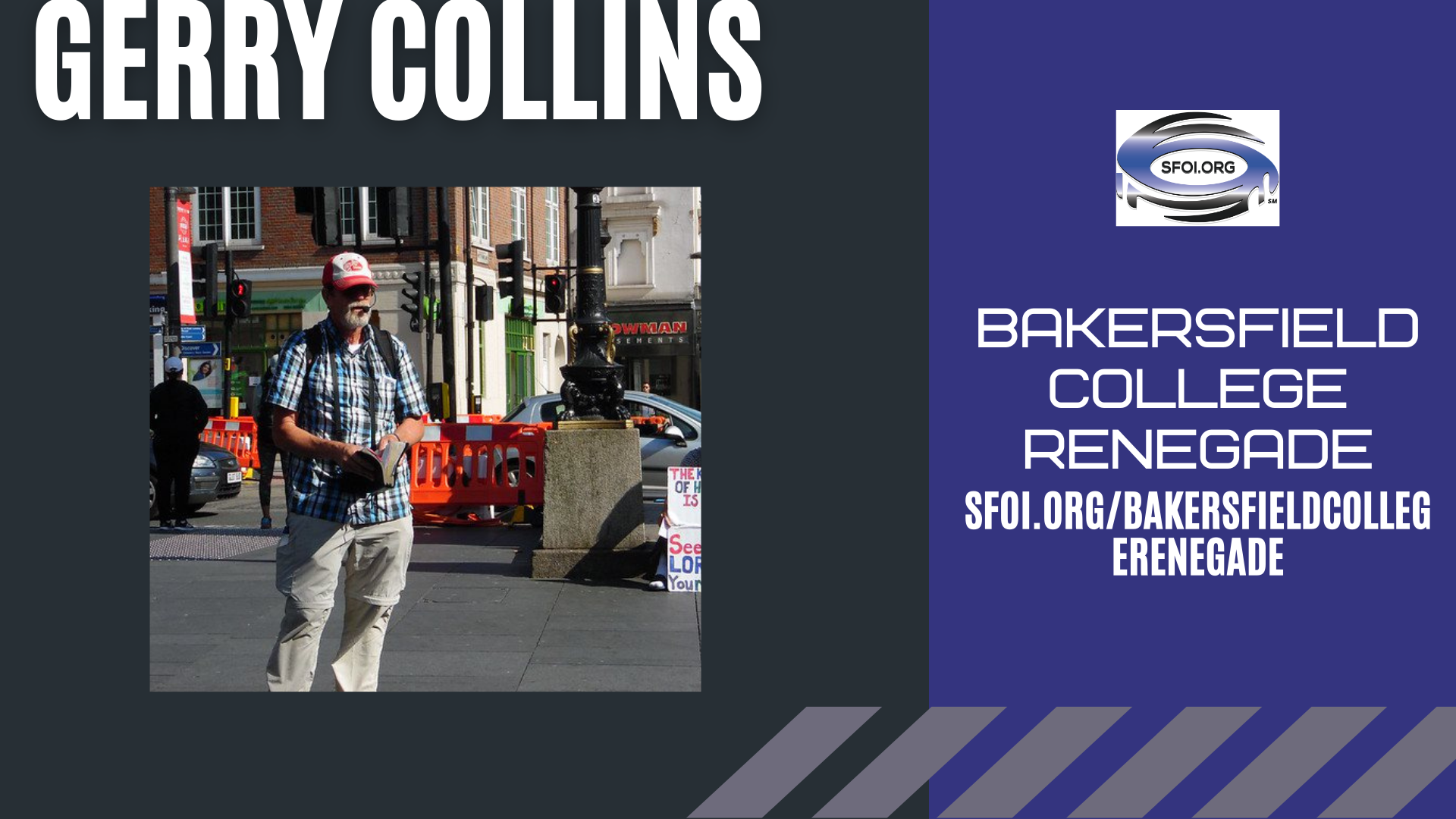
10/16 – Gerry Collins – Bakersfield College Renegade #SFOI1000

Game Summary

image of open air preaching

We had a good outreach at the Bakersfield College football game this last week. I had invited 2 others from my church to join me last week with one showing up. We had myself, Rick and Amy Garland and Anton Labrentz. We were able to pass out about 440 tracts and a few conversations. We also were questioned for the first time by the workers at the game as to what we were doing there. But no objection to our being there. Anton was glad to be there and Lord willing were joining us in the future.

God Bless,

Gerry Collins

https://www.sfoi.org/BakersfieldCollegeRenegade

10/16 – Ken White – University of South Carolina #SFOI1000

Game Summary

image of open air preaching

MANY SOULS HEARD THE GOSPEL OF JESUS CHRIST PROCLAIMED AT THE USC FOOTBALL GAME TODAY!

I apologize for only one picture (that does not reflect the big crowd of fans that were out today), and no pictures or video of the nine diligent laborers sowing the seed of the Gospel of Jesus Christ!

I do believe that the LORD was greatly pleased and Glorified through his precious and faithful servants from Covenant Baptist Church out there today! Thank you for your prayers!

“TO THE PRAISE OF HIS GLORY!”

https://www.sfoi.org/UniversityofSC

10/16 – Brackston Combs – Illinois State University #SFOI1000

Game Summary

This is Saturdays game at ISU’s football stadium. It was the 100th homecoming for their school so there was a parade and a ton of tailgaters. Usually there is about half or more of that amount of attendees at these games. The guys laying down while Joshua Payne is preaching is quite drunk; mind you it is about 1pm! At any rate, I preached on Mark 8:34-38, read some Scripture (Matt. 5-7 & Romans 1-2) and quoted Doug Wilson: “The more like Jesus you are, the more like yourself you are going to be. The less like Jesus you are, the more monotonous and predictable it’s going to be. Sin is monotonous. Godliness is not.”

It was an excellent outreach. Jacob Nelson came and preached as well as Joshua. https://www.sfoi.org/Illinois-State-University

Daily Devotional 9-16-21

Daily Devotional 9-16-21

The Gospel According to Norm

I was sitting in my hotel room recently when I realized I missed an old podcast interview with Norm Macdonald. This simply could not stand. For the longest time I’ve been a huge fan of Norm, devouring his stand up, talk show appearances, and most other things one can gorge on YouTube. So, knowing I had a few hours to kill, I eagerly listened to the show. In some ways, Norm is exactly what you might expect. He’s funny, sharp, and filled with great old stories about his days at Saturday Night Live. But in some ways, he (like so many other stand-up comics) is not what you might expect. He is philosophical, theological, and unsettled. Specifically, he’s unsettled about suffering and death. Unlike many of us, who distract ourselves enough to ignore the inevitable always coming our way, Norm hasn’t always been able to do that. He told Marc Maron once:

“I can’t stop myself from constantly ruminating over death.”

As a result, Norm’s been looking for solutions. He has looked for answers from the great Russian novelists Dostoevsky and Tolstoy. He has had periods of time that he’s looked for hope in the church (sometimes referring to himself as a Christian), while other times, he has sought solace from Judaism (sometimes saying he’s probably most comfortable in that faith). In the context of the interview I was listening to, he began discussing this persistent quest for truth when he said something that rocked me:

“I have a Rabbi who I talk to a lot… he’s a real scholar. My pastor doesn’t know anything-I mean anything…. he’s just a pleasant guy. If you ask him a direct question, he’ll go: ‘What? Didn’t you hear my sermon?'”

And this is the part that got me:

“But his sermon’s always like ‘How to be a nice fella’ or some nonsense.”

Immediately, I stopped the recording and rewound it to listen more closely… Yes, he said what I thought he said:

“But his sermon’s always like ‘How to be a nice fella’ or some nonsense.“

Now, before I go off here on a tangent, let me acknowledge a few things. First of all, I have no idea who this pastor is. Second, I have no idea what denomination the pastor is from (though from other discussions I’ve heard, he appears to be broadly evangelical?). I have no idea about anything other than this is somebody Norm Macdonald knows who happens to be a pastor. So, I don’t want to rashly indict the whole of God’s church based on this one impression from Norm. However…

(Tangent Time) 
I wasn’t terribly surprised that this had been his experience with whatever church he was attending. Based on my times witnessing and talking to people all over New York City, I’ve shared here before, that I have met very few people that actually associate Christianity with what it really is. The vast majority of the time, Christianity is associated with political positions, and well, as Norm says it, telling someone “how to be a nice fella.” Norm’s smart enough to know that “Being a nice fella” does not do a thing to fight off his fear of death. Sadly, it is not the amazing proclamation that “our Savior Christ Jesus has abolished death and brought life and immortality to light through the gospel” (2 Tim. 1:10) but the milquetoast mush of a thousand self-help books that Macdonald and so many others have heard emphasized. The distinctly Christian good news that Christ has died and risen in your place for the forgiveness of all your sins (Romans 5:1-11) has foolishly been swapped out in favor of “Jesus, Life Coach.” The proclamation heard is not St. Paul confidently taunting our greatest enemy with the words, “O death where is your sting? O death where is your victory?” but the snore inducing, “Be a better you.” It all reminds me of the oft used quote from William Willimon describing modern Evangelicalism’s preaching:
 “Unable to preach Christ and Him crucified, we preach humanity, and it improved.”

I can’t blame Norm for calling this message what it is: “Nonsense.”
 Thankfully, that’s not the whole story. In fact, I have reason to be encouraged that some preacher somewhere is declaring to him what Christianity is really all about. If I had to wager a guess, it might be his good friend, legendary country singer/songwriter Billy Joe Shaver, who is an unapologetic man of the cross.

For example, listen to this little nugget he shares in another interview:
 “Some people believe that man is divine, like kind of a hippie idea. I can’t believe that because I know my own heart, and I know that’s not true. Other people believe that we’re wretched like the cynics or the atheists would believe we’re all just wretched nothingness, just animals, just creatures. I can’t believe that. It doesn’t make any sense, that we’re just beasts. I will say that Christianity has this interesting compromise where we’re both divine and wretched, and there’s this Middle Man that’s the Savior, that through Him we can become divine, but we’re born wretched. I kind of like that one, because it sort of makes sense.”

Just like in the previous interview, I had to rewind to make sure I was hearing all this right. Yeah, that’s actually what he said. In this short statement, Norm notes the fallenness of his own heart (that he’s a wretch), while at the same time acknowledging that there’s something about us that is connected to the divine (what we might refer to as the Imago Dei, the fact that we’re created in the image of God). And notice what Norm says everyone needs in his equation to be made right with the Divine again: A “Middle Man the Savior” aka, Jesus Christ. Yes, at its most basic, that’s the message the world around us who are all facing suffering and death need to hear declared with thunderous confidence. That though you are wretched, through Jesus Christ, God has provided a Mediator who has won eternal life for you and for the entire world. My hope is that Norm is trusting in this message for his victory over death. As was mentioned earlier, it’s not always clear where Norm’s at, but he’s dropped hints…

Over on Twitter, scattered every once in a while between seemingly endless tweets about golf, gambling or comedy, sometimes he’ll fire off something a little more substantive. A little while back, he tweeted out this simple message on Reformation Day:

“Scripture. Faith. Grace. Christ, Glory of God. Smart men say nothing is a miracle. I say everything is.”

Yes, Norm Macdonald was listing out the Five Solas of the Reformation and declaring it all to be miraculous.

To that, I can only say, “Amen.”

From: https://www.1517.org/articles/the-gospel-according-to-norm

Daily Devotional 9-15-21

Daily Devotional 9-15-21

Unexpected Power…

With the geo-political upheavals the world is experiencing many fear what the future holds. The uncertainty today is exacerbated by the angry divisions within societies. Vindictiveness has replaced respectful and serious conversation. And we can feel utterly powerless when it comes to talking about our faith.

In Perelandra, the second in CS Lewis’ science-fiction trilogy, Ransom, the main character, feels powerless in confronting an evil force at work on the untainted planet Venus. The crafty subtle evil power reflects the temptations in Genesis 3. Despite being a learned scholar in philology, Ransom constantly finds himself defeated in his arguments. What could he do?

This raises an important question for us, for today people have no knowledge of the Jesus of the Gospels. So subtle and persistent has been the attack on Christianity they are not looking to the Christian faith for answers. It is time to review our approach?.

Come with me to a parable Jesus told – the parable of the sower. It begins in Luke chapter 8, verse 4. When a great crowd gathered and people from town after town came to him, he said in a parable: ‘A sower went out to sow his seed; and as he sowed, some fell on the path and was trampled on, and the birds of the air ate it up. Some fell on the rock; and as it grew up, it withered for lack of moisture. Some fell among thorns, and the thorns grew with it and choked it. Some fell into good soil, and when it grew, it produced a hundredfold.’ As he said this, he called out, ‘Let anyone with ears to hear listen!’… ‘Now the parable is this,’ Jesus explained: ‘The seed is the word of God.’

Expectations. People travelled from near and far to see Jesus. Expectations were rising. It would have been a great time for him to call people to join him in a march on Jerusalem to set Israel free from Rome. But that was not God’s way.

We need to focus on the key to the parable: “…The seed is the word of God” (verse 11).

Causes and revolutions are staged by various means. Last century Marxists brought in Communism at the end of a gun. This century began, as we were reminded on 9/11, with Islamist extremists trying to de-stabilise and destroy through terrorism. In Jesus’ day zealots tried to revive Jewish independence through guerrilla warfare.

But these are not Jesus’ methods. The picture he paints is of a farmer quietly sowing seed. The Word of God he is saying, has within its DNA the capacity to change people’s lives for good. At first the transformation is hidden but there comes a day when the change is obvious.

Churches today have often lost confidence in the power of God’s Word to change lives. So, many churches focus on the sacraments, and others on social justice. But to make these things the priority is to lose sight of the way God works. God’s Word is the key that unlocks the door into God’s kingdom and therefore to life.

In Second Timothy chapter 3, verses 16 and 17 we read: All scripture is inspired by God and profitable for teaching, for reproof, for correction, and for training in righteousness, that the people of God may be complete, equipped for every good work.

As the Word of God, the Scriptures give us exclusive information about salvation. They don’t contain exhaustive truth, but what they give us is sufficient for our rescue and furthermore, for living as God’s people.

In the larger context of Second Timothy, Paul reminds us that we live in a world that prefers to find or invent its own religion. He tells us that our only real hope for life and meaning is to turn to God’s unique self-revelation. Human resources won’t provide deep and satisfying answers. Our sure hope is in dependence on the resources of the living God.

To return to the parable in Luke chapter 8, Jesus warns us that the results of sowing the seed of God’s Word aren’t uniform. Some of the crop grows well, some poorly, some hardly at all. The results are not so much caused by bad sowing but rather because of some failure in the ground. We could call this parable the parable of the four soils.

One group, having heard God’s Word have hardened hearts through the silent, crafty work of the power of evil. A second group receive God’s Word with joy, but in times of testing fall away. They had liked the preacher but there had been no true repentance, no real change in their lives. A third group have also heard God’s Word, but they have not counted the cost of commitment. They were not convicted of their sin and their need to turn to Christ in repentance. They had come as customers to buy, not as disciples to surrender.

But then Jesus speaks of a fourth group. They are true followers of Christ who hold fast to God’s Word with an honest and good heart, and bear fruit with patient endurance. Perseverance in godly living is the sign of God’s grace at work. A real lesson here is the encouragement we can experience in the ministry of disciple-making and outreach.

Jesus’ references to birds, stones, and thorns could easily demoralise us. But he is saying, ‘Don’t be put off. Be realistic, yes. But the ministry of God’s Word will always have its successes, and what success that will be!’ So, let’s be encouraged. Let’s not forget Jesus’ words: “I will build my church, and nothing will prevail against it” (Matthew 16:18).

And most of all, remember the key to ministry is letting God’s Word do its work.

A prayer. Blessed Lord, you have caused all holy scriptures to be written for our learning, grant us so to hear them, read, mark, learn and inwardly digest them, that, encouraged and supported by your holy Word, we may embrace and always hold fast the joyful hope of everlasting life, which you have given us in our Savior Jesus Christ.

Amen.

From: https://anglicanconnection.com/unexpected-power/

Daily Devotional 9-14-21

Daily Devotional 9-14-21

What is the Kingdom of God?

Suppose someone asked you that question: What is the kingdom of God? How would you respond? The easy answer would be to note that a kingdom is that territory over which a king reigns. Since we understand that God is the Creator of all things, the extent of His realm must be the whole world. Manifestly, then, the kingdom of God is wherever God reigns, and since He reigns everywhere, the kingdom of God is everywhere.

But I think my pastor was getting at something else. Certainly the New Testament gets at something else. We see this when John the Baptist comes out of the wilderness with his urgent announcement, “Repent, for the kingdom of God is at hand.” We see it again when Jesus appears on the scene with the same pronouncement. If the kingdom of God consists of all of the universe over which God reigns, why would anyone announce that the kingdom of God was near or about to come to pass. Obviously, John the Baptist and Jesus meant something more about this concept of the kingdom of God.

At the heart of this theme is the idea of God’s messianic kingdom. It is a kingdom that will be ruled by God’s appointed Messiah, who will be not just the Redeemer of His people, but their King. So when John speaks of the radical nearness of this breakthrough, the intrusion of the kingdom of God, he’s speaking of this kingdom of the Messiah.

At the end of Jesus’ life, just as He was about to depart from this earth, His disciples had the opportunity to ask Him one last question. They asked, “Lord, will You at this time restore the kingdom to Israel?” (Acts 1:6b). I can easily imagine that Jesus might have been somewhat frustrated by this question. I would have expected Him to say, “How many times do I have to tell you, I’m not going to restore the kingdom to Israel?” But that’s not what He said; He gave a patient and gentle answer. He said: “It is not for you to know times or seasons which the Father has put in His own authority. But you shall receive power when the Holy Spirit has come upon you; and you shall be witnesses to Me in Jerusalem, and in all Judea and Samaria, and to the end of the earth” (Acts 1:7–8). What did He mean? What was He getting at?

When Jesus told Pilate, “My kingdom is not of this world,” was He indicating that His kingdom was something spiritual that takes place in our hearts or was He speaking of something else? The whole Old Testament called attention not to a kingdom that would simply appear in people’s hearts, but to a kingdom that would break through into this world, a kingdom that would be ruled by God’s anointed Messiah. For this reason, during His earthly ministry, Jesus made comments such as, “If I cast out demons with the finger of God, surely the kingdom of God has come upon you” (Luke 11:20). Similarly, when Jesus sent out seventy disciples on a preaching mission, He instructed them to tell impenitent cities that “The kingdom of God has come near you” (Luke 10:11b). How could the kingdom be upon the people or near them? The kingdom of God was near to them because the King of the kingdom was there. When He came, Jesus inaugurated God’s kingdom. He didn’t consummate it, but He started it. And when He ascended into heaven, He went there for His coronation, for His investiture as the King of kings and Lord of lords.

So Jesus’ kingship is not something that remains in the future. Christ is King right this minute. He is in the seat of the highest cosmic authority. All authority in heaven and on earth has been given to God’s anointed Son (Matt. 28:18).

In 1990, I was invited into Eastern Europe to do a series of lectures in three countries, first in Czechoslovakia, then in Hungary, and finally in Romania. As we were leaving Hungary, we were warned that the border guards in Romania were quite hostile to Americans and that we should be prepared to be hassled and possibly even arrested at the border.

Sure enough, when our rickety train reached the border of Romania, two guards got on. They couldn’t speak English, but they pointed for our passports, then pointed to our luggage. They wanted us to bring our bags down from the luggage rack and open them up, and they were very brusque and rude. Then, suddenly, their boss appeared, a burly officer who spoke some broken English. He noticed that one of the women in our group had a paper bag in her lap, and there was something peeking out of it. The officer said: “What this? What in bag?” Then he opened the bag and pulled out a Bible. I thought, “Uh-oh, now we’re in trouble.” The officer began leafing through the Bible, looking over the pages very rapidly. Then he stopped and looked at me. I was holding my American passport, and he said, “You no American.” And he looked at Vesta and said, “You no American.” He said the same thing to the others in our group. But then he smiled and said, “I am not Romanian.”

By now we were quite confused, but he pointed at the text, gave it to me, and said, “Read what it says.” I looked at it and it said, “Our citizenship is in heaven” (Phil. 3:20a). The guard was a Christian. He turned to his subordinates and said: “Let these people alone. They’re OK. They’re Christians.” As you can imagine, I said, “Thank you, Lord.” This man understood something about the kingdom of God—that our first place of citizenship is in the kingdom of God.

I had a crisis on this point in my last year of seminary, when I was a student pastor of a Hungarian refugee church in Western Pennsylvania. It was a little group of about one hundred people, many of whom didn’t speak English. Someone donated an American flag to the church, which I placed in the chancel, across from the Christian flag. My crisis came the next week, when one of the elders, who was a veteran, came to me and said, “Reverend, you’ve got it all wrong there on the chancel.” I asked, “What’s the matter?” He said: “Well, the law of our land requires that any time any flag is displayed with the American flag, it must be placed in a subordinate position to the American flag. The way you have it arranged here, the American flag is subordinate to the Christian flag. That has to change.” Anyone who has lived outside this country knows how wonderful this place is. I love it and I honor it, along with its symbols, including the flag. But as I listened to this elder speak, I asked myself, how can the Christian flag be subordinate to any national flag?

The kingdom of God trumps every earthly kingdom. I’m a Christian first, an American second. I owe allegiance to the American flag, but I have a higher allegiance to Christ, because He is my King. So I had a dilemma. I didn’t want to violate the law of the United States and I didn’t want to communicate that the kingdom of God is subordinate to a human government. So I solved the dilemma easily enough—I took both flags out of the church.

We experience this conflict of kingdoms when Jesus tells us to pray, “Your kingdom come.” What does this mean? What are we praying for when we speak this petition? There is a logic that runs like a ribbon through the Lord’s Prayer. Each of the petitions is connected to the others. The first petition Jesus taught us was, “Hallowed be Your name,” which is a plea that the name of God would be regarded as holy. Manifestly, unless and until the name of God is regarded as holy, His kingdom will not and cannot come to this world. But we who do regard His name as holy then have the responsibility to make the kingdom of God manifest.

John Calvin said it is the task of the church to make the invisible kingdom visible. We do that by living in such a way that we bear witness to the reality of the kingship of Christ in our jobs, our families, our schools, and even our checkbooks, because God in Christ is King over every one of these spheres of life. The only way the kingdom of God is going to be manifest in this world before Christ comes is if we manifest it by the way we live as citizens of heaven and subjects of the King.

From: https://www.ligonier.org/learn/articles/what-is-kingdom-god

Daily Devotional 9-13-21

Daily Devotional 9-13-21

What Does Justification Have to do with the Gospel?

“I must stress again that the doctrine of justification by faith is not what Paul means by ‘the gospel’. It is implied by the gospel; when the gospel is proclaimed, people come to faith and so are regarded by God as members of his people. But ‘the gospel’ is not an account of how people get saved.”

—N.T. Wright, What Saint Paul Really Said, pp. 132–33

There is a striking plausibility about saying that “justification by faith is not what Paul means by ‘the gospel.’” After all, as N.T. Wright elsewhere observes, we are not justified by believing in justification by faith but by believing in Jesus Christ.

How Luther-like this all sounds. Did he not affirm that the gospel is “entirely outside of us”?

Is this perhaps the longed-for antidote to evangelical individualism and a cure for subjectivism? Clearly Bishop Wright and others believe so. Elsewhere, Dr. Wright confesses the great relief he felt in discovering that we are not justified by believing in justification by faith.

But this already suggests that the plausibility of this perspective is scarcely matched by the reality. These words seem to describe an escape from the theological immaturity of an earlier evangelicalism. But having been reared at the same time in that same evangelicalism, I seriously question that such teaching ever existed in any serious form. This should make us reconsider the apparent plausibility of what is being said here. At the end of the day, it may turn out to be a sleight of hand—for several reasons. What follows are three of them.

First, there is a false dichotomy suggested in the notion that the gospel is not justification by faith but the latter is “implied” by the gospel. But this “either-or” way of thinking expresses the logical fallacy tertium non datur (if not A, then necessarily B). Thus, the gospel is Christ OR it is justification by faith.

This is falsely to abstract justification from Christ, the benefit (the implication of what Jesus did) from the Benefactor (the person of Jesus who has accomplished His work). But as Paul notes, Christ Himself is made righteousness for us (1 Cor. 1:30). Justification cannot be abstracted from Christ as if it were a “thing” apart from or added to Him. Christ Himself is our justification. We cannot have justification without Christ! Nor can we have Christ without justification! Insofar as this is true, we cannot say that Christ, not justification by faith, is the gospel.

Second and perhaps more surprisingly, given N.T. Wright’s extensive commentary on Romans, Paul himself provides us with what he calls “my gospel” (Rom. 2:16). But this gospel is saving power (1:16–17) — thus “being saved” is part of the gospel. In addition it includes not only Romans 1–3 but Romans 4–16 as well. More pointedly, it includes Romans 12–16. In technical language it includes not only kerygma (the proclamation of Christ and His work) but also didache (the application of that work in and to the life of the believer and the community).

Earlier, Paul believed that the distortion and falsifying of the gospel taking place in the Galatian church involved the application of redemption. Justification by grace alone, in Christ alone, through faith alone, is as much part of the gospel as Christ becoming a curse for us on the cross (Gal. 3:13).

Finally, unless we are familiar with the context of Wright’s words quoted above, we may not notice a further sleight of hand taking place.

In the statement “when the gospel is proclaimed, people come to faith and so are regarded by God as members of his people,” “justification” itself is being radically redefined. Here it no longer means “counted righteous in God’s sight although a guilty sinner in oneself.” It means “being regarded as members of His people.” Justification no longer belongs to the definition of the gospel as such, to pardon and acceptance, but refers to membership in the covenant community.

But this faces insurmountable problems. It is an eccentric understanding of Paul’s Greek terms. Were “justification” the antithesis of “alienation,” the argument might be more plausible. But “justification” is the antithesis of “condemnation.” Its primary thrust has to do with transgression, guilt, and punishment — relatedness to God’s holiness expressed in legal norms, not primarily relationship to the community.

Membership, therefore, is an implication of justification; it is not what justification means. That is why the gospel confession that “Jesus is Lord” (1 Cor. 12:3) must never be understood apart from the interpretation given it in 1 Corinthians 15:1–3 — that “Christ died for our sins, in accordance with the Scriptures.” This Paul specifically calls the gospel. It deals first and foremost with our sin, pollution, and guilt as the reasons for exclusion from the presence of God. Yes, justification is relational language. But it is no less forensic language for that reason — since it deals with our relationship to the holy Lord and Lawgiver!

It is right to be concerned that the objectivity of the gospel should never be swallowed up by subjectivity, or the church community destroyed by individuality. But the understanding of the gospel and of justification in Luther and Calvin, in Heidelberg and Westminster, provides all the necessary safeguards. The old wine is best. It satisfies both the requirements of biblical teaching and the deepest hunger of the awakened human heart.

From: https://www.ligonier.org/learn/articles/what-does-justification-have-do-gospel

Daily Devotional 9-10-21

Daily Devotional 9-10-21

Communing with God on the Mountain

Here was sovereignty. Impatient spirits may fret and fume because they are not called to the highest places in ministry; but, reader, learn to rejoice that Jesus calls those He desires. If He leaves me as a doorkeeper in His house, I will cheerfully bless Him for His grace in allowing me to do anything in His service. The call of Christ’s servants comes from above. Jesus stands on the mountain, forever above the world in holiness, zeal, love, and power. Those whom He calls must go up the mountain to Him; they must seek to rise to His level by living in constant communion with Him. They may not be able to achieve classic honors or attain scholastic eminence, but they must, like Moses, go up to the mountain of God and experience intimate communion with the unseen God if they are ever to be fit to proclaim the Gospel of peace.

Jesus went away to hold high fellowship with the Father, and we must enter into the same divine companionship if we want to bless our fellowmen. No wonder that the apostles were clothed with power when they came down fresh from the mountain where Jesus was. This morning we must endeavor to ascend the mount of communion, so that we may be ordained to the lifework for which we are set apart. Let us not see the face of man today until we have met with Jesus. Time spent with Him is time well spent. We will cast out devils and work wonders if we go down into the world clothed with that divine energy that only Christ can give. It is no use going to the Lord’s battle until we are armed with heavenly weapons. We must see Jesus; this is essential. At the mercy-seat we will linger until He makes Himself known to us and until we can truthfully say, “We were with Him on the Holy Mountain.”

From: https://www.truthforlife.org/resources/daily-devotionals/latest/?gclid=CjwKCAjwnK36BRBVEiwAsMT8WCR8UteIwaWlAyP4o9ZIuAWio8l7qmAM1nDcB3pFiYr-jOUNkgMsShoC68IQAvD_BwE

Daily Devotional 9-9-21

Daily Devotional 9-9-21

Good Guys and Bad Guys

The following is an excerpt from “Scandalous Stories: A Sort of Commentary on Parables” written by Daniel Emery Price and Erick Sorensen (1517 Publishing, 2018).

One of those rare ideas that often unites both the quasi-religious and the “super-religious” legalistic folks among us is the idea that ultimately what will save a person is how good he or she is. You ask quasi-religious people how they know they will go to heaven someday and chances are (no matter what belief system they hold to), they will probably give you an answer something like “my good outweighs my bad, so I’m pretty confident God will let me in.”

At the same time, you ask super-religious, legalistic people what they need to get into heaven and you’ll hear them say something very similar. Yes, it will be couched in spiritual-sounding language, but scratch beneath the surface of the pious words, and it will probably boil down to, “You need to be really, really good to get into heaven.”

One says you just need to have 51 percent “goodness” compared to 49 percent “badness” and you’re in, while the other says you need to have the much higher ratio of let’s say 90 percent goodness to 10 percent badness to even think about eternal life. But essentially, they’re both using the same scale.

This thinking makes sense, because this is the hallmark of natural man’s religion: climb the ladder, be the winner. Work hard enough, earn your spot. Then, along comes our parable, tossing over the scale and screwing the whole thing up:

He also told this parable to some who trusted in themselves that they were righteous, and treated others with contempt: “Two men went up into the temple to pray, one a Pharisee and the other a tax collector. The Pharisee, standing by himself, prayed thus: ‘God, I thank you that I am not like other men, extortioners, unjust, adulterers, or even like this tax collector. I fast twice a week; I give tithes of all that I get.’ But the tax collector, standing far off, would not even lift up his eyes to heaven, but beat his breast, saying, ‘God, be merciful to me, a sinner!’ I tell you, this man went down to his house justified, rather than the other. For everyone who exalts himself will be humbled, but the one who humbles himself will be exalted (Luke 18:9–14).

The “Good Guy”

If you’re like me, chances are you’ve heard a few sermons on this parable before. But I’ve got to be honest with you: I take issue with the way this is preached a lot of the time, specifically with the way the Pharisee is presented. Oftentimes (to make the point really stand out) preachers will portray the Pharisee as extreme and terribly irritating in his proclamations. He is loud and verbose and quite cocky in his tone of voice. He is haughty in his appearance and is made to look as villainous as possible. But in real life, villains don’t show themselves so obviously.

So, let’s just take this character at face value. For all intents and purposes, he really does appear to be a good guy. Instead of loudly boasting about his deeds to the world (as some preachers might make it seem), he is shown “standing by himself ” in the temple. In other words, it appears that the words he will mouth are words he keeps between him and God in prayer. Also, notice that he even begins with what sounds like praise: “God, I thank you . . .” So far so good. As this good guy thinks about his life, he praises God for all the sinful lifestyles that he doesn’t participate in and for the various ways he’s living righteously: “Thank you God that I am not like other men, extortioners, unjust, adulterers, or even like this tax collector. I fast twice a week; I give tithes of all that I get.” I don’t think this is some sort of show prayer from a caricatured legalist. I think this is the prayer from a man who believes he is praying in a very devout manner. Truth is, in most aspects of his life, this Pharisee probably was “better” than others (at least outwardly). After all, if he really was fasting twice a week and giving tithes of all he received, then he was going above and beyond the call of duty. Indeed, if the Pharisee were alive today, we would certainly recognize him for being an upright man. So what’s his problem?

To get the answer, we sort of have to read between the lines a little. For starters, it appears this dude is super proud of himself. Yes, he thanks God at the beginning, but look a little closer and you’ll notice five times in his short prayer he mentions the word “I”. This Pharisee was completely focused on himself and all that he had done. His prayer to God was really just a facade for praying to himself. Really, he was thanking himself for being different than others. He was doing what we might call today a humble-brag (a statement that sounds humble but is really a secret way of bragging). Chances are you’ve done this yourself and certainly have heard others do it.

As a pastor, I can attest that my fellow clergymen and I fall into this trap all the time. It might sound something like this: “I thank God that since I arrived at this church, we’ve grown by leaps and bounds. I’m really praising God for all the programs I’ve been able to initiate and for all the new faces I—oops, I mean God has brought in . . .”

But the biggest problem with the Pharisee’s prayer is that he judges himself compared to other people, rather than to God. Our natural tendency is to do just this. I mean we can all think of people that we’re better than: “Sure, I’m not perfect, but it’s not like I’m as bad as _____________.” Once we do that, it’s only a small leap to move to, “Therefore, I’m doing okay.” And if we’ve deemed ourselves okay, then we’re pretty sure God will too.

Shortly after leaving his office as mayor, Michael Bloomberg was interviewed about his work. In his mind, because of all his work fighting obesity, smoking cessation and gun control, with a grin to the interviewer he said: “I am telling you if there is a God, when I get to heaven I’m not stopping to be interviewed. I am heading straight in. I have earned my place in heaven. It’s not even close.” (1)

Contrary to what Bloomberg (and this Pharisee) thinks, our good deeds are not what will grant us entrance into heaven. You may do a lot of nice things and you may be a really generous person. You may have paid your taxes on time, and hey, maybe you were even so good that you were the one guy who actually checked that little box to give a little extra to the government, but I’m telling you, the Bible is telling you, before God none of that stuff is gonna cut it. God does not grade on a curve.

The Bible says no one is righteous enough, not one (Rom. 3:10). The Bible declares that from birth we are infected and plagued with a sinful nature and by nature are at war with God. Even worse news, it declares that there is no way of making up for this problem. We cannot become redeemable in it of ourselves. We are by nature damned.

But our Pharisee is blinded by the comparison game. His prayer would sound quite a bit different if his comparison was to the standards of a holy and just God. But yeah, sure, if you compare yourself to a tax collector you just might convince yourself. Of course you’re better than him!

Frankly, everyone in that society was pretty sure they were better than him.

The Bad Guy

Just as we must avoid a caricature of the Pharisee, we must also avoid the caricature of the tax collector. We have to stop and give a little background to this man before we plunge forward. Tax collectors were some of the most despised people in all of Jewish life. And there was a good reason for their being despised.

The tax collector was a Jew who had essentially traded sides and was working for the Roman occupiers rather than with the Jews. They were seen as collaborators with the enemy. They charged extra to their countrymen and got rich doing so. So hated were they that they were some- times referred to by the simple title, “Sinner.” So we must not whitewash where this tax collector was coming from. He was probably a bad guy who had done wrong and treated his own people poorly. And yet, to the audience’s surprise, he headed to the temple to pray.

What happened to make this sinful man feel like he should go to the temple? We can be fairly certain that this wasn’t a regular visit for him but rather something unique for him. Yet here he was heading to the temple to fellowship with God when Jesus gives us an interesting detail: he “was standing far off.” Did he get to the temple and feel that he was just so unholy that he had no right to enter with the rest of the people? Did he think that others would look down on him in church if he went in like the rest of them? Was he just sure if he darkened the doors of the church he’d burst into flames? We don’t know. All we know is that this tax collector stands far off from the rest. He knows he doesn’t belong with the rest of these good church people. After all, he’s a bad guy.

Maybe some of you reading this now have felt like that about going to church? Your addiction, your sexuality, your theft, your_______________ has left you believing that there’s just no place for you there.

I remember reading this passage out of Philip Yancey’s book What’s So Amazing About Grace? some years ago, and it hit me like a ton of bricks. A prostitute came to a friend of his in wretched straits, homeless, sick, unable to buy food for her two-year-old daughter. His friend describes the scene:

“Through sobs and tears, she told me she had been renting out her daughter—two years old!—to men . . . for you know what. She made more renting out her daughter for an hour than she could earn on her own in a night. She had to do it, she said, to support her own drug habit. I could hardly bear hearing her sordid story. For one thing, it made me legally liable—I’m required to report cases of child abuse. I had no idea what to say to this woman. At last I asked if she had ever thought of going to a church for help. I will never forget the look of pure, naïve shock that crossed her face. “Church!” she cried. “Why would I ever go there? I was already feeling terrible about myself. They’d just make me feel worse.” (2)

The tax collector seems to feel the same way. He is so ashamed of his actions that he can’t even look to heaven, beating his breast over and over as he encounters a holy God. He is well aware of his sin, and he has nothing articulate to say. No declarations; no accomplishments to boast of; just a heartfelt plea: “God, be merciful to me, a sinner!”

In the Greek, the sentence he says could be rendered, “O God, be propitiated toward me, the sinner.” Notice, there’s no comparison for this man to other people. He refers to himself as “the sinner.” And as such, he knows God must be propitiated toward him. That is, he senses that a sacrifice must be made to God to appease his wrath at his sin. It is the only way. This tax collector hopes that some way, somehow, the enmity brought by his sin between him and God can be dealt with for him to have any real chance of a right relation- ship to God. The good news for the tax collector, and us, is that God has indeed provided a propitiation for our sins.

The Justified Guy

First John 2: 2 says about Jesus, “He is the propitiation for our sins, and not for ours only but also for the sins of the whole world.” Let that sink in: God has provided propitiation for himself so sinners like this tax collector are completely forgiven and declared wholly righteous. Thus, Jesus can go on to deliver the shocking conclusion to the story: “I tell you, this man went down to his house justified, rather than the other. For everyone who exalts himself will be humbled, but the one who humbles himself will be exalted.” Indeed, the only thing that separates the justified and unjustified is not whether they’re “good guys” or “bad guys.” Rather it is based on whose righteousness they’re depending on: their own or Christ’s.

I mentioned at the beginning of this chapter that sometimes I get irked by the way the Pharisee is often portrayed. That’s not all that irks me (sorry). There’s one other thing that usually comes at right about this moment in the sermon as the preacher wraps up. It usually comes in the form of a question, and it goes like this: “So, which one of these characters are you? Are you the humble tax collector or the proud Pharisee?”

Any sane person knows that the answer should obviously be “the humble tax collector.” But . . . if we’re honest, any one of us is a mixture of both on any given day.Sometimes I am utterly humbled by my sin, while at other times, I can be a proud son of a gun. If we’re honest, we find ourselves comparing our righteousness to others all the time. As David Zahl has said, “‘All have sinned and fall short of the glory of God,’ But that hasn’t stopped us from comparing distances.” Each of us stands or kneels as a combination of the two men in our parable. Because as Martin Luther said, we are simultaneously saint and sinner. Nevertheless, the solution to the problem is always the same. Whether we find ourselves becoming too proud of our accomplishments or utterly humbled by our failures, the plea on our lips should always and ever be, “Lord, have mercy on me, the sinner.”

Amen.

An excerpt from “Scandalous Stories: A Sort of Commentary on Parables” written by Daniel Emery Price and Erick Sorensen (1517 Publishing, 2018). Pgs 38-44.

From: https://www.1517.org/articles/good-guys-and-bad-guys
Design a site like this with WordPress.com
Get started